Andhra Pradesh Cabinet Approves PPP Policy and Withdraws Disha Bill
Source:telanganatoday ↗
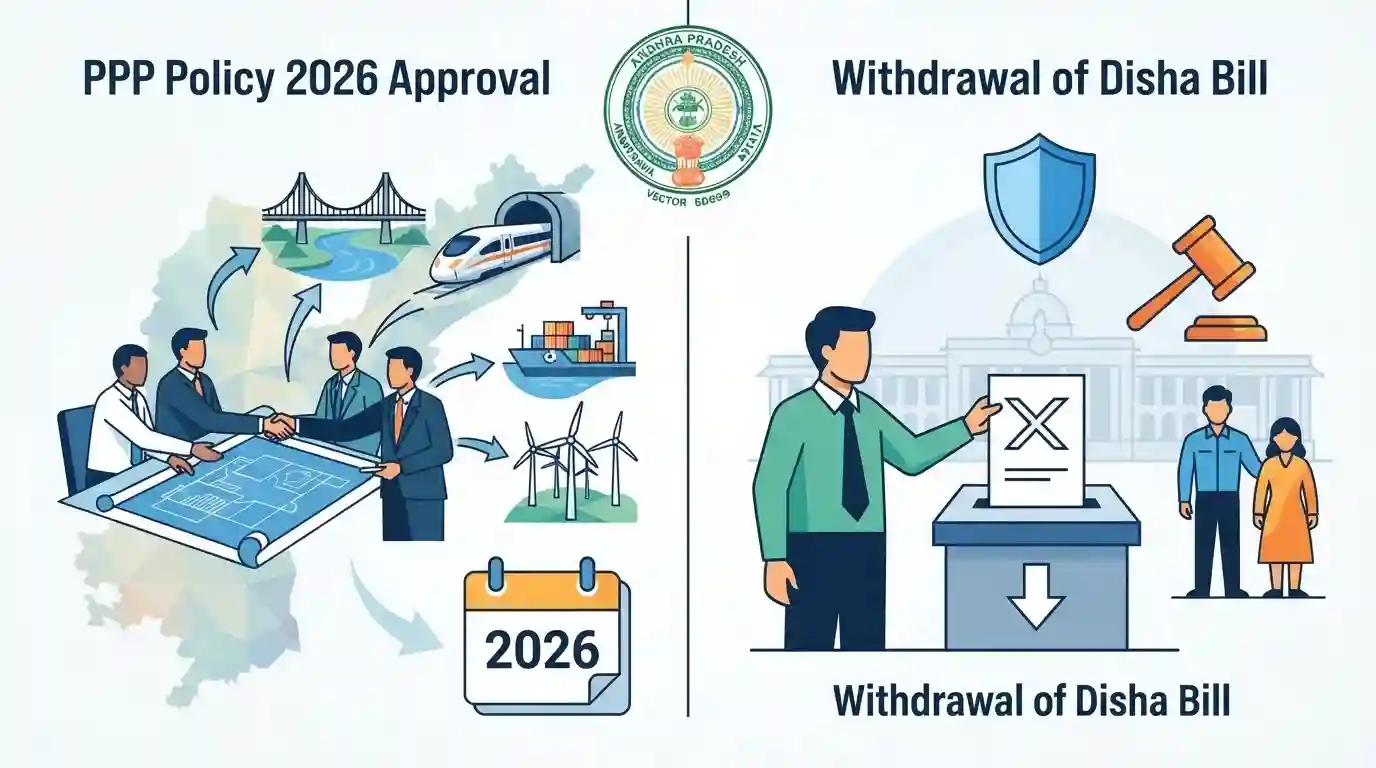
Why It Matters
Important for APPSC aspirants tracking state-level economic policies, infrastructural framework revisions via PPP models, and significant administrative and legislative changes such as the withdrawal of the Disha Bill.
Summary
The Andhra Pradesh Cabinet approved the Public-Private Partnership (PPP) Policy 2026 to enhance infrastructure frameworks through private investment cooperation and concurrently decided to withdraw the controversial Disha Bill previously introduced for expedited trials in crimes against women.
Key Points
- The Andhra Pradesh Cabinet approved the Public-Private Partnership (PPP) Policy 2026 to boost infrastructure development and attract private investments in the state.
- The Cabinet decided to formally withdraw the Disha Bill, which was earlier intended to institute special courts and harsher penalties for crimes against women.
- The policy shift highlights changes in state economic governance and legislative priorities under the current administration in Andhra Pradesh.
Important Terms
PPP Policy 2026

A policy framework approved by the AP cabinet to enhance infrastructure development through private investment cooperation, featuring mechanisms like Viability Gap Funding and a Bridge Fund for key public projects.
UPSC context
APPSC Group 1 & 2: Tests knowledge of state economic policies, infrastructure funding, and public-private partnerships in Andhra Pradesh.
Disha Bill (Andhra Pradesh Special Courts for Specified Offences against Women Act)
A legislative initiative originally passed in 2019 to expedite trials and investigations for crimes against women, withdrawn following Union Ministry advice to align with new criminal laws.
UPSC context
APPSC Group 1/2: Tests awareness of women safety legislation, criminal law reforms, and Centre-state legislative interactions.
Andhra Pradesh Cabinet
The executive decision-making body of the Government of Andhra Pradesh, headed by the Chief Minister, responsible for policy formulation and administrative sanction of major state projects.
UPSC context
APPSC Polity: Tests understanding of state executive powers, cabinet decision-making, and administrative governance in Andhra Pradesh.
Static Concepts Connected
What are the key variants of Public-Private Partnership (PPP) models used in infrastructure development in India?
- BOT Model: BOT model involves private partner building, operating, and transferring the facility back to the government.
- DBFOT Model: DBFOT model combines design, build, finance, operate, and transfer elements with private risk absorption.
- Hybrid Annuity: HAM model combines EPC and BOT, where government pays 40% during construction and 60% through annuities.
Cross-Topic Patterns
State Criminal Legislation vs. Central Criminal Codes
The replacement of state-level penal bills with central frameworks like BNS 2023 reflects federal dynamics in criminal justice legislation.
PPP Models and Infrastructure Fiscal Deficits
Introduction of VGF and Bridge Funds within state PPP frameworks illustrates innovative fiscal tools for infrastructure financing.

APPSC often tests specific state policy names and central acts like BNS 2023 replacing state bills. Expect a multi-statement question.
Linked PYQs · 2
Linked PYQs · 2
- 2023APPSC_PRELIMSGS1
The following App developed by Government of Andhra Pradesh is an SOS service for women in distress or danger.
- 2024APPSC_PRELIMSGS1
Which of the following statement/statements is/are incorrect regarding the Andhra Pradesh Industrial Policy 2023 - 27? I. To achieve a minimum contribution of 25% by industry in the State GDP II. To provide end-to-end facilitation in 2 weeks III. To envisage ten (10) priorities of accomplishment IV. To focus on becoming a 'Plug and Play State' for investments V. Ensuring land allotment by APIIC within a period of 2 weeks upon receipt of application Select the answer using the codes given below :
