Andhra Pradesh Cabinet: PPP Policy and Legislative Decisions
Source:telanganatoday ↗
Why It Matters
This covers multiple crucial domains for APPSC Group 1 Prelims: the mechanics of State Bills requiring Presidential assent (and MHA's role), specific AP economic schemes (PPP VGF, EoDB reforms, aquaculture subsidies), and the transition from state-specific criminal laws (Disha Act) to the new central Bharatiya Nyaya Sanhita.
Summary
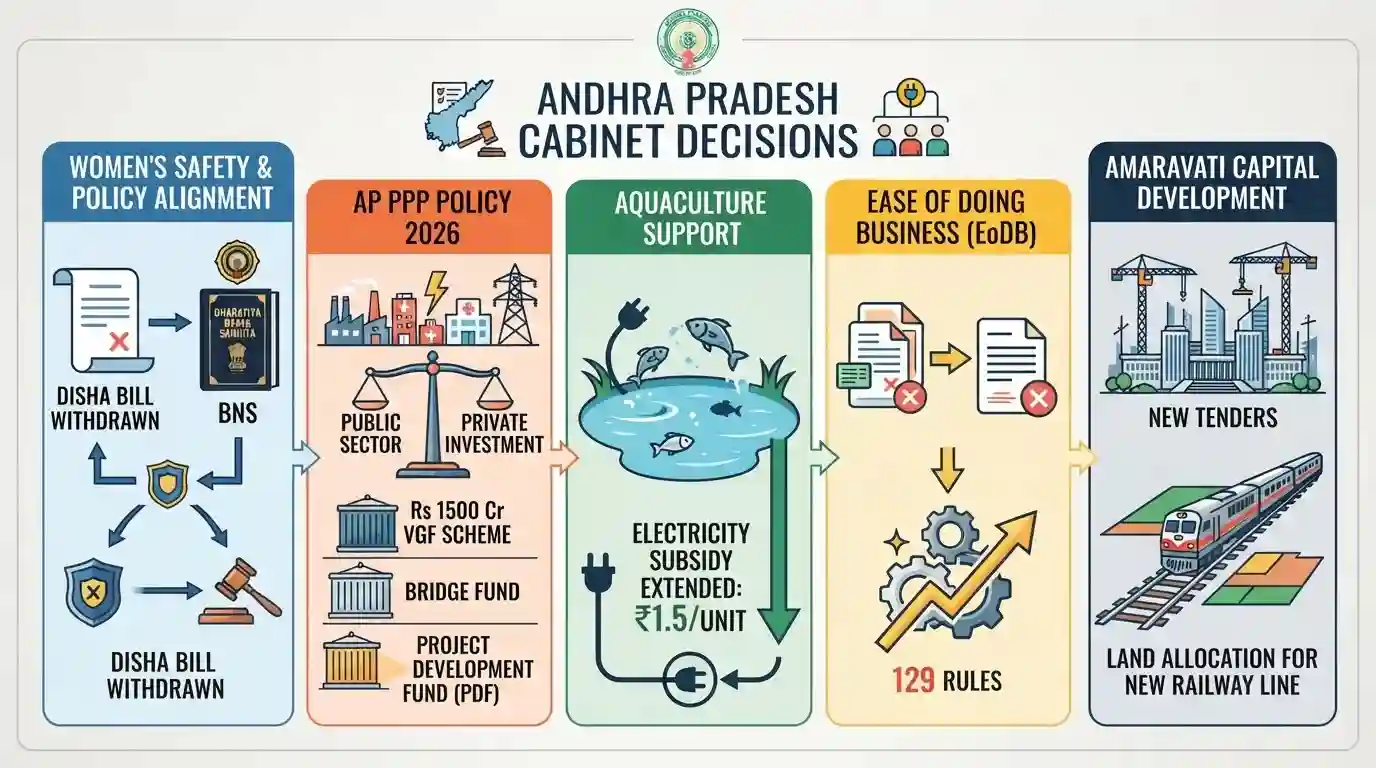
The Andhra Pradesh Cabinet cleared multiple significant policy decisions, including the approval of the AP PPP Policy 2026 and the withdrawal of the Disha Bill based on MHA advice. The PPP policy includes a Rs 1,500 crore Viability Gap Funding (VGF) scheme, a Bridge Fund, and a Project Development Fund (PDF) to attract private infrastructure investments in transport, energy, and healthcare. The Disha Bill was withdrawn to align with the newly implemented central criminal laws (Bharatiya Nyaya Sanhita). Additionally, the Cabinet extended electricity subsidies for aquaculture farmers at Rs 1.5 per unit, approved an Ease of Doing Business law amending 129 rules, and cleared major Amaravati capital region infrastructure projects, including new tenders for government complexes and land allocation for a new railway line.
Key Points
- The Andhra Pradesh Cabinet approved the AP PPP Policy 2026, establishing a Rs 1,500 crore Viability Gap Funding (VGF) scheme to support economically essential but financially unviable infrastructure projects.
- The new PPP framework introduces a Bridge Fund for projects with long-term revenue potential and a Project Development Fund (PDF) targeting sectors like transport, ports, and renewable energy.
- The Cabinet formally withdrew the Disha Bill (Criminal Law Amendment and Special Courts Bills of 2019/2020) upon advice from the Ministry of Home Affairs.
- The Disha Bill's withdrawal aligns the state with the newly implemented central criminal laws, Bharatiya Nyaya Sanhita and Bharatiya Nagarik Suraksha Sanhita, which already encompass enhanced provisions for crimes against women.
- To improve the Ease of Doing Business (EoDB), a new AP law was approved to amend or repeal 129 outdated compliance rules across 10 government departments.
- The state extended an electricity tariff subsidy for aquaculture farmers at Rs 1.5 per unit, costing the exchequer Rs 2,244 crore.
- Major Amaravati infrastructure initiatives were cleared, including the resumption of High Court and Secretariat construction and land pooling for the new Errupalem-Namburu railway line.
Important Terms
Andhra Pradesh Public-Private Partnership (PPP) Policy 2026

A state policy to attract private investments in transport, energy, and infrastructure. It includes a Rs 1,500 crore Viability Gap Funding (VGF) scheme and a Bridge Fund for projects with long gestation periods.
UPSC context
Important for APPSC Group 1 & 2 Economy, testing state policies on infrastructure development and investment promotion.
Disha Bill (Criminal Law (AP Amendment) Bill 2019)
A 2019 state bill aimed at expediting trials for sexual offences. It was withdrawn in 2026 after the Union Ministry of Home Affairs advised that new central criminal laws adequately cover its objectives.
UPSC context
Crucial for APPSC Polity, illustrating state-centre legislative dynamics, women's safety measures, and legal reform updates.
Bharatiya Nyaya Sanhita, 2023
The new central criminal code replacing the Indian Penal Code (IPC). Its implementation strengthened national legal provisions regarding crimes against women, rendering state-specific legislation like the AP Disha Bill redundant.
UPSC context
Vital for APPSC Polity, testing knowledge of nationwide legal overhauls and their superseding effect on state bills.
Bharatiya Nagarik Suraksha Sanhita, 2023
The new central law replacing the Code of Criminal Procedure (CrPC). It modernizes criminal procedure and expedites trials, effectively covering the procedural changes previously sought by state-specific laws like the Disha Bill.
UPSC context
Significant for APPSC Polity and Governance, focusing on criminal justice reforms and central legislative precedence.
Andhra Pradesh Omnibus (Ease of Doing Business) Act 2026
An umbrella legislation proposing amendments to multiple existing state laws through a single act. It aims to simplify industrial approvals, attract investment, and improve the business climate in Andhra Pradesh.
UPSC context
Essential for APPSC Economy, highlighting administrative reforms and state government initiatives to boost industrial growth.
AP Pedestrian Safety and Universal Accessibility Policy 2026
A state policy seeking to eliminate pedestrian fatalities through a zero-tolerance approach to unsafe road conditions. It mandates the removal of encroachments from footpaths to ensure universally accessible infrastructure.
UPSC context
Relevant for APPSC Urban Development, reflecting state initiatives on public safety, traffic management, and urban infrastructure.
Andhra Pradesh Capital Region Development Authority (APCRDA)
The nodal agency responsible for planning and developing Amaravati. Recent state cabinet decisions authorized it to raise loans and issue new tenders for key capital infrastructure projects.
UPSC context
Key to AP-specific Geography and Economy, covering the administrative and infrastructural development of the state capital.
Prelims Trap
"The Andhra Pradesh Disha Act 2019 was repealed by the State Legislature."
It was never an Act. The Disha Bill was pending Presidential assent under Article 200. It was withdrawn on MHA advice due to overlapping provisions in the new Central criminal laws (BNS/BNSS).
Static Concepts Connected
What is the primary objective of Viability Gap Funding (VGF) in PPP projects?
- Core Objective: To provide a one-time capital grant to infrastructure projects that are economically justified but fall short of financial viability.
- Private Investment: It makes public infrastructure projects lucrative for private players by lowering capital costs, effectively bridging the revenue-expenditure gap.
What is the Constitutional process for reserving a State Bill for Presidential Assent?
- Article 200: Empowers the State Governor to withhold assent and reserve a legislative bill for the President's consideration.
- Concurrent Overlap: Commonly invoked when a state bill overlaps or conflicts with Central laws on Concurrent List subjects, such as Criminal Law.
- Presidential Veto: Under Article 201, the President can direct the Governor to return the bill to the legislature or withhold assent entirely.
Cross-Topic Patterns
Concurrent List & Central Primacy
The Disha Bill's withdrawal exemplifies Article 254, where Central statutes (BNS/BNSS) dominate Concurrent List subjects (Criminal Law). MHA advice effectively nullified the need for a separate state framework.
Blue Economy vs Fiscal Deficit
Providing Rs 1.5/unit power to aquaculture farmers boosts AP's coastal economy but adds a Rs 2,244 crore subsidy burden, highlighting the tension between agricultural support and fiscal consolidation in AP Economy.

Multi-statement Q likely combining AP PPP Policy 2026 funds (VGF, Bridge, PDF) and the constitutional basis for Disha Bill's withdrawal.
Linked PYQs · 5
Linked PYQs · 5
- 2023APPSC_PRELIMSGS1
The following App developed by Government of Andhra Pradesh is an SOS service for women in distress or danger.
- 2024APPSC_PRELIMSGS1
Which of the following statement/statements is/are incorrect regarding the Andhra Pradesh Industrial Policy 2023 - 27? I. To achieve a minimum contribution of 25% by industry in the State GDP II. To provide end-to-end facilitation in 2 weeks III. To envisage ten (10) priorities of accomplishment IV. To focus on becoming a 'Plug and Play State' for investments V. Ensuring land allotment by APIIC within a period of 2 weeks upon receipt of application Select the answer using the codes given below :
- 2024APPSC_PRELIMSGS1
The Interim Union Budget (FY25) has proposed initiatives to boost India's Green Energy Sector. Which of the following proposals are connected with developing India's Green Energy ? I. Viability Gap Funding (VGF) for utilizing solar energy projects II. To set up coal gasification and liquefaction capacity of 100MT by 2030 III. Optional blending of Compressed Bio Gas (CBG) in Compressed Natural Gas (CNG) for transport and Piped Natural Gas (PNG) for domestic purposes IV. Provision of financial assistance for procurement of biomass aggregation machinery V. Setting up of a payment security system for expanding the bio-manufacturing system in the country Select the correct answer using the codes given below :
- 2024APPSC_PRELIMSGS1
The strategic objective of Asset Monetization Programme may be explained as :
- 2019APPSC_PRELIMSGS1
State Government can pass a law imposing restrictions on goods imported from other States. Such law shall be moved in the Legislature of a State without the previous sanction of the
