Andhra Pradesh Public Private Partnership Policy and Legislation
Source:telangana-today ↗
Why It Matters
The article provides critical examples of state-level policy formulation (PPP, Ease of Doing Business) and federalism in practice, such as the withdrawal of state legislation (Disha Bill) due to overlap with newly enacted Central criminal codes (BNS, BNSS), a relevant theme for Polity and Governance.
Summary
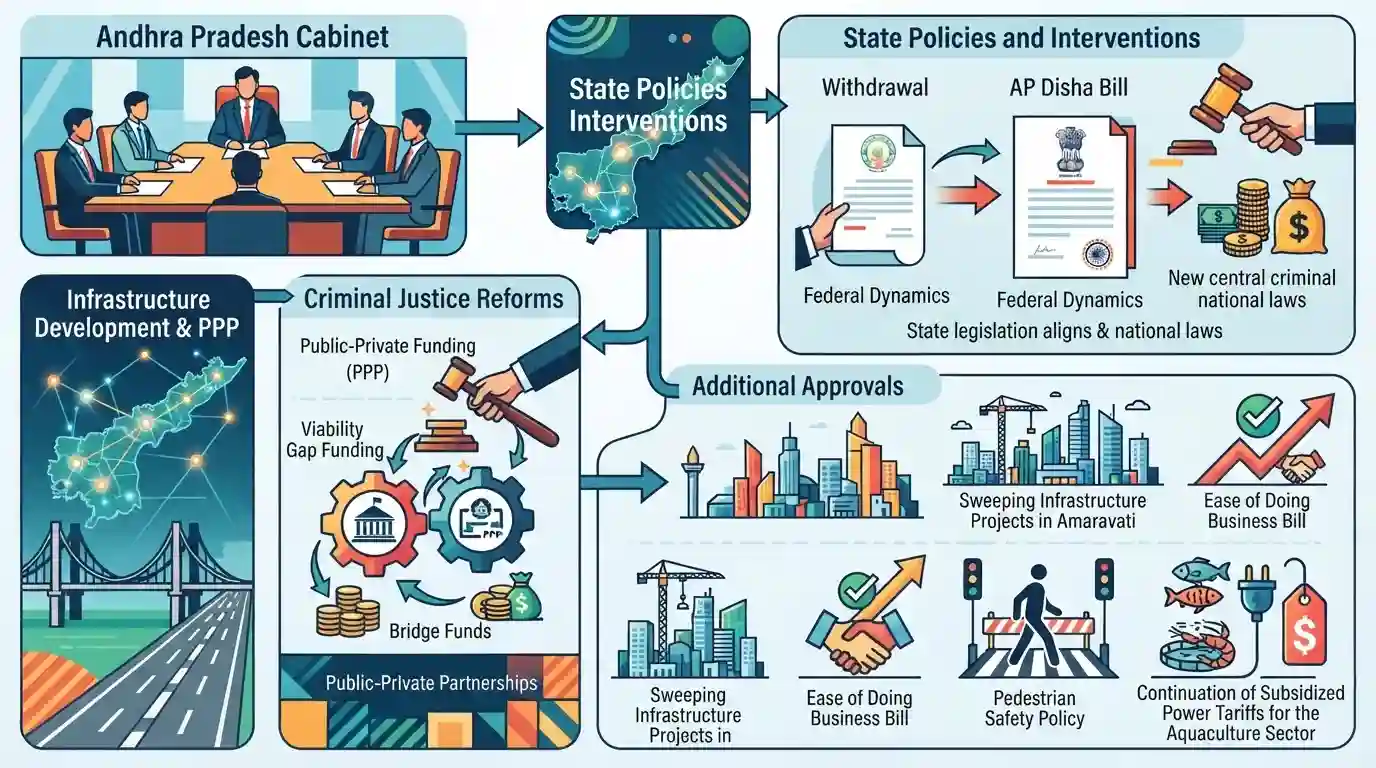
The Andhra Pradesh Cabinet, chaired by Chief Minister N. Chandrababu Naidu, has cleared several key policies, including the AP PPP Policy 2026 to boost infrastructure development through an empowered authority, Viability Gap Funding, and bridge funds. The Cabinet notably decided to withdraw the controversial AP Disha Bill after the Ministry of Home Affairs indicated its provisions were superseded by the new central criminal codes, the Bharatiya Nyaya Sanhita (BNS) and Bharatiya Nagarik Suraksha Sanhita (BNSS). Additional approvals include sweeping infrastructure projects in Amaravati, an Ease of Doing Business Bill, a Pedestrian Safety Policy, and the continuation of subsidized power tariffs for the aquaculture sector.
Key Points
- The AP Cabinet approved the AP PPP Policy 2026, creating an Infrastructure Authority and introducing Viability Gap Funding (VGF) and a bridge fund for infrastructure investments.
- The state formally withdrew the AP Disha Bill based on MHA advice, as its goals are now covered by the new central criminal laws, BNS and BNSS.
- Approval was granted for large-scale infrastructure and road networks in the capital city, Amaravati, through CRDA.
- An Ease of Doing Business Bill, 2024, was cleared to improve the business environment alongside a new Pedestrian Safety Policy.
- Aquaculture power subsidies were extended, maintaining power tariffs at ₹1.5 per unit for aquaculture farmers.
Important Terms
Andhra Pradesh Public Private Partnership (PPP) Policy 2026

A state policy aimed at attracting private investment in transport, healthcare, and infrastructure. It features ₹1,500 crore in Viability Gap Funding (VGF) and a Bridge Fund to support projects requiring initial financial assistance.
UPSC context
GS Paper 3 (Infrastructure & Investment Models). Highlights state-level frameworks to fund public projects through private capital.
Andhra Pradesh Disha Bill
A 2019 state bill aimed at fast-tracking sexual offense trials to 21 days and awarding the death penalty. It was withdrawn in 2026 following the enactment of the superseding central criminal codes (BNS and BNSS).
UPSC context
GS Paper 2 (Center-State Relations). Illustrates the doctrine of repugnancy (Article 254) regarding state bills and central laws.
Bharatiya Nyaya Sanhita (BNS)
India’s comprehensive criminal code enacted in 2023 replacing the colonial-era Indian Penal Code (IPC), 1860. It modernizes offenses, introduces provisions for organized crime and terrorism, and shifts focus toward victim protection.
UPSC context
GS Paper 2 (Governance, Statutory Reforms). Crucial for understanding the modernization and decolonization of India's criminal justice system.
Bharatiya Nagarik Suraksha Sanhita (BNSS)
The procedural law introduced in 2023 replacing the Code of Criminal Procedure (CrPC), 1973. It establishes time-bound trials, mandates forensic investigations for serious crimes, and introduces digital provisions like e-FIRs.
UPSC context
GS Paper 2 (Judiciary, Criminal Justice Reforms). Tests knowledge on accelerating justice delivery and modernizing police procedures.
Andhra Pradesh Omnibus (Ease of Doing Business) Act, 2026
A legislative framework consolidating multiple regulations into a single omnibus act to eliminate outdated procedures, simplify compliance hurdles, and create an investor-friendly environment in the state of Andhra Pradesh.
UPSC context
GS Paper 2 & 3 (Governance, Economic Growth). Demonstrates state-level administrative reforms to reduce regulatory overlap and attract investment.
Prelims Trap
State laws on Concurrent List subjects that conflict with Central laws are automatically void under all circumstances.
Under Article 254(2), a conflicting State law can actually prevail over a Central law in that specific state if it was reserved for the President's consideration and received assent.
Static Concepts Connected
How does Article 254 resolve conflicts between State and Central laws on the Concurrent List?
- General Rule: If a State law contradicts a Central law on a Concurrent subject, the Central law prevails and the State law is void (Doctrine of Repugnancy).
- Presidential Assent Exception: If the State law is reserved for the President's consideration and receives their assent, it prevails within that State over the Central law.
- Parliamentary Override: Parliament retains the power to enact a subsequent law adding to, amending, varying, or repealing that specific State law.
What is Viability Gap Funding (VGF) for Public-Private Partnerships?
- Core Purpose: A one-time or deferred capital grant provided to infrastructure projects that are economically justified but fall marginally short of financial viability.
- Target Sectors: Usually targets long-gestation projects (like roads, ports, water supply) where user charges alone cannot cover capital costs and return on investment.
- State vs Centre: While the Central Government runs a specific VGF scheme via the DEA, State governments can also formulate their own VGF policies for local projects.
Cross-Topic Patterns
State PPPs & Contingent Liabilities
State PPPs relying heavily on VGF and sovereign guarantees can increase off-budget contingent liabilities. The RBI closely monitors these within its annual State Finances reports.
BNS/BNSS superseding state penal laws
The rollout of central codes (BNS/BNSS) forces states to withdraw overlapping localized criminal bills (like AP's Disha), standardizing penal jurisprudence nationwide and removing dual-legislation friction.

Expect a 2026 Polity question linking Art 254 (Doctrine of Repugnancy) to the state-level rollout of the new criminal codes (BNS/BNSS).
Linked PYQs · 3
Linked PYQs · 3
- 2024APPSC_PRELIMSGS1
The strategic objective of Asset Monetization Programme may be explained as :
- 2024APPSC_PRELIMSGS1
Which of the following statement/statements is/are valid regarding the National Infrastructure Pipeline (NIP)? I. NIP includes only economic infrastructure projects but not social infrastructure projects. II. NIP is aimed to focus on key greenfield projects alone. Brownfield projects are excluded from the NIP's coverage. III. NIP aims to offer investment opportunities in India's infrastructure sector, and to attract investments into India. IV. India Investment Grid (IIG) as a platform has ceased to facilitate the NIP and instead 'Invest India' is presently facilitating NIP. Select the correct answer using the codes given below:
- 2024APPSC_PRELIMSGS1
Which of the following State Bill/Bills will have to be mandatorily reserved for the President's consideration? I. A Bill that proposes to give effect to certain Directive Principles of State Policy. II. A Bill requiring prior Presidential sanction but which was however not obtained under Article 304. III. A Bill that attracts the provisions of Article 288. IV. A Bill seeking to operate a provision that belongs to one of the Concurrent List entries, but which is however repugnant to any Union law. Select the correct answer using the codes given below :
