Andhra Pradesh Budget Fiscal Indicators and Allocations Analysis
Source:prsindia ↗
Why It Matters
Crucial for understanding state-level fiscal federalism, resource mobilization, debt management, and developmental priorities in Andhra Pradesh.
Summary
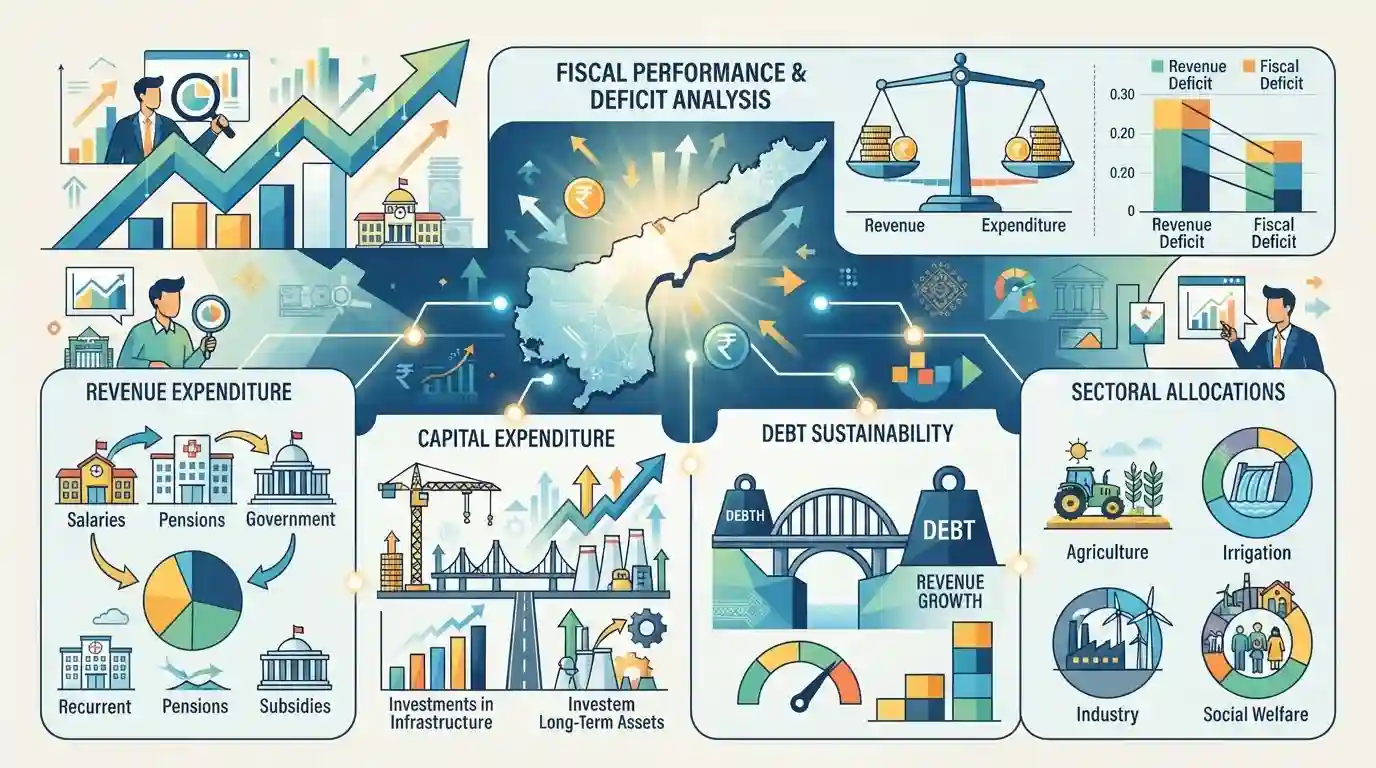
An analysis of the Andhra Pradesh budget providing a detailed overview of the state's fiscal performance, revenue and capital expenditures, debt sustainability, and sectoral allocations relevant for administrative and economic governance.
Key Points
- Andhra Pradesh Budget analysis outlines key financial allocations, revenue receipts, and expenditure targets.
- Examines fiscal indicators such as fiscal deficit, revenue deficit, and debt profile as percentages of GSDP.
- Provides insights into sectoral allocations including social welfare, infrastructure, and development expenditure.
Important Terms
PRS Legislative Research

An independent research organization in India that provides non-partisan analysis of legislative data, state budgets, and policy issues to assist lawmakers and researchers.
UPSC context
Important for GS Paper II and APPSC Group 1 (Governance, Public Policy, and Budgetary Analysis), testing analytical understanding of state finances.
Government of Andhra Pradesh
The executive and administrative authority of the state of Andhra Pradesh, responsible for formulating state economic policies, preparing annual financial statements (budgets), and executing welfare programs.
UPSC context
Core to APPSC Group 1/2 exams under Andhra Pradesh Economy, State Administration, and Governance.
Prelims Trap
State fiscal deficit must strictly remain within the 3% FRBM limit without any conditional relaxations or off-budget liabilities.
Aspirants often confuse Revenue Deficit with Fiscal Deficit, or assume states can borrow without Centre's nod when under FRBM limits.
Static Concepts Connected
What are the key fiscal indicators and deficit metrics monitored under State FRBM Acts in India?
- Fiscal Deficit:: Measures the excess of total expenditure over total receipts (excluding borrowings). Standard FRBM limit is 3% of GSDP, often relaxed conditionally.
- Revenue Deficit:: Measures the excess of revenue expenditure over revenue receipts, indicating borrowing for consumption rather than asset creation.
- Debt-to-GSDP Ratio:: Total outstanding liabilities of the state government as a percentage of Gross State Domestic Product, reflecting long-term solvency.
- Off-Budget Borrowings:: Borrowings raised by state entities/corporations where repayment is guaranteed or serviced from the state budget, circumventing formal debt ceilings.
Cross-Topic Patterns
State Fiscal Deficits and Article 293
AP's high debt-to-GSDP ratio (>32%) and off-budget borrowings connect state fiscal health directly to Article 293(3) borrowing limits imposed by the Union government.
Welfare Spending versus Capital Outlay
Large outlays on direct benefit transfers (DBTs) and freebies impact capital outlay percentages, mirroring nationwide debates on fiscal prudence versus welfare economics.

APPSC Group 1/2 questions on state finance will test exact FRBM fiscal deficit ceiling percentages vs actuals and debt-to-GSDP ratios.
Linked PYQs · 3
Linked PYQs · 3
- 2024APPSC_PRELIMSGS1
Which of the following statement/statements is/are valid regarding the socio-economic status of Andhra Pradesh ? I. Andhra Pradesh won the Best State Award of ICAR - National Research Center for Banana (NRCB) for export promotion. II. Andhra Pradesh GSDP growth rate has been registering a decline in recent times owing to repeated lower returns in certain sub-sectors of the Service Sector. III. For the FY 2024 - 25, the Revenue Deficit is budgeted higher than the Fiscal Deficit in terms of percentage of Andhra Pradesh GSDP. IV. The technology used by the Government of Andhra Pradesh while conducting resurvey of landholdings is referred to as 'Continuously Operating Reference Stations (CORS)' technology. Select the correct answer using the codes given below :
- 2023APPSC_PRELIMSGS1
Which of the bodies recommends the distribution of the net proceeds of taxes to be shared between the Centre and the States, and allocation between the States, the respective shares of such proceeds?
- 2024APPSC_PRELIMSGS1
Consider the following statements in connection with the distribution of tax revenues between the Centre and the States: I. The proceeds of the surcharges that are levied on taxes and duties referred to in Article 269 and Article 270 of the Constitution of India, would be shared between the Centre and the States. II. Article 268A and Article 272 of the Constitution of India were both repealed by same Constitutional Amendment Act. III. Tax on the sale of petroleum crude is levied by the Centre but collected by the States. IV. The net proceeds of tax categories that are falling under Article 269 of the Constitution of India, do not form a part of the Consolidated Fund of India. Which of the above statement/statements is/are valid?
