Andhra Pradesh Budget Fiscal Parameters and Sectoral Outlays
Source:prsindia ↗
Why It Matters
Crucial for aspirants tracking state-level fiscal governance, economic performance indicators, and policy priorities in Andhra Pradesh for the Group 1 examination.
Summary
An analytical summary of the Andhra Pradesh Budget for 2026-27, detailing key fiscal parameters, revenue and capital expenditure patterns, sectoral allocations, and financial health indicators for the state.
Key Points
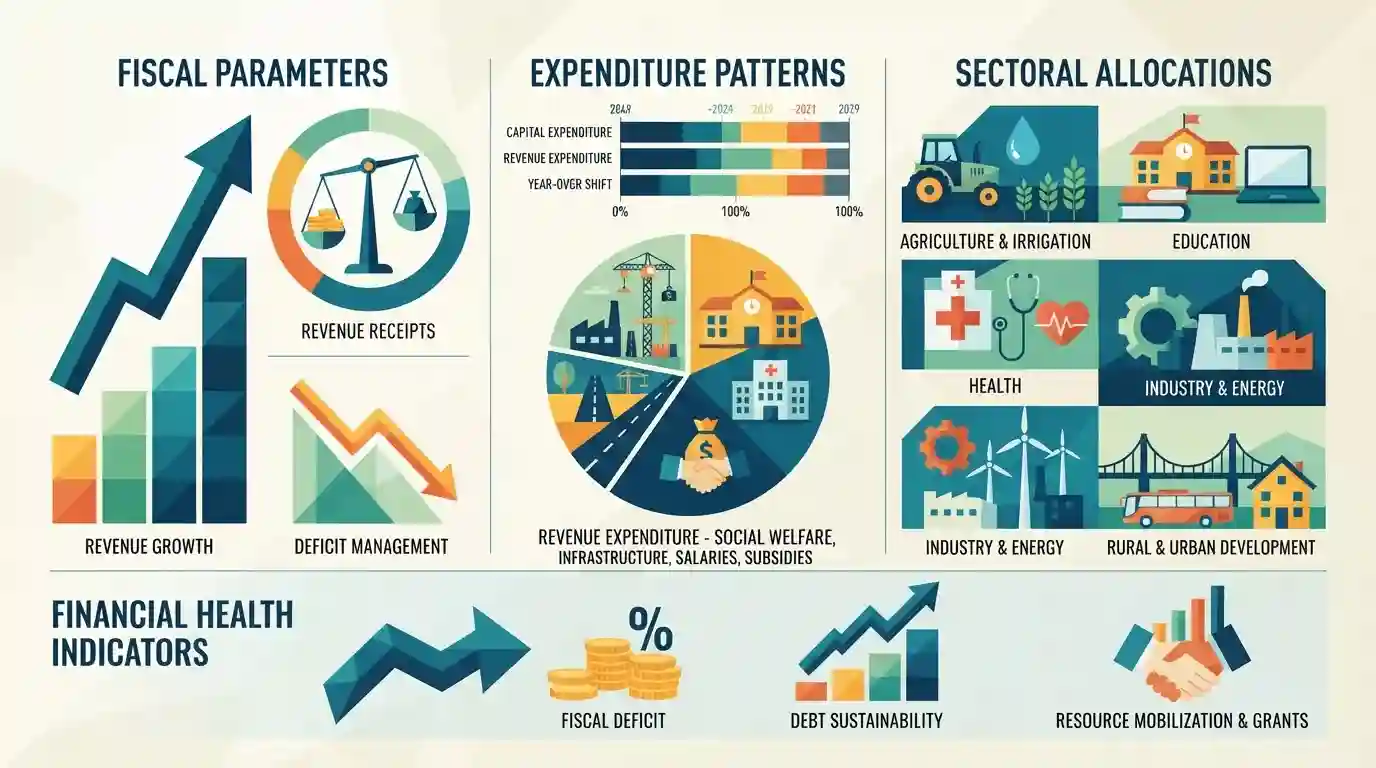
- The Andhra Pradesh Budget Analysis provides a comprehensive overview of the state's fiscal indicators, including GSDP growth, total revenue receipts, fiscal deficit, and revenue deficit projections for the financial year 2026-27.
- Analysis of resource allocation across key sectors such as agriculture, infrastructure, education, and health care in Andhra Pradesh.
- Evaluation of tax and non-tax revenue performance, capital outlay, and debt profiles of the state government.
Important Terms
Government of Andhra Pradesh

The constitutional head and executive authority of the state government of Andhra Pradesh, responsible for presenting the annual financial statement (state budget) through the Finance Minister under Article 202.
UPSC context
Important for APPSC Group 1 & 2 (Indian Polity & Economy of AP), testing governance structures, budget formulation, and state-level financial administration.
PRS Legislative Research
A prominent Indian non-profit policy research institute that provides non-partisan analysis of legislative data, central and state budgets, and policy issues to aid lawmakers and researchers.
UPSC context
Crucial for APPSC aspirants tracking economic surveys and budget analysis, testing analytical understanding of fiscal indicators like revenue and fiscal deficits.
Prelims Trap
fiscal deficit of 3.8% of GSDP and revenue deficit of 1.1% of GSDP
Aspirants often confuse revenue deficit with fiscal deficit limits or assume capital expenditure exceeds total revenue receipts in state budgets.
Static Concepts Connected
What are the core fiscal indicators tracked in state budget analyses under the FRBM framework?
- Revenue Deficit:: Measures the gap between total revenue receipts and total revenue expenditure, indicating current consumption financing.
- Fiscal Deficit:: Measures total borrowings needed by the state, acting as the primary indicator of overall fiscal health.
- Debt-to-GSDP:: Ratio of total outstanding liabilities to the Gross State Domestic Product, governed by state-specific FRBM limits.
- Capital Outlay:: Expenditure directed towards asset creation, infrastructure, and long-term economic productive capacity.
Cross-Topic Patterns
State Fiscal Deficit & FRBM Compliance
AP's targets under FRBM Act link fiscal discipline with capital outlay quality, often tested in APPSC Group 1 mains economics papers.
Capex Outlays & State Infrastructure Financing
State budget capital outlays directly connect to infrastructure financing frameworks like NABARD RIDF and Union-State capex loans.

AP budget deficit percentages, GSDP growth projections, and specific fund allocations will feature in APPSC Group 1/2 Prelims & Mains.
Linked PYQs · 1
Linked PYQs · 1
- 2024APPSC_PRELIMSGS1
Which of the following statement/statements is/are valid regarding the socio-economic status of Andhra Pradesh ? I. Andhra Pradesh won the Best State Award of ICAR - National Research Center for Banana (NRCB) for export promotion. II. Andhra Pradesh GSDP growth rate has been registering a decline in recent times owing to repeated lower returns in certain sub-sectors of the Service Sector. III. For the FY 2024 - 25, the Revenue Deficit is budgeted higher than the Fiscal Deficit in terms of percentage of Andhra Pradesh GSDP. IV. The technology used by the Government of Andhra Pradesh while conducting resurvey of landholdings is referred to as 'Continuously Operating Reference Stations (CORS)' technology. Select the correct answer using the codes given below :
