Andhra Pradesh Implements New Comprehensive Land Use Regulations
Source:The Hindu ↗
Why It Matters
Important for understanding Andhra Pradesh's state governance, administrative frameworks, and policy updates regarding urban and rural land management.
Summary
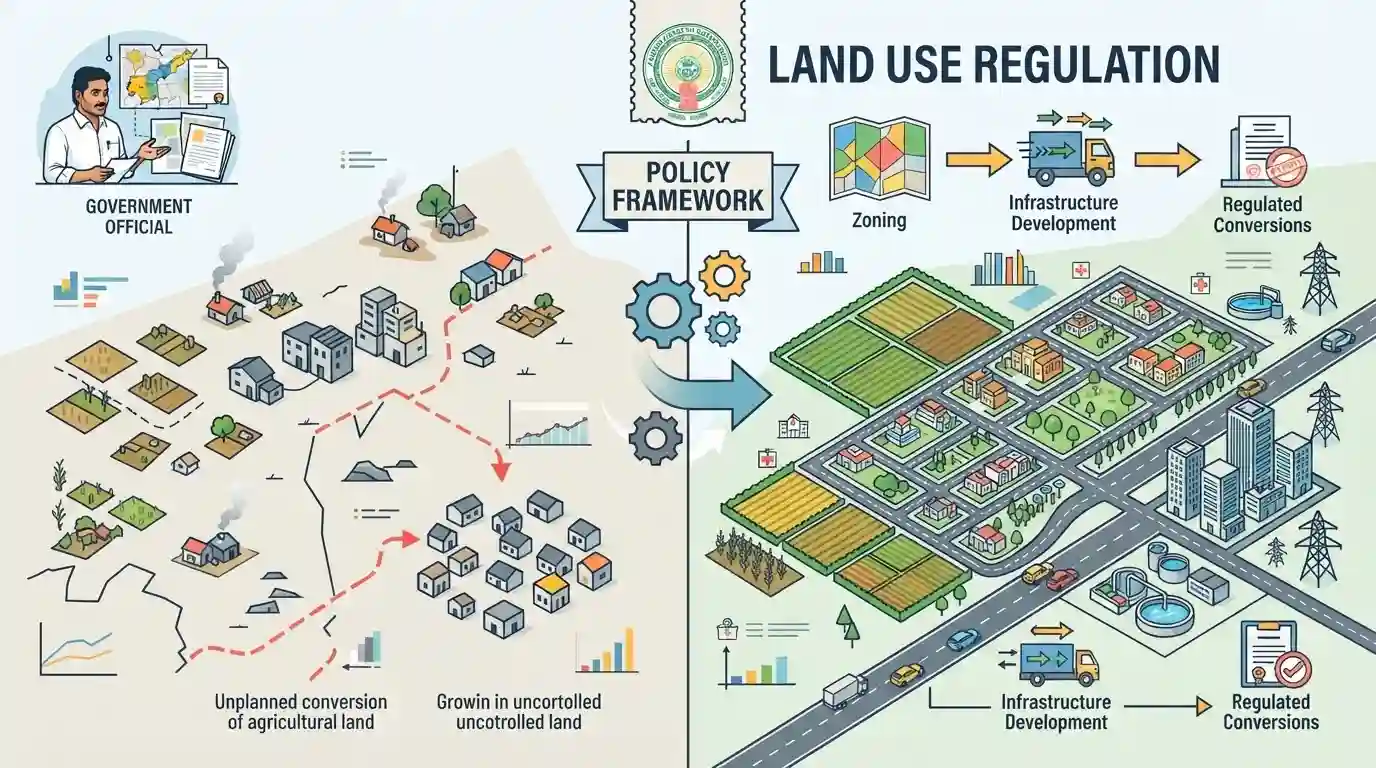
The Government of Andhra Pradesh has implemented comprehensive new rules for regulating land use across the State. The policy framework aims to streamline urban and rural planning, control haphazard development, regulate agricultural land conversions, and ensure proper zoning and infrastructure development.
Key Points
- The Andhra Pradesh government has introduced new rules for regulating land use across the State to streamline development and check unauthorized conversions.
- The regulations aim to bring systematic planning, streamline master plans, and govern zoning laws for urban and rural areas.
- The policy framework addresses issues related to agricultural to non-agricultural land conversions, ensuring better environmental management and infrastructural growth.
Important Terms
Common Zoning Regulations 2026

A uniform framework introduced by the Government of Andhra Pradesh to streamline urban development, consolidate land-use categories into nine standard types, and implement a negative-list approach for building approvals.
UPSC context
APPSC Group 1 & 2 (Governance & Urban Planning): Important for questions on state-level planning reforms, ease of doing business, and land management.
Amaravati Economic Region (AER)
A strategic regional development initiative established across nine districts of Andhra Pradesh, with Amaravati as the growth engine, to coordinate infrastructure, investment, and spatial planning.
UPSC context
APPSC Group 1 (Andhra Pradesh Economy & Governance): Tests knowledge of regional economic corridors, state growth engines, and decentralized planning.
Negative-List Approach
A regulatory method utilized in the new AP land-use rules where specific activities are permitted in a given zone unless they are explicitly prohibited on a negative list.
UPSC context
APPSC Group 2 (Public Administration & Policy): Important for assessing administrative ease of doing business, regulatory simplification, and urban governance.
Municipal Administration and Urban Development (MA&UD) Department
The state department responsible for municipal administration, urban development policies, master plans, and town planning schemes across urban local bodies in Andhra Pradesh.
UPSC context
APPSC Group 2 (Andhra Pradesh Administration): Evaluates the functional jurisdiction of state bodies handling urban local governance and infrastructure.
Prelims Trap
Union Government dictates mandatory nationwide agricultural-to-non-agricultural conversion guidelines for all states.
Aspirants often assume land use and agricultural conversion laws are framed exclusively by Union agencies or Parliament, missing that land is a State List subject.
Static Concepts Connected
What are the key constitutional provisions and legislative frameworks governing land in India?
- Constitutional Status: Land is included in the State List (List II, Entry 18) of the Seventh Schedule of the Constitution, giving states exclusive legislative power over land, land tenure, and land improvement.
- Central Legislation: The Right to Fair Compensation and Transparency in Land Acquisition, Rehabilitation and Resettlement (LARR) Act, 2013 governs federal-state land acquisition processes.
- State Frameworks: States enact specific Tenancy Acts, Land Revenue Codes, and Urban Areas (Development) Acts to manage zoning, master plans, and agricultural conversions.
Cross-Topic Patterns
Land Use Regulation + AP Urban Planning
Agricultural land conversion frameworks are closely tied to food security norms, AP Land Revenue Acts, and spatial planning under urban development authorities (like VUDA, CRDA).
State Zoning Laws + Federal Infrastructure Schemes
State-level master planning intersects with federal initiatives like PM GatiShakti and AMRUT, balancing regional zoning with national infrastructure corridors.

AP land use reform policies frequently appear in Group 1/2 mains regarding administrative reforms, urban planning, and agrarian stress.
Linked PYQs · 1
Linked PYQs · 1
- 2024APPSC_PRELIMSGS1
Which of the following statement/statements is/are valid regarding the socio-economic status of Andhra Pradesh ? I. Andhra Pradesh won the Best State Award of ICAR - National Research Center for Banana (NRCB) for export promotion. II. Andhra Pradesh GSDP growth rate has been registering a decline in recent times owing to repeated lower returns in certain sub-sectors of the Service Sector. III. For the FY 2024 - 25, the Revenue Deficit is budgeted higher than the Fiscal Deficit in terms of percentage of Andhra Pradesh GSDP. IV. The technology used by the Government of Andhra Pradesh while conducting resurvey of landholdings is referred to as 'Continuously Operating Reference Stations (CORS)' technology. Select the correct answer using the codes given below :
