Andhra Pradesh Notifies Common Zoning Regulations for Land Use
Source:The Hindu ↗
ఇది ఎందుకు ముఖ్యం
This regulatory shift represents a major change in Andhra Pradesh's urban development, zoning, and ease of doing business landscape. For APPSC Group 1, understanding regional town planning, classification of land-use zones, and industrial/agricultural regulations is critical for governance, geography, and economy sections.
సారాంశం
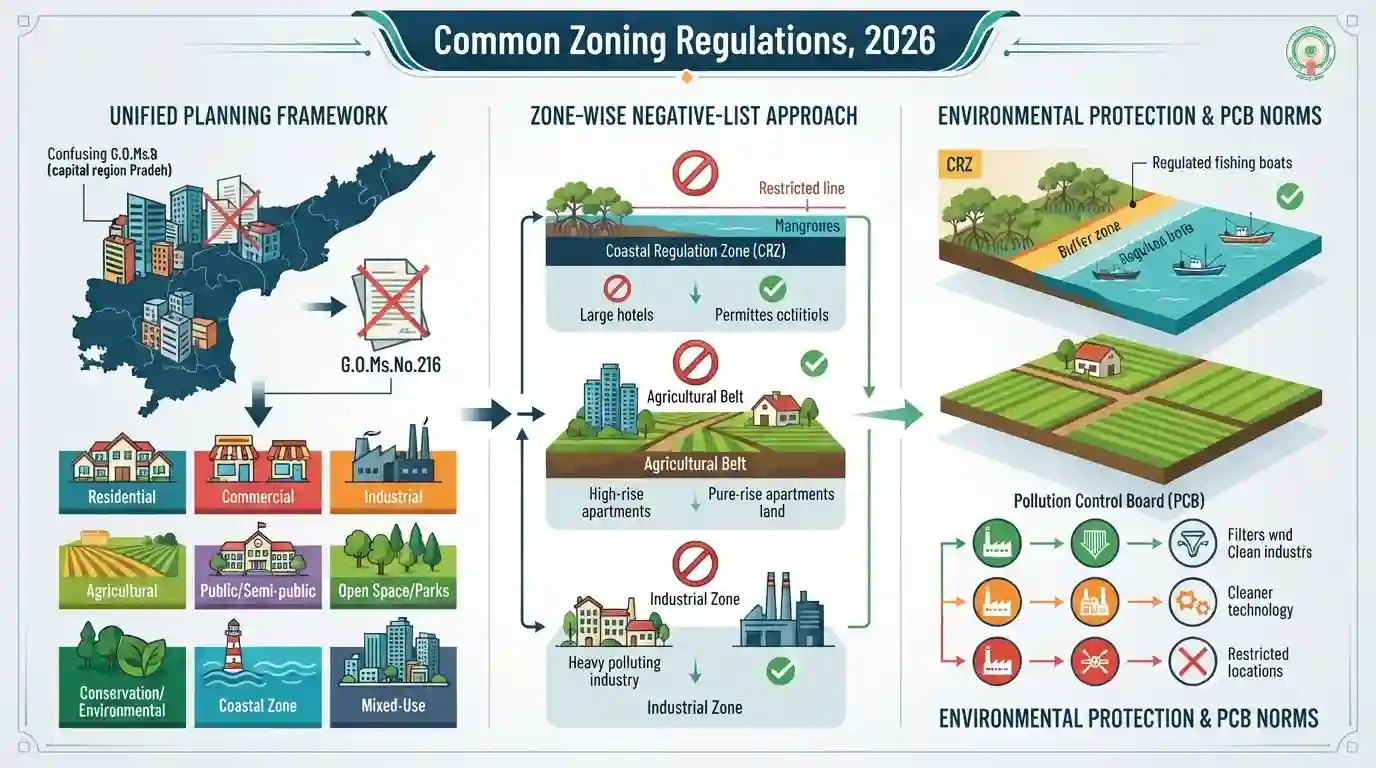
The Andhra Pradesh government has notified the Common Zoning Regulations, 2026, which establish a uniform, rule-based framework for land use and urban development across the state, excluding the capital city. Replacing multiple older frameworks and superseding G.O.Ms.No.216, the new regulations consolidate land-use into nine categories and introduce a 'zone-wise negative-list approach' to allow compatible development while protecting environmental zones, regulating farmhouse construction in agricultural belts, and classifying industries according to Pollution Control Board norms.
ముఖ్య అంశాలు
- The Government of Andhra Pradesh has notified the Common Zoning Regulations, 2026, creating a uniform, rule-based framework for land use and urban development across all Master Plans, Zonal Development Plans, and General Town Planning Schemes in the state (excluding the capital city area).
- The regulations replace multiple legacy zoning frameworks with nine consolidated land-use categories: residential, commercial, public and semi-public, recreational, industrial, transportation, mixed-use, agricultural, and development-restricted zones.
- The policy adopts a 'zone-wise negative-list approach' where compatible activities are considered permissible unless they are explicitly prohibited in the negative list of a specific zone.
- The 'development-restricted category' strictly covers sensitive areas, including water bodies, forests, hills, eco-sensitive zones, coastal regulation zones (CRZ), heritage sites, and defense precincts.
- Within agricultural zones, 'White' and 'Green' category industries can be permitted subject to Pollution Control Board conditions, while farmhouses are allowed with a minimum plot size of 0.50 acres, maximum 10% ground coverage, G+1 floor limit, and maximum height of 11 meters.
- Specified non-residential activities are permitted on plots of at least 300 square meters abutting roads of 60 feet width and above, subject to impact fees and land-use charges.
- The rules supersede G.O.Ms.No.216 (dated October 22, 2025) but maintain safety distances, industrial buffers, and water-body buffers under the Andhra Pradesh Building Rules, 2017.
ముఖ్యమైన పదాలు
Common Zoning Regulations, 2026

A uniform, rule-based urban planning framework adopted by Andhra Pradesh to streamline development approvals. It consolidates legacy frameworks into nine standard land-use categories and applies state-wide, excluding the capital city.
UPSC context
GS-1 (Urbanization) & GS-2 (Governance). Demonstrates structural reforms in state land-use policy to promote sustainable planning and ease of doing business.
G.O.Ms.No.216
An October 2025 government order that introduced the initial zoning rules. It has been superseded by the 2026 framework to further eliminate overlapping regulations and administrative ambiguities.
UPSC context
GS-2 (Government Policies). Illustrates the iterative process of statutory planning and policy course-correction by state governments.
Andhra Pradesh Building Rules, 2017
The ongoing statutory framework enforcing structural norms such as road widths, parking, setbacks, and safety distances. These rules remain actively applicable in tandem with the new 2026 zoning regulations.
UPSC context
GS-1 (Urban Planning) & GS-3 (Infrastructure). Tests the distinction between spatial land-use zoning and physical building development controls.
Department of Municipal Administration and Urban Development (MAUD)
The nodal state government department responsible for urban planning, civic administration, and notifying statutory frameworks like the Common Zoning Regulations to balance economic growth with environmental protection.
UPSC context
GS-2 (State Government & Local Bodies). Important for understanding the institutional framework governing urban administration and regional master planning.
Pollution Control Board (PCB)
Statutory environmental agencies at the Central and State levels whose industrial classifications dictate permitted land use, actively restricting hazardous or polluting activities from residential and eco-sensitive urban zones.
UPSC context
GS-3 (Environmental Pollution). Highlights the integration of statutory environmental regulations with urban land-use planning and industrial zoning.
ప్రిలిమ్స్ ఉచ్చు
The Common Zoning Regulations, 2026, establish a uniform land-use framework applicable to the entire territory of Andhra Pradesh.
Aspirants often miss explicit exclusions. The new rules apply state-wide but deliberately exclude the capital city area, which retains its own separate master planning framework.
అనుసంధానమైన స్థిర భావనలు
How does the CPCB classify industries for pollution regulation and land-use?
- Pollution Index: Based on a Pollution Index (PI) from 0 to 100, factoring in emissions, effluents, and hazardous wastes generated by the industrial unit.
- Red & Orange: Red (PI 60+) and Orange (PI 41-59) handle polluting units. They require mandatory environmental clearances and strict 'Consent to Operate' (CTO) from PCBs.
- Green & White: Green (PI 21-40) and White (PI up to 20). White category units are practically non-polluting and are exempt from obtaining a formal 'Consent to Operate'.
What is the constitutional basis for urban land-use planning in India?
- 12th Schedule: Added by the 74th Constitutional Amendment Act, 1992, it lists 18 functional items for municipalities, specifically including urban planning and the regulation of land use.
- State Subject: Local government, including municipal corporations and improvement trusts, falls strictly under Entry 5 of the State List (List II) of the 7th Schedule.
- DPC & MPC: Articles 243ZD and 243ZE mandate the creation of District and Metropolitan Planning Committees to consolidate spatial plans across rural and urban local bodies.
అంతర-అంశ నమూనాలు
Negative-list approach in governance
The shift from a 'permissive list' to a 'negative list' minimizes bureaucratic discretion. Similar regulatory structures are found in India's FDI policy (automatic route) and the recent Foreign Trade Policy frameworks.
Urban Planning vs Eco-Sensitive Zones (ESZ)
State-level zoning rules frequently intersect with Central environmental mandates. UPSC repeatedly tests the overlap of urban land-use expansion with Eco-Sensitive Zones notified under the Environment (Protection) Act, 1986.

Expect a prelims question linking municipal land-use planning (12th Schedule) with CPCB's industry color-coding (White/Green exemptions).
