Opposition demands cbi probe into ap dsc recruitment
Source:aninews ↗
Why It Matters
The incident underscores the challenges in maintaining transparency and fairness in state public service recruitments, a crucial topic under Governance and State Administration. It highlights the controversies surrounding the application of specific reservation quotas (like sports) and the role of oversight bodies like the CBI in investigating state-level administrative irregularities.
Summary
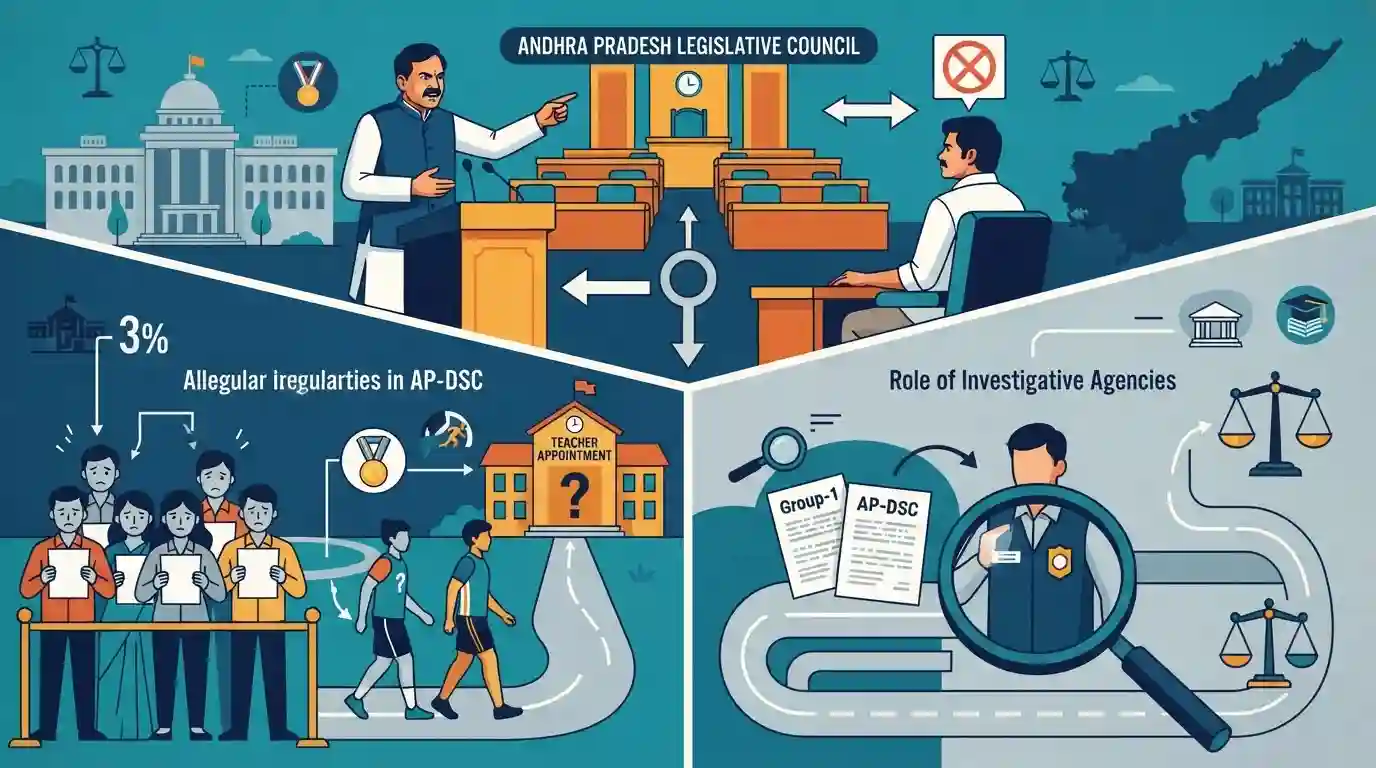
Botcha Satyanarayana, Leader of the Opposition in the Andhra Pradesh Legislative Council, has called for a Central Bureau of Investigation (CBI) probe into alleged irregularities in the AP-DSC recruitment process. He accused the government of appointing teachers under the 3% sports quota without requiring them to sit for the DSC exams, demanding the resignation of Education Minister Nara Lokesh. Furthermore, Satyanarayana challenged the ruling government to order a CBI inquiry into the Group-1 exams held during the previous YSRCP government, emphasizing the need for transparency in public service recruitment.
Key Points
- Leader of Opposition in AP Legislative Council, Botcha Satyanarayana, has demanded a CBI inquiry into alleged irregularities in AP-DSC teacher recruitment.
- He alleged that candidates under the 3% sports quota were appointed to teaching posts without appearing for the mandatory DSC examination.
- Satyanarayana demanded the immediate resignation of State Education Minister Nara Lokesh over the recruitment row.
- He also challenged the ruling NDA government to order a CBI probe into the Group-1 exams conducted during the previous YSRCP regime to establish transparency.
Important Terms
AP-DSC (Andhra Pradesh District Selection Committee)

The state-level committee responsible for conducting the Teacher Recruitment Test (TRT) to appoint educators in Andhra Pradesh's government schools.
UPSC context
Relevant to State Administration and Public Services. Tests knowledge of state-level recruitment mechanisms and transparency issues.
Central Bureau of Investigation (CBI)
India's premier investigating agency operating under the Ministry of Personnel. It derives powers from the Delhi Special Police Establishment Act, 1946, and probes high-profile corruption and major crimes.
UPSC context
Crucial for Polity and Governance. Tests understanding of central investigative agencies, their jurisdiction, and center-state conflicts.
Meritorious Sportspersons (MSP) Quota
A horizontal reservation policy in Andhra Pradesh that allocates a specific percentage of state government jobs (such as 3% in AP-DSC) to recognized athletes to encourage sports participation.
UPSC context
Important for Social Justice and Public Policy. Tests concepts of horizontal versus vertical reservations and state affirmative action.
APPSC Group-1 Exams
The premier state civil services examination conducted by the Andhra Pradesh Public Service Commission to recruit candidates for top administrative posts like Deputy Collector and DSP.
UPSC context
Core to State Governance and Administration. Tests knowledge of state executive structures and the role of the State Public Service Commission.
Prelims Trap
Meritorious sportspersons claiming the 3% quota in AP must clear the mandatory competitive examinations.
Under the AP Sports Policy 2024-29, eligible meritorious sportspersons receiving the 3% horizontal reservation are actually exempted from taking competitive written examinations.
Static Concepts Connected
How does the CBI acquire jurisdiction to investigate cases within a state?
- DSPE Act 1946: CBI derives investigative powers from this Act, but it is not a statutory body; it was created by a 1963 executive resolution.
- State Consent: Under Section 6 of the DSPE Act, the CBI requires prior consent (General or Specific) of the state government to probe crimes within its territory.
- Constitutional Courts: The Supreme Court and High Courts can directly order a CBI probe anywhere in the country without requiring the concerned state government's consent.
What constitutional provisions govern the Andhra Pradesh Public Service Commission (APPSC)?
- Part XIV: Articles 315 to 323 of the Constitution detail the establishment, composition, powers, and functions of State Public Service Commissions.
- Appointment & Removal: Members are appointed by the Governor of the State, but they can only be removed by the President of India.
- Financial Independence: Expenses of the SPSC are charged on the Consolidated Fund of the State, ensuring functional autonomy from the state executive and legislature.
Cross-Topic Patterns
Horizontal Quotas vs Recruitment Rules
The controversy highlights the intersection of the AP Sports Policy 2024-29 (3% horizontal quota, written exam exemption) and general public employment fairness under Article 16 of the Constitution.
CBI general consent dynamics
Politicization of state recruitment often triggers CBI probe demands, repeatedly testing the polity framework of Section 6 of the DSPE Act and the withdrawal of general consent by states.

Expect a multi-statement question on CBI's non-statutory origin and Section 6 consent rules, or AP's 3% sports quota exam exemptions.
Linked PYQs · 1
Linked PYQs · 1
- 2023APPSC_PRELIMSGS1
Which of the following is not a function of the Union Public Service Commission (UPSC)?
