Andhra Pradesh Cyclone Disaster Management and Mitigation Readiness
Source:The Hindu ↗
Why It Matters
Assesses institutional preparedness, early warning infrastructure, and disaster mitigation strategies implemented by the Andhra Pradesh government in cyclone-prone coastal regions.
Summary
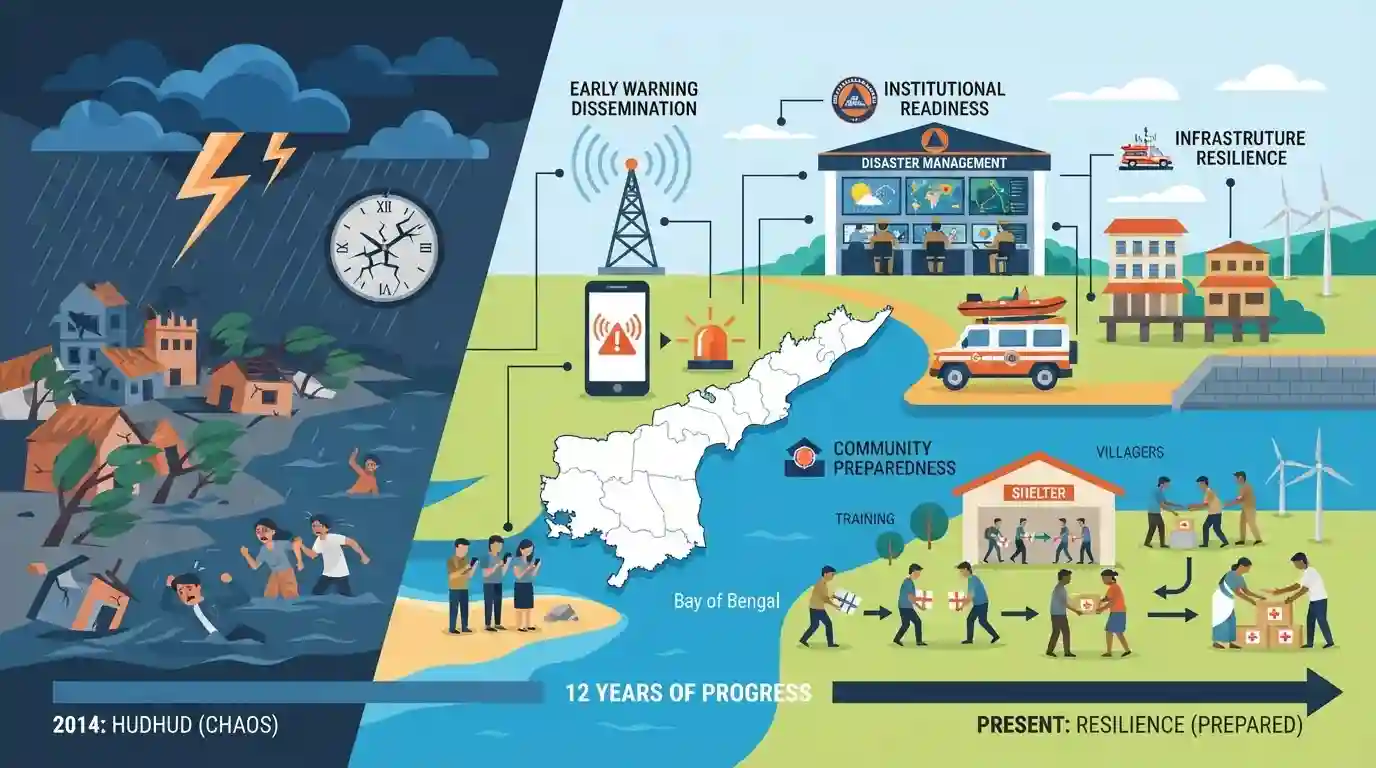
Officials note that Andhra Pradesh is substantially better equipped to manage and mitigate severe cyclonic storms 12 years after Cyclone Hudhud, highlighting advancements in early warning dissemination, institutional readiness, infrastructure resilience, and community preparedness under the framework of disaster management.
Key Points
- Andhra Pradesh has significantly enhanced its disaster resilience and cyclone preparedness 12 years after the devastating Cyclone Hudhud hit Visakhapatnam in 2014.
- Improvements include advanced early warning systems, upgraded cyclone shelters, improved coordination between the IMD and APSDMA, and rapid evacuation protocols that minimize human casualties.
- Focus has shifted from post-disaster relief to comprehensive pre-disaster mitigation, capacity building, and community-level awareness.
Important Terms
Disaster Management Act 2005

The statutory framework established by Parliament in 2005 to provide a holistic institutional mechanism for disaster mitigation, preparedness, and response across national, state, and district levels in India.
UPSC context
UPSC Paper III (Disaster Management). Tests knowledge of legal structures, institutional hierarchies, and multi-tier response systems in India.
Andhra Pradesh State Disaster Management Authority (APSDMA)
The apex state-level nodal agency established under the DM Act 2005 to formulate policies and coordinate disaster preparedness, early warning dissemination, and mitigation in Andhra Pradesh.
UPSC context
APPSC Group 1/2 (State Governance & Disaster Management). Tests state-specific administrative mechanisms, early warning systems, and resilience-building against coastal cyclones.
India Meteorological Department (IMD)
The national nodal agency under the Ministry of Earth Sciences responsible for meteorological observations, weather forecasting, and issuing timely tropical cyclone warnings.
UPSC context
UPSC Paper III & APPSC (Geography/Disaster Management). Tests technical competence in early warning, tracking systems, and mitigation of extreme weather events.
Static Concepts Connected
What are the institutional tiers under the Disaster Management Act, 2005 in India?
- National Tier: National level headed by the Prime Minister as Chairperson of the National Disaster Management Authority (NDMA).
- State Tier: State level headed by the Chief Minister as Chairperson of the State Disaster Management Authority (SDMA).
- District Tier: District level headed by the Collector/District Magistrate as Chairperson of the District Disaster Management Authority (DDMA).
Cross-Topic Patterns
Cyclone Preparedness and State Governance Frameworks
Andhra Pradesh's coastal vulnerability is managed through coordinated efforts between IMD and APSDMA under the national Disaster Management Act, 2005, linking state-specific geography with national administrative frameworks.

APPSC frequently asks about institutional mechanisms like APSDMA and statutory bodies under the Disaster Management Act, 2005.
Linked PYQs · 1
Linked PYQs · 1
- 2012APPSC_PRELIMSGS1
Disaster Management includes
