Andhra Pradesh and Australia Sign Bilateral Development MoUs
Source:The Hindu ↗
Why It Matters
The article highlights crucial bilateral cooperation at the sub-national level (state-to-nation) addressing key developmental sectors like renewable energy manufacturing, specialized inclusive education, and vocational skills. These align with India's broader goals of energy transition and demographic dividend optimization.
Summary
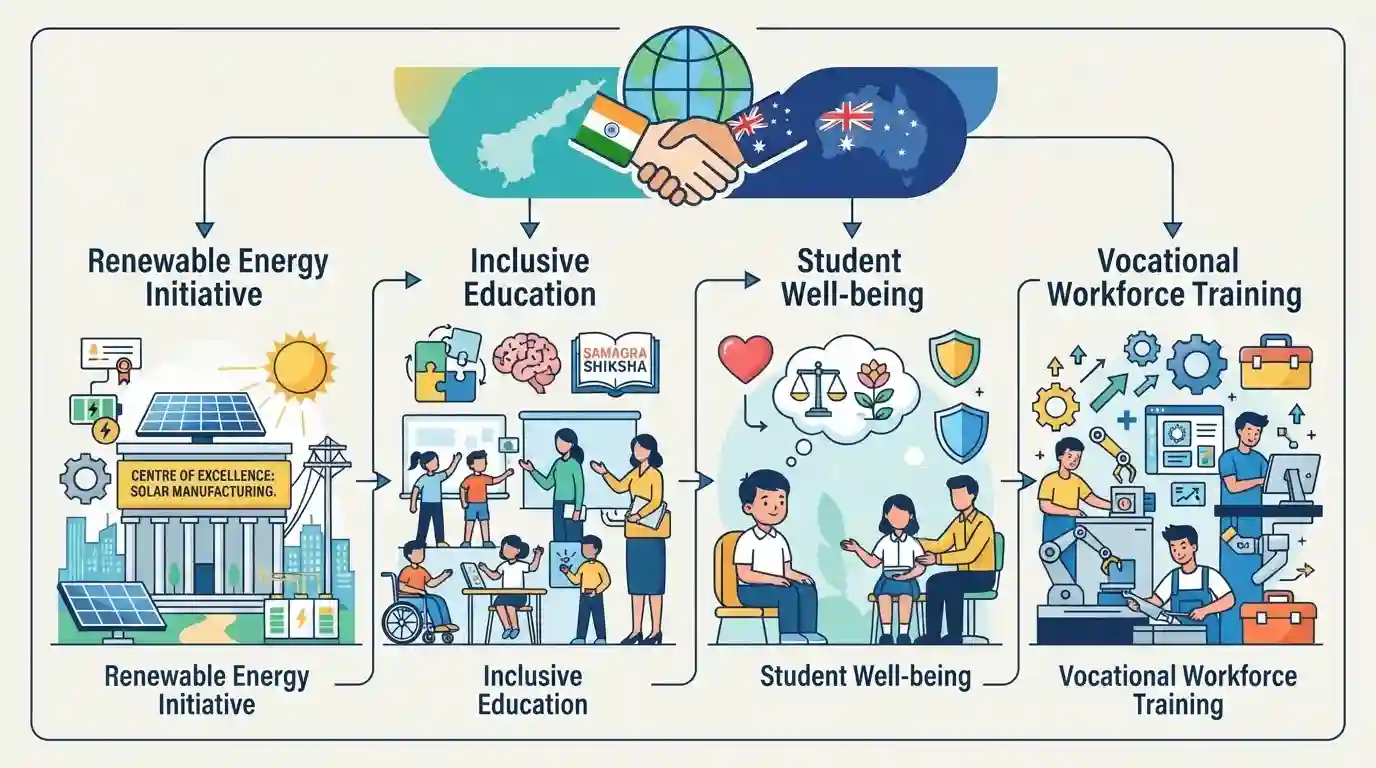
The Government of Andhra Pradesh signed four Memoranda of Understanding (MoUs) with Australian institutions to enhance bilateral cooperation in clean energy, inclusive education, and skill development. The agreements will facilitate the establishment of a Centre of Excellence for Solar Manufacturing at IIT-Tirupati, strengthen support for neurodiverse children through Samagra Shiksha, promote student mental well-being, and advance vocational workforce training.
Key Points
- Andhra Pradesh and Australia signed four MoUs focusing on clean energy, inclusive education, and skill development.
- A Centre of Excellence for Solar Manufacturing will be established at IIT-Tirupati through a partnership between CoEET and the University of New South Wales.
- UNSW, Sri Padmavati Mahila Visvavidyalayam, and Samagra Shiksha will collaborate to strengthen inclusive education, particularly for children with autism and neurodiverse needs.
- APSCHE partnered with the Australian organization 'Rebound' for student mental health, while APSSDC tied up with Dynamic Learning Services for vocational training and workforce development.
Important Terms
Samagra Shiksha

An overarching Centrally Sponsored Scheme of the Government of India for school education, extending from pre-school to class 12, aiming to ensure inclusive and equitable quality education.
UPSC context
GS Paper II: Social Sector initiatives and Education policies, testing understanding of equitable and inclusive governance models.
Centre of Excellence for Energy Transition (CoEET)
A collaborative initiative registered as a society under the Andhra Pradesh Eastern Power Distribution Company (APEPDCL) to drive clean energy innovation, grid modernization, and sustainable policy formulation.
UPSC context
GS Paper III: Infrastructure and Energy, testing concepts of renewable energy transition policies and technology hubs.
Andhra Pradesh State Skill Development Corporation (APSSDC)
A state-backed organization in Andhra Pradesh designed to bridge the skill gap, provide industry-aligned vocational training, and enhance youth employability through public-private partnerships.
UPSC context
GS Paper III: Employment, human resource planning, and economic growth through targeted skill development programs.
Andhra Pradesh State Council of Higher Education (APSCHE)
A statutory apex body established to advise the Andhra Pradesh government, coordinate standards, plan policies, and regulate higher education and research institutions in the state.
UPSC context
GS Paper II: Governance and education policies, testing understanding of state-level academic coordination and administrative structures.
IIT-Tirupati
A premier public technical university and Institute of National Importance in Andhra Pradesh, established under the Ministry of Education to promote advanced engineering research and scientific development.
UPSC context
GS Paper III: Science & Technology developments, testing national capacity for technical research and academic excellence.
Prelims Trap
State governments possess the constitutional authority to independently sign binding international treaties.
Foreign affairs and treaties fall strictly under the Union List (Entry 14). States engage in 'paradiplomacy' (MoUs) but require Ministry of External Affairs clearance.
Static Concepts Connected
How does the Constitution govern foreign agreements signed by Indian States?
- Union List: Foreign affairs, diplomacy, and treaty-making are exclusive Union subjects under Entry 10 and 14 of the 7th Schedule.
- MEA Clearance: States negotiate non-binding MoUs for investment, skills, and energy (paradiplomacy), but final operationalization requires political clearance from the Ministry of External Affairs.
What are the core components of the Samagra Shiksha Scheme?
- Integrated Scheme: It is an overarching Centrally Sponsored Scheme for the school education sector extending from pre-school to class 12.
- Subsumed Programs: It absorbs Sarva Shiksha Abhiyan, Rashtriya Madhyamik Shiksha Abhiyan, and Teacher Education to ensure equitable and inclusive learning.
- Inclusive Education: Provides dedicated financial support for Children with Special Needs (CWSN), ensuring barrier-free access, stipends, and support for neurodiverse students.
Cross-Topic Patterns
Solar manufacturing + Quad mineral resilience
Australia's critical minerals combined with India's solar manufacturing ambitions aim to de-risk clean energy supply chains, reducing overdependence on Chinese solar modules.
Paradiplomacy + Competitive Federalism
State-level foreign MoUs align with India's broader push for sub-national diplomacy, where states actively compete to attract FDI and secure technological/educational partnerships.

GS-2 Mains 2026 may link 'paradiplomacy' (states signing foreign MoUs) with the Union's exclusive constitutional power over foreign affairs.
Linked PYQs · 2
Linked PYQs · 2
- 2024APPSC_PRELIMSGS1
The Interim Union Budget (FY25) has proposed initiatives to boost India's Green Energy Sector. Which of the following proposals are connected with developing India's Green Energy ? I. Viability Gap Funding (VGF) for utilizing solar energy projects II. To set up coal gasification and liquefaction capacity of 100MT by 2030 III. Optional blending of Compressed Bio Gas (CBG) in Compressed Natural Gas (CNG) for transport and Piped Natural Gas (PNG) for domestic purposes IV. Provision of financial assistance for procurement of biomass aggregation machinery V. Setting up of a payment security system for expanding the bio-manufacturing system in the country Select the correct answer using the codes given below :
- 2019APPSC_PRELIMSGS1
What is the main objective of 12th Five Year Plan?
