State Legislative Assembly Local Bodies Reservation and Repeal Bills
Source:the-hans-india ↗
Why It Matters
Highlights the constitutional mechanisms regarding Centre-State legislative conflicts (Article 254) and demonstrates significant structural shifts in local self-governance, including changes to direct elections and reservation quotas.
Summary
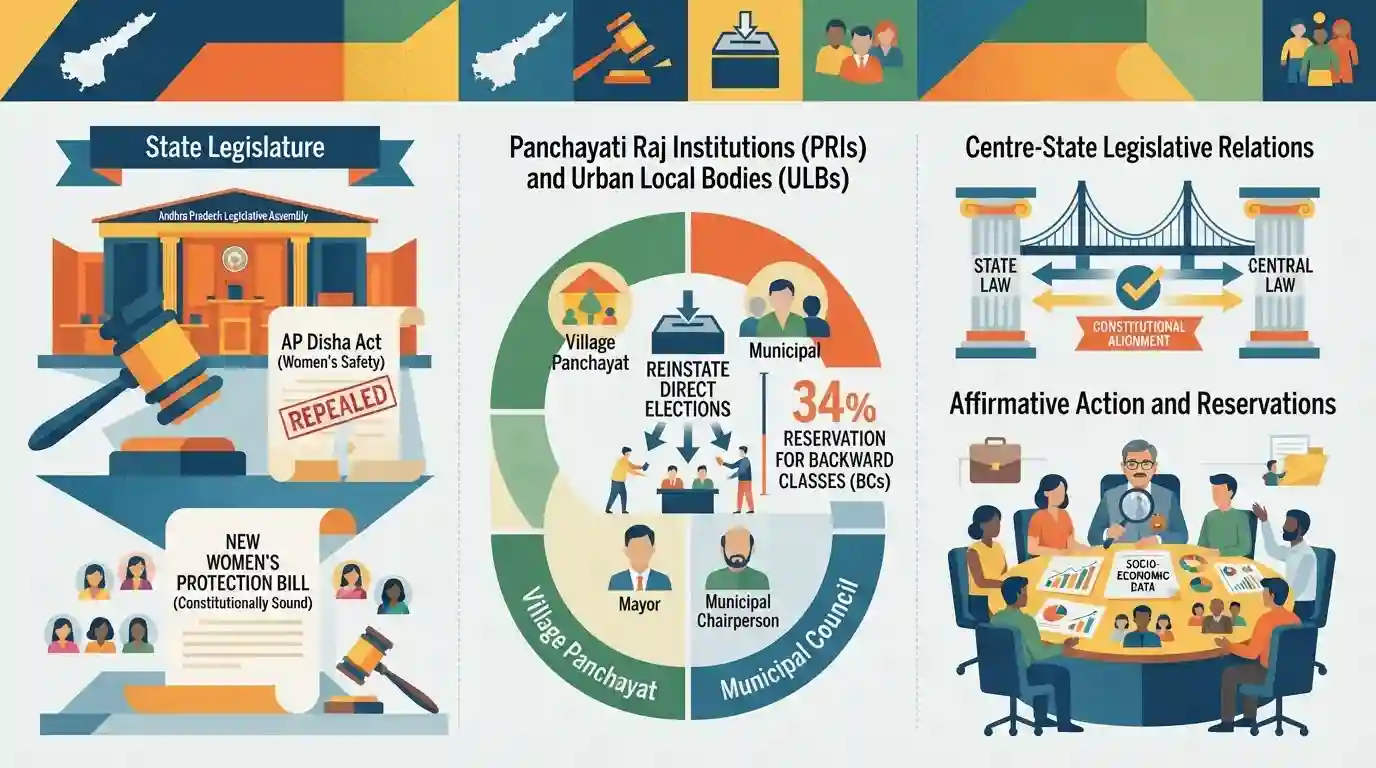
The Andhra Pradesh Legislative Assembly will convene on August 17 to address major legislative reforms. Key on the agenda is the repeal of the AP Disha Act, a women's safety law enacted by the previous government, which is being scrapped because its provisions conflict with central laws. It will be replaced by a new, constitutionally sound women's protection bill. In local governance reforms, the state plans to mandate 34% reservation for Backward Classes (BCs) in urban and rural local bodies and reinstate direct elections for mayors and municipal chairpersons. Additionally, a special commission led by retired IAS officer Rajiv Ranjan Mishra will be established to study the socio-economic conditions and reservation needs of the BC community.
Key Points
- The Andhra Pradesh government will repeal the AP Disha Act, originally passed by the previous administration, due to inconsistencies with central laws.
- A newly drafted bill focusing on women's safety and protection will be introduced to replace the Disha Act.
- Legislation will be tabled to provide 34% reservation for Backward Classes (BCs) in panchayats and municipalities.
- The assembly plans to pass a bill restoring direct elections for mayors and chairpersons of municipal corporations.
- An autonomous commission headed by retired IAS officer Rajiv Ranjan Mishra will be formed to evaluate the social, economic, and political backwardness of BCs for accurate reservation policies.
Important Terms
AP Disha Act

A 2019 Andhra Pradesh law that mandated the death penalty and 21-day trials for rape cases. It is being repealed due to provisions conflicting with central criminal laws and policies.
UPSC context
GS Paper 2 (Centre-State Relations). Highlights Article 254 (repugnancy) where state legislation contradicts central statutes.
Backward Classes Commission
A dedicated single-member commission in Andhra Pradesh, led by Rajiv Ranjan Mishra, established to conduct an empirical inquiry into the backwardness of BCs to justify reservations in local bodies.
UPSC context
GS Paper 2 (Local Self-Government, Vulnerable Sections). Essential for fulfilling the Supreme Court's "triple test" mandate for OBC quotas in panchayats and municipalities.
Andhra Pradesh Legislative Assembly
The lower house of the state's legislature. It is convening to undertake major legislative reforms, including repealing repugnant state laws and enacting 34% BC reservation in local governance.
UPSC context
GS Paper 2 (State Legislature). Relevant for understanding the legislative process, functioning of state assemblies, and their role in enacting local governance reforms.
Prelims Trap
"The 73rd and 74th Amendments constitutionally mandate proportional reservations for Other Backward Classes (OBCs) in local bodies."
The Constitution mandates reservations for SCs, STs, and women. For OBCs, Articles 243D(6) and 243T(6) only grant discretionary power to State Legislatures to enact such quotas.
Static Concepts Connected
What is the Supreme Court's "Triple Test" for OBC reservations in local bodies?
- Dedicated Commission: Establish a dedicated state commission to conduct a rigorous empirical inquiry into the nature and implications of backwardness qua local bodies.
- Quota Specification: Specify the proportion of reservation required in local bodies based on the commission's data, avoiding blanket quotas.
- 50% Ceiling limit: Ensure that total reservations (SC, ST, and OBC combined) do not breach the 50% maximum ceiling of total seats.
When does a State law prevail over a Central law on a Concurrent List subject?
- General Rule (Repugnancy): Under Article 254, if a state law and central law conflict on a concurrent subject, the central law generally prevails, rendering the state law void to the extent of repugnancy.
- Presidential Assent Exception: The state law can prevail within that state ONLY if it was reserved for the President's consideration and received their assent.
- Parliament's Overriding Power: Even with Presidential assent, Parliament retains the power to enact a subsequent law adding to, amending, or repealing the state law.
Cross-Topic Patterns
Doctrine of Repugnancy in State Bills
The repeal of the AP Disha Act highlights Article 254 (Repugnancy). UPSC frequently links state-specific gender, farming, or labor laws with the necessity of Presidential assent to bypass Central laws.
Direct vs Indirect Mayoral Elections
Shifting to direct mayoral elections reflects state discretion under Article 243R. This contrasts sharply with the constitutionally mandated direct elections for territorial constituency seats (ward members).

Expect a Prelims question testing the discretionary vs mandatory provisions of the 73rd/74th Amendments, specifically targeting OBC quotas.
Linked PYQs · 3
Linked PYQs · 3
- 2019APPSC_PRELIMSGS1
Regarding the disagreement between the two Houses of the State Legislature, which of the following is correct ?
- 2024APPSC_PRELIMSGS1
In the context of Centre - State Relations, which of the following statement/statements are valid ? I. Punchhi Commission had recommended that the procedure that is followed for the removal of President should also be applicable for the impeachment of Governors as well. II. The law that is made by the Parliament with respect to any matter in the State List in relation to the State in which President's rule is imposed, cannot be re-enacted by the State Legislature after the President's rule is ended. III. The Sarkaria Commission was not the first to recommend the establishment of an Inter-State Council. IV. Only the Lok Sabha can pass a resolution declaring that it is necessary in the national interest that the Parliament should make laws with respect to Goods and Services Tax. Select the correct answer using the codes given below :
- 2024APPSC_PRELIMSGS1
Which of the following source/sources of revenue qualifies/qualify for being given to the Panchayats? I. The tax proceeds that are assigned to the States from the Centre may be again re-distributed to the Panchayats as recommended by the Central Finance Commission. II. Loans from the State Government. III. Under Article 243-I of the Constitution of India, the State Government is empowered to devolve its own funds to the Panchayats even in the absence of the State Finance Commission's recommendations. IV. Internal Resource Generation is facilitated only in the case of Panchayats situated in Scheduled Areas as per the Fifth Schedule. Select the correct answer using the codes given below:
