AP Assembly adopts central water pollution amendment act
Source:The Hindu ↗
Why It Matters
Understanding the adoption of Central legislation by State assemblies highlights crucial elements of Centre-State legislative relations under the Constitution. Furthermore, rationalising environmental penalties to balance ecological conservation with 'ease of doing business' is a recurrent theme in current environmental governance and directly relevant to GS2 (Polity) and GS3 (Environment).
Summary
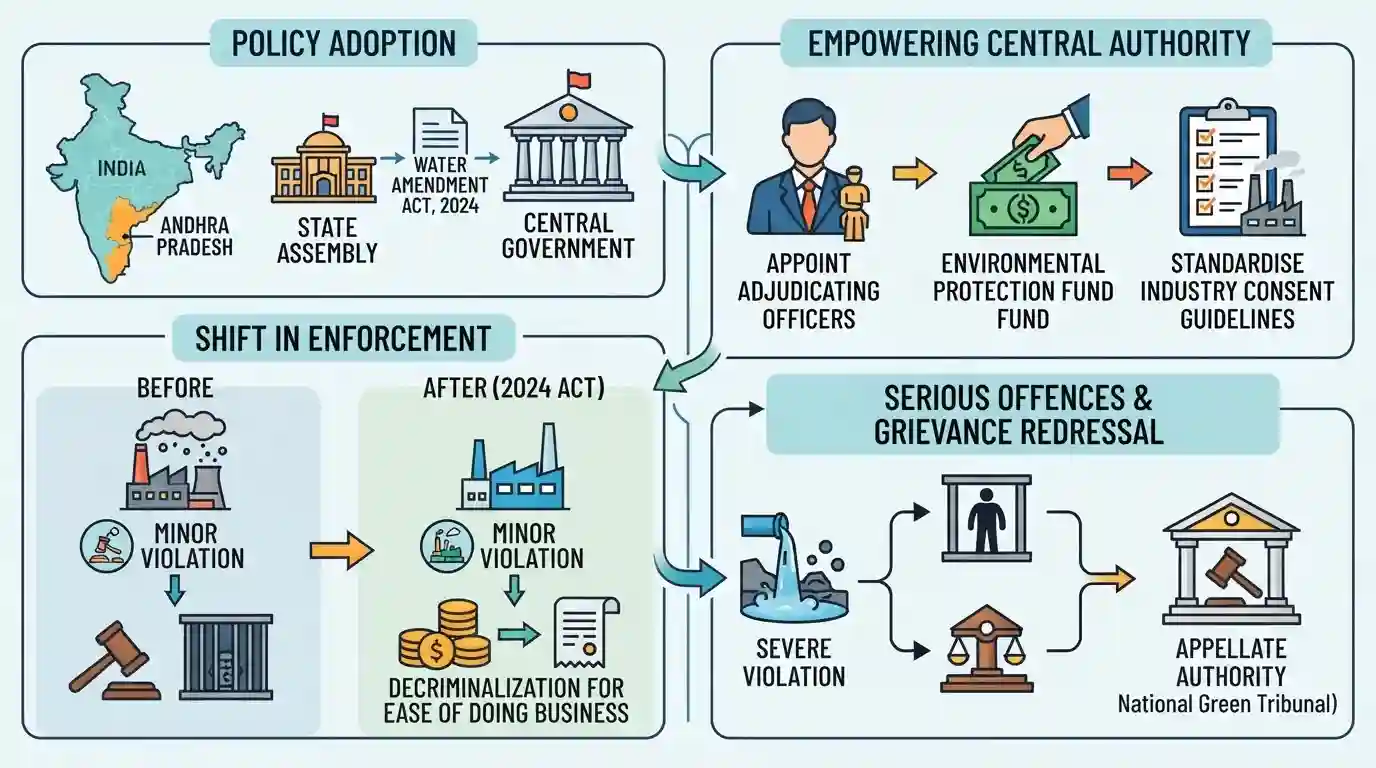
The Andhra Pradesh Legislative Assembly has formally adopted the Centre's Water (Prevention and Control of Pollution) Amendment Act, 2024. This significant legislative step transitions minor environmental violations from strict criminal liabilities to structured financial penalties to foster ease of doing business without compromising environmental protection. The amendment empowers the Central government to appoint adjudicating officers, manage the Environmental Protection Fund, and standardise industry consent guidelines. Serious offences retain criminal liabilities, and the National Green Tribunal remains the designated appellate authority for grievance redressal.
Key Points
- The Andhra Pradesh Assembly passed a statutory resolution to adopt the Centre's Water (Prevention and Control of Pollution) Amendment Act, 2024.
- The amendment rationalises penalties by replacing criminal provisions for minor technical violations with financial penalties (₹10,000 to ₹15 lakh) to promote ease of doing business.
- Serious environmental offences and failure to pay fines for over 90 days will continue to attract criminal action, including one to seven years of imprisonment.
- The Act empowers the Central government to appoint senior officials as adjudicating officers to levy fines and issue binding guidelines on industrial establishment consent.
- Penalties will be credited to the Environmental Protection Fund, and appeals against rulings can be made to the National Green Tribunal within 60 days.
Important Terms
Water (Prevention and Control of Pollution) Amendment Act, 2024

A 2024 central legislation adopted by state assemblies like AP to modernize the 1974 Water Act. It decriminalizes minor pollution offenses, replacing them with structured financial penalties to promote ease of doing business while maintaining environmental standards.
UPSC context
Crucial for GS Paper III (Environment). Demonstrates the shift from strict criminal liability to financial penalties in India's pollution governance framework.
Environmental Protection Fund
A centralized fund under the Public Account of India where penalties collected under the amended Water, Air, and Environment Acts are deposited. Funds are distributed to states for environmental restoration, pollution control, and research.
UPSC context
Relevant to GS Paper III (Environment/Economy). Highlights the operationalization of the 'polluter pays' principle and institutional funding for environmental compliance.
National Green Tribunal (NGT)
A specialized judicial body established in 2010 for effective and speedy resolution of environmental disputes in India. It serves as the appellate authority for orders passed under laws like the Water Act.
UPSC context
Important for GS Paper II (Statutory/Quasi-judicial Bodies). Tests knowledge of specialized environmental justice mechanisms and their appellate jurisdictions.
Prelims Trap
The Water Amendment Act 2024 uniformly applies to all States across India immediately after Parliament's enactment.
Water is a State List subject. Enacted under Article 252, this amendment requires individual State Legislatures to pass statutory resolutions adopting it before enforcement.
Static Concepts Connected
How does Article 252 affect Centre-State legislative powers?
- State Consent: Requires resolutions by two or more State legislatures before Parliament can enact laws on a subject enumerated in the State List.
- Adoption Mechanism: The enacted law applies initially only to consenting States; other States can adopt it subsequently via their own Assembly resolutions.
- Amendment Power: Crucially, any law passed under Article 252 can only be amended or repealed by Parliament, not by the State legislature.
What is the mandate of the National Green Tribunal (NGT)?
- Core Mandate: A statutory body established in 2010 to expedite the disposal of cases relating to environmental protection and conservation of forests.
- Appellate Jurisdiction: It acts as the appellate authority for 7 key environmental laws, now hearing appeals against adjudicating officers under the amended Water Act within 60 days.
Cross-Topic Patterns
Decriminalisation for Ease of Doing Business
Replacing imprisonment with structured financial penalties (₹10k-₹15L) mirrors the Jan Vishwas Act framework, balancing industrial compliance with the broader push for 'ease of doing business'.
Centralisation of Environmental Penalty Funds
Shifting fine collections to the Central Government’s Environmental Protection Fund alters the fiscal and administrative dynamics between State Pollution Control Boards and the Centre.

Expect multi-statement questions combining Article 252 legislative mechanics with the specific decriminalisation provisions of the Water Act.
Linked PYQs · 2
Linked PYQs · 2
- 2023APPSC_PRELIMSGS1
Which of the following statements is/are correct about the National Green Tribunal? I. It was set up under the National Green Tribunal Act, 2010 II. NGT is bound by the procedure laid down under the Code of Civil Procedure, 1908. III. NGT has six places of sitting throughout the country. Choose the correct answer using the codes given below:
- 2019APPSC_PRELIMSGS1
Parliament has the power to enact laws with respect to a matter in the State list in the national interest. In this regard choose the wrong answer.
