AP Treated Wastewater Reuse Policy for All 123 Urban Bodies
Source:The Hindu ↗
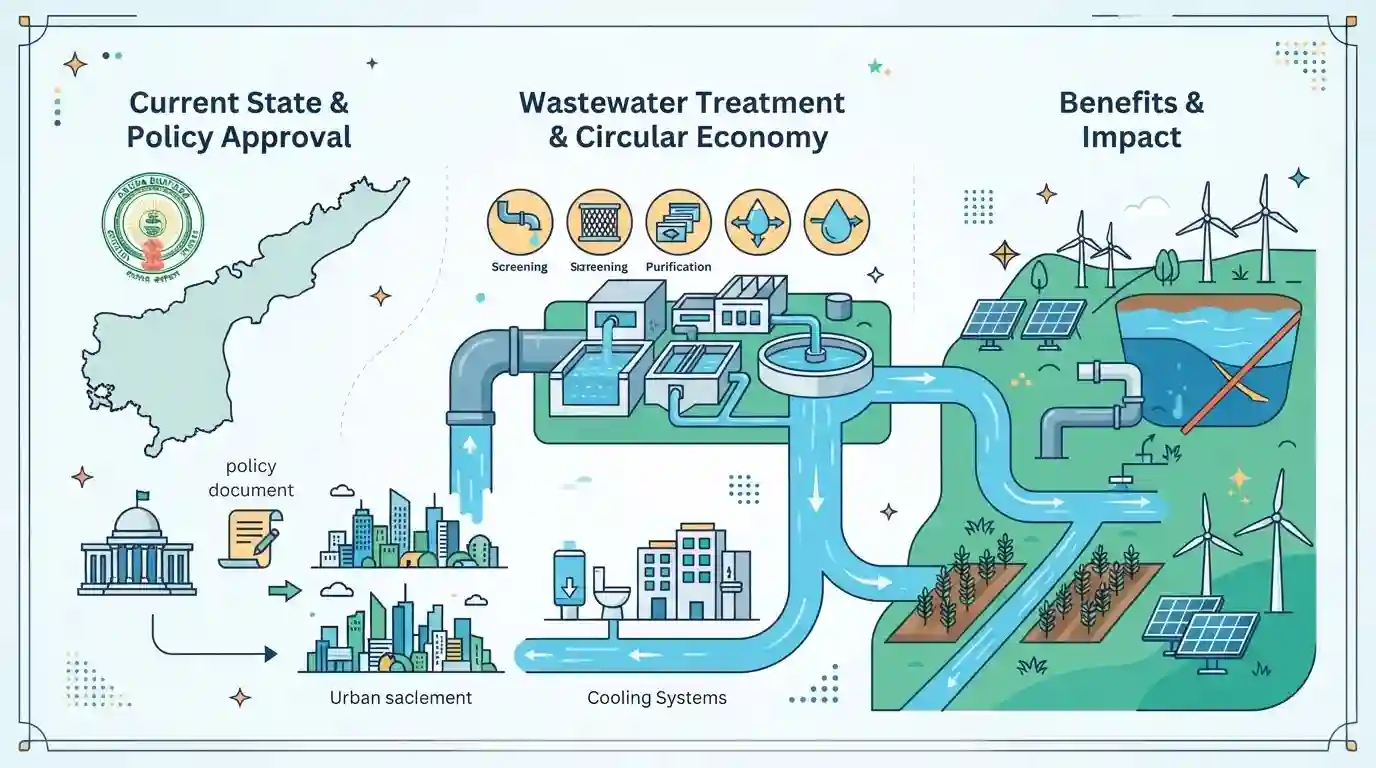
Why It Matters
This policy marks a significant step towards sustainable urban governance and water resource management in Andhra Pradesh, aligning with national goals of circular economy and water security.
Summary
The Andhra Pradesh government has approved a comprehensive Treated Wastewater Reuse Policy applicable to all 123 urban bodies across the state to boost water security, promote circular economy principles in water management, and reduce stress on freshwater resources.
Key Points
- Andhra Pradesh government approved the Treated Wastewater Reuse Policy covering all 123 urban local bodies in the state.
- The policy aims to enhance water security, reduce freshwater consumption for non-potable purposes, and mitigate environmental pollution from untreated sewage discharge.
- It mandates the integration of wastewater reuse infrastructure in future urban planning and industrial/agricultural applications near urban centers.
Important Terms
Treated Wastewater Reuse Policy

A comprehensive state framework governing the collection, treatment, pricing, and non-potable reuse of wastewater across all 123 urban bodies to enhance long-term water security and promote a circular economy.
UPSC context
Important for APPSC Group 1 & 2 (Environment, Water Conservation, and State Policies). Tests understanding of sustainable resource management frameworks.
Urban Local Bodies (ULBs)
Local self-government institutions at the municipal level, encompassing municipal corporations, municipalities, and nagar panchayats responsible for civic administration and urban infrastructure.
UPSC context
Crucial for APPSC Polity and Governance (74th Constitutional Amendment Act) and urban development schemes, testing decentralization and local administration.
Prelims Trap
The Andhra Pradesh Treated Wastewater Reuse Policy permits treated wastewater for dual-use including domestic drinking after advanced filtration.
The policy strictly prohibits drinking applications and mandates treated wastewater exclusively for non-potable uses like industrial cooling, construction, and landscaping.
Static Concepts Connected
What are the primary institutional frameworks and guidelines governing urban wastewater management in India?
- FSSM Policy: National Policy on Faecal Sludge and Septage Management (FSSM) was issued by the Ministry of Housing and Urban Affairs in 2017 to prioritize sanitation solutions.
- NUSP Framework: National Urban Sanitation Policy (NUSP) aims to transform urban India into community-driven, totally sanitized, and healthy cities.
- AMRUT Mission: Namami Gange and Atal Mission for Rejuvenation and Urban Transformation (AMRUT) fund urban STPs and sewerage infrastructure across states.
Cross-Topic Patterns
Wastewater Reuse & Thermal Power Mandates
Andhra Pradesh's mandate linking urban wastewater to thermal power plants directly operationalizes national circular economy targets under the Ministry of Housing and Urban Affairs (MoHUA) frameworks.
Urban Building Bylaws & SDG 6
Integrating dual-piping systems in municipal building bylaws connects state urban governance reforms with SDG 6 (Clean Water and Sanitation) compliance metrics.

AP state policy questions often test quantitative targets; remember: 20% urban and 40% industrial wastewater reuse by 2030.
Linked PYQs · 3
Linked PYQs · 3
- 2023APPSC_PRELIMSGS1
Part V of the Andhra Pradesh Reorganisation Act deals with
- 2024APPSC_PRELIMSGS1
Which of the following statements are valid in connection with Andhra Pradesh Green Hydrogen and Green Ammonia Policy (2023)? I. The objective is to target Green Energy production up to the capacity of 1 MPTA (Million Tonnes Per Annum) or Green Ammonia production up to the capacity of 2-0 MTPA in the next five years. II. New and Renewable Energy Development Corporation of A.P. Ltd (NREDCAP) shall act as a Nodal Agency under this policy. III. All the Ports in the State have infrastructure for storing liquid nitrogen which can then be utilized for storing Green Hydrogen for exporting to other countries. IV. The Policy prohibits the production of Green Hydrogen/Green Ammonia by using Renewable Energy and/or Biomass from 'Third-Party/Power exchange'. Select the correct answer using the codes given below :
- 2023APPSC_PRELIMSGS1
Apex Council of Godavari and Krishna river water resources and their management consists of
