MGNREGS Horticulture Diversification Drive in Andhra Pradesh
Source:The Hindu ↗
Why It Matters
It serves as an excellent case study for GS-2 and GS-3 answers demonstrating how MGNREGS funds can be synergized with agricultural diversification to build long-term productive assets, alleviate rural poverty, and ensure ecological sustainability rather than limiting the scheme to temporary wage labor.
Summary
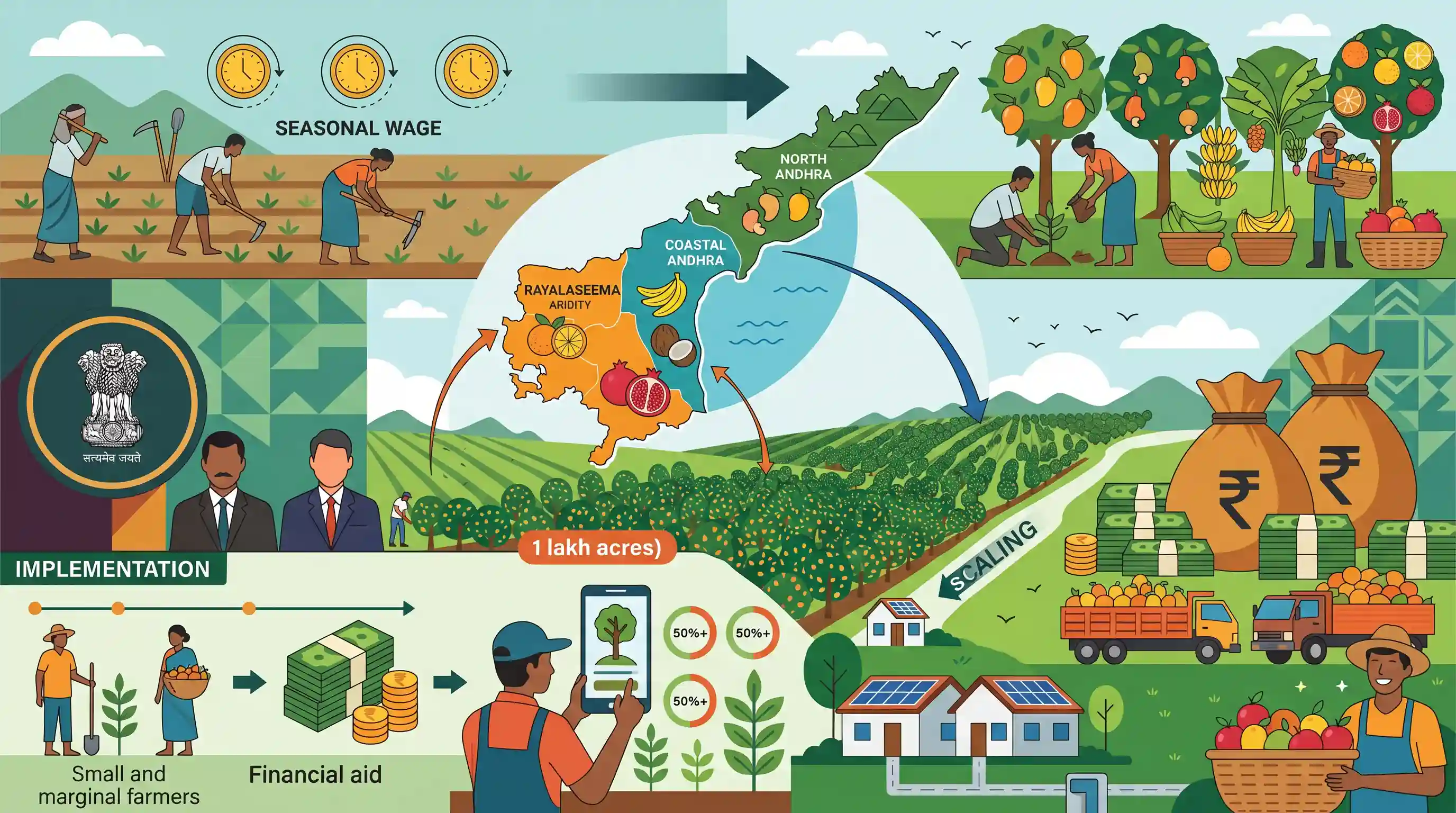
The Andhra Pradesh government has launched an ambitious horticulture plantation drive under the Mahatma Gandhi National Rural Employment Guarantee Scheme (MGNREGS), targeting one lakh acres across the state. By promoting region-specific high-value crops tailored to the agro-climatic strengths of North Andhra, Coastal Andhra, and Rayalaseema, the initiative aims to shift MGNREGS's focus from mere seasonal wage support to the creation of durable, income-generating assets. Small and marginal farmers will receive financial assistance of up to ₹1.09 lakh per acre over three years, provided they maintain a 50% plant survival rate monitored through a mobile app. The program is expected to yield an annual recurring income of up to ₹1 lakh per acre post-harvest, ensuring both rural economic empowerment and environmental sustainability.
Key Points
- The Andhra Pradesh government launched a horticulture plantation drive under MGNREGS, targeting 1 lakh acres in FY 2025-26.
- The initiative aims to transition rural employment from seasonal wage support to recurring agricultural income by creating durable livelihood assets.
- Farmers are expected to earn ₹80,000 to ₹1,00,000 per acre per annum post-harvest, cultivating on 0.25 to 5 acres of land.
- Financial assistance of up to ₹1.09 lakh per acre is provided over three years, contingent on a 50% minimum plant survival rate monitored via a mobile app.
- Crop strategies are tailored to agro-climatic zones, such as rubber and cashew in North Andhra, cocoa in Coastal Andhra, and sweet orange in Rayalaseema.
Important Terms
Mahatma Gandhi National Rural Employment Guarantee Scheme (MGNREGS)

A social security scheme providing at least 100 days of guaranteed wage employment annually to rural households whose adult members volunteer for unskilled manual work.
UPSC context
GS II/III; tests rural development, poverty alleviation, and welfare legislation.
Horticulture
The branch of agriculture dealing with the cultivation of fruits, vegetables, and flowers, typically offering higher economic returns per unit of land than traditional cereals.
UPSC context
GS III (Agriculture); key for crop diversification and doubling farmers' income.
Small and Marginal Farmers
Marginal farmers own less than 1 hectare of land; small farmers own 1 to 2 hectares. They represent over 85% of India's agricultural households.
UPSC context
GS III (Agriculture); focus on land fragmentation and targeted agricultural interventions.
Agro-Climatic Zones
Land units defined by major climate, rainfall, and soil type to determine suitable cropping patterns. India is divided into 15 such regions by the Planning Commission.
UPSC context
GS I (Geography) and GS III (Agriculture); tests resource-based agricultural planning.
Durable Assets
Permanent physical infrastructure like plantations or ponds built under MGNREGS to provide long-term livelihood security beyond immediate wage payments.
UPSC context
GS II/III; evaluates the shift from social relief to productive rural infrastructure.
Rayalaseema
A drought-prone geographic region in southern Andhra Pradesh characterized by a semi-arid climate and rain-shadow geography.
UPSC context
GS I (Geography); specific instance of dryland agriculture and regional developmental challenges.
Prelims Trap
MGNREGS funds are restricted to community asset creation and cannot be utilized on individual private lands.
Schedule I of MGNREGS explicitly permits the creation of individual assets for specific vulnerable groups, including small and marginal farmers, for activities like horticulture.
Static Concepts Connected
What types of asset creation are permitted on individual lands under MGNREGS?
- Target Groups: SC/STs, nomadic tribes, BPL families, women-headed households, and small/marginal farmers are eligible.
- Permitted Works: Improving land productivity, horticulture, plantation, sericulture, farm ponds, and livestock shelters.
- Funding Priority: Gram Panchayats are mandated to allocate at least 60% of the works in terms of cost to agriculture and allied activities.
How does agro-climatic zoning dictate horticulture diversification in India?
- Classification Basis: Planning Commission (15 zones) and ICAR (127 sub-zones) categorize regions based on soil type, topography, rainfall, and temperature.
- Crop Alignment: Humid/coastal zones favor plantation crops (rubber, cocoa), while arid and semi-arid zones optimally support dryland horticulture (sweet oranges).
- Resource Efficiency: Aligning crop choices with natural ecological zoning prevents severe water stress and reduces the reliance on artificial irrigation and chemical fertilizers.
Cross-Topic Patterns
Scheme Convergence: MGNREGS & Agriculture
Shifting MGNREGS from pure wage-support to agricultural capital formation (horticulture) addresses GS3 themes of rural distress, asset creation, and crop diversification simultaneously.
Digital Accountability in Welfare Schemes
App-based tracking of plant survival rates extends the digital governance push seen in NMMS, tying phased financial assistance strictly to verifiable field outcomes.

Expect a 2026 Prelims question testing the exact eligibility of 'individual land assets' under MGNREGS and its digital monitoring tools.
Linked PYQs · 4
Linked PYQs · 4
- 2025MainsGS3
Explain the factors influencing the decision of the farmers on the selection of high value crops in India.
- 2021MainsGS3
What are the present challenges before crop diversification? How do emerging technologies provide an opportunity for crop diversification?
- 2023MainsGS3
Explain the changes in cropping pattern in India in the context of changes in consumption pattern and marketing conditions.
- 2020MainsGS2
Micro-Finance as an anti-poverty vaccine, is aimed at asset creation and income security of the rural poor in India". Evaluate the role of the Self Help Groups in achieving the twin objectives along with empowering women in rural India.
