State Advances Statewide Rollout of Sanjeevani Health Platform
Source:digital-health-news ↗
Why It Matters
The initiative reflects the active application of e-governance in healthcare delivery and administration, which is a core part of the GS2 syllabus covering governance, social justice (health), and government policies and interventions for development in various sectors.
Summary
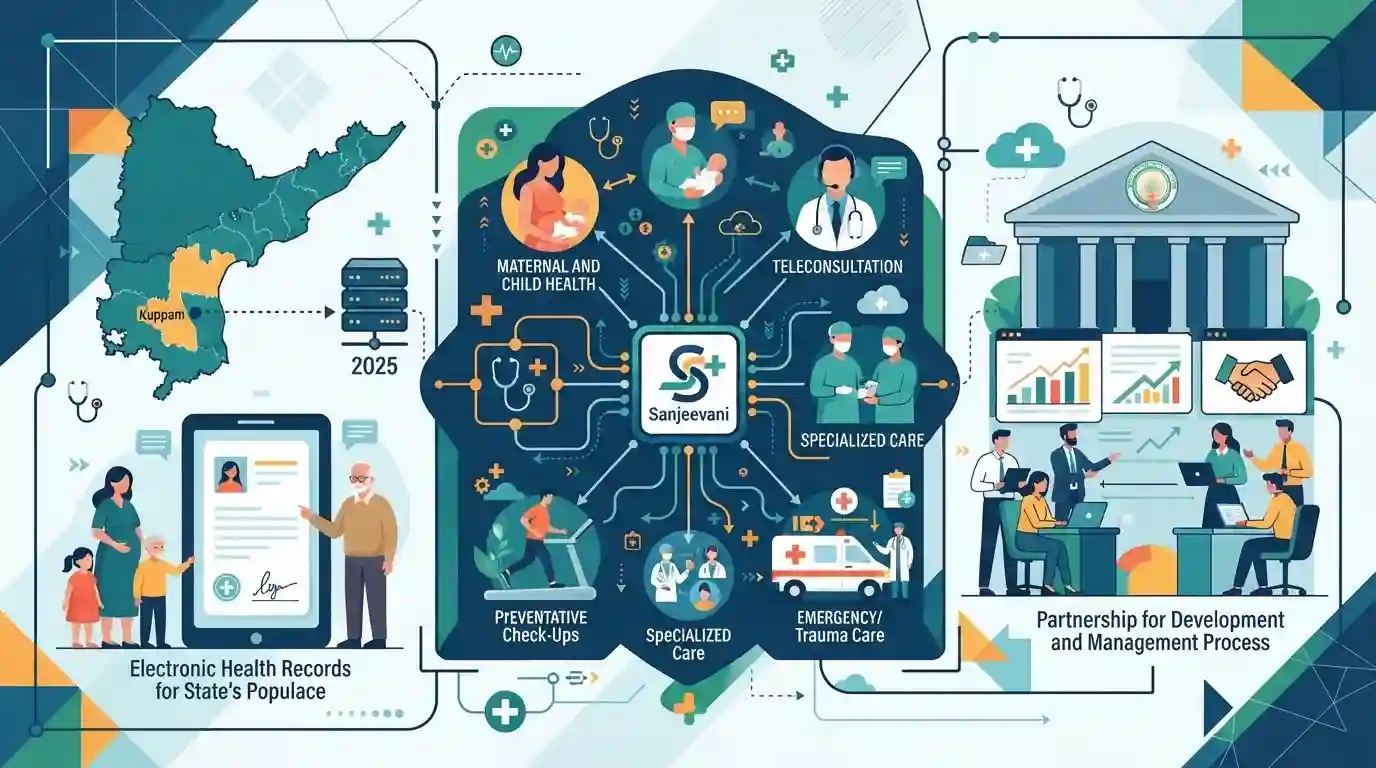
The Andhra Pradesh government is advancing the statewide implementation of the Sanjeevani digital health platform to unify healthcare services and maintain electronic health records for over five crore citizens. Following a successful pilot in Kuppam in July 2025, the state's Department of Health, Medical and Family Welfare has invited bids for a technology partner to develop and manage the platform for five years. The comprehensive system will offer coordinated care by analyzing medical histories, enabling teleconsultations, and integrating a wide array of public healthcare services from maternal health to trauma care.
Key Points
- The Andhra Pradesh government is rolling out the Sanjeevani digital health platform statewide to maintain integrated health records for over 5 crore residents.
- Sanjeevani was initially introduced as a pilot project in Kuppam in July 2025 to improve coordination across state and central healthcare programs.
- The Department of Health, Medical and Family Welfare has issued an RFP to select a technology partner for developing, operating, and maintaining the platform for five years using a Quality and Cost Based Selection (QCBS) method.
- The platform will support advance alerts for health risks, doctor appointments, teleconsultations, and consolidate data across various public health domains such as maternal health, non-communicable diseases, and trauma care.
Important Terms
Sanjeevani Project (Andhra Pradesh)

A digital care coordination and healthcare delivery platform in Andhra Pradesh launched to maintain integrated electronic health records, enable screenings, and provide coordinated public health services.
UPSC context
GS Paper II (e-Governance, Health) and Paper III (Digital Infrastructure); tests knowledge of technology-driven state-level health initiatives.
Ayushman Bharat Health Account (ABHA)
A unique 14-digit digital health ID under India's National Health Authority, enabling secure storage and digital sharing of a citizen's personal medical records.
UPSC context
GS Paper II (Social Sector/Health); tests understanding of national digital health infrastructure and welfare delivery mechanisms.
Preventive Healthcare
Medical practices, screenings, and public health policies designed to avert diseases and promote well-being before illnesses develop or progress.
UPSC context
GS Paper II (Issues relating to Health); tests awareness of structural shifts in public health policy from treatment to disease prevention.
Digital Health Records (DHR)
Systematically compiled electronic health data containing an individual's lifetime medical history, diagnoses, treatments, and test results, shared across clinical systems.
UPSC context
GS Paper II (e-Governance) and Paper III (IT & Science); tests integration of IT applications in citizen-centric public service delivery.
Department of Health, Medical and Family Welfare (Andhra Pradesh)
The state government department responsible for formulating, implementing, and supervising public healthcare policies, medical infrastructure, and welfare schemes in Andhra Pradesh.
UPSC context
GS Paper II (State Government Policies & Welfare Schemes); tests candidate's knowledge of provincial administrative machinery in governance.
Prelims Trap
Sanjeevani is a national telemedicine service developed by C-DAC under the Ayushman Bharat scheme.
Aspirants easily confuse Andhra Pradesh's state-specific 'Sanjeevani' EHR platform with the Ministry of Health's 'eSanjeevani' (National Telemedicine Service). Always watch for the "e-" prefix!
Static Concepts Connected
What are the core building blocks of Ayushman Bharat Digital Mission (ABDM)?
- ABHA Number: A unique 14-digit health identifier allowing citizens to digitally access, standardize, and share their medical records.
- HPR & HFR: Healthcare Professionals Registry and Health Facility Registry act as unified, verified repositories for medical practitioners and clinical establishments.
- Consent Manager: Ensures that health data is exchanged between providers and patients securely, temporarily, and only with the explicit consent of the user.
What is Quality and Cost-Based Selection (QCBS) in public procurement?
- Beyond L1 Bidding: Unlike traditional L1 (lowest bidder) selection, QCBS evaluates bids using a weighted formula combining both technical capability (quality) and the financial bid (cost).
- Use Case: It is primarily used for complex IT, consultancy, or sensitive projects where compromising on technical quality for a cheaper price poses severe systemic risks.
Cross-Topic Patterns
Digital Health APIs & Cooperative Federalism
State platforms like Sanjeevani integrating with the national ABDM stack via APIs highlight digital cooperative federalism, balancing state administrative autonomy with national data standardization.
EHRs and the DPDP Act 2023
The mass digitization of 5 crore citizens' health records tests the interplay between public health administration and the Digital Personal Data Protection (DPDP) Act regarding sensitive personal data.

Expect a 2026 Prelims paired-statement question directly contrasting AP's Sanjeevani (EHR platform) with the Centre's eSanjeevani.
Linked PYQs · 1
Linked PYQs · 1
- 2024APPSC_PRELIMSGS1
Which of the following statements are valid regarding the interventions of the Government of Andhra Pradesh in the context of Healthcare ? I. Telemedicine facility is available in all Ayushman Bharat Health and Wellness Centres (AB-HWCs) to avail specialist services through district hub. II. The Family Doctor Programme has been planned to be implemented as a standalone project without the need to be integrated with Primary Health Centres (PHCs). III. Dr. YSR Aarogyasri Scheme has been revamped, by increasing the income limit from ₹ 2.5 lakh to ₹ 5 lakh per annum per family. IV. 'Aarogya Aasara' Scheme is intended to provide post-operative sustenance allowance with certain eligible conditions complied with. Select the correct answer using the codes given below :
