Andhra Pradesh Launches Land Pooling Scheme Two for Amaravati Capital
Source:The Hindu ↗
Why It Matters
Land pooling is an alternative model to traditional land acquisition for large-scale urbanization and infrastructure projects. It highlights the balance between rapid capital city development (Amaravati) and safeguarding the socio-economic interests of local farmers through debt waivers and enhanced lease compensations.
Summary
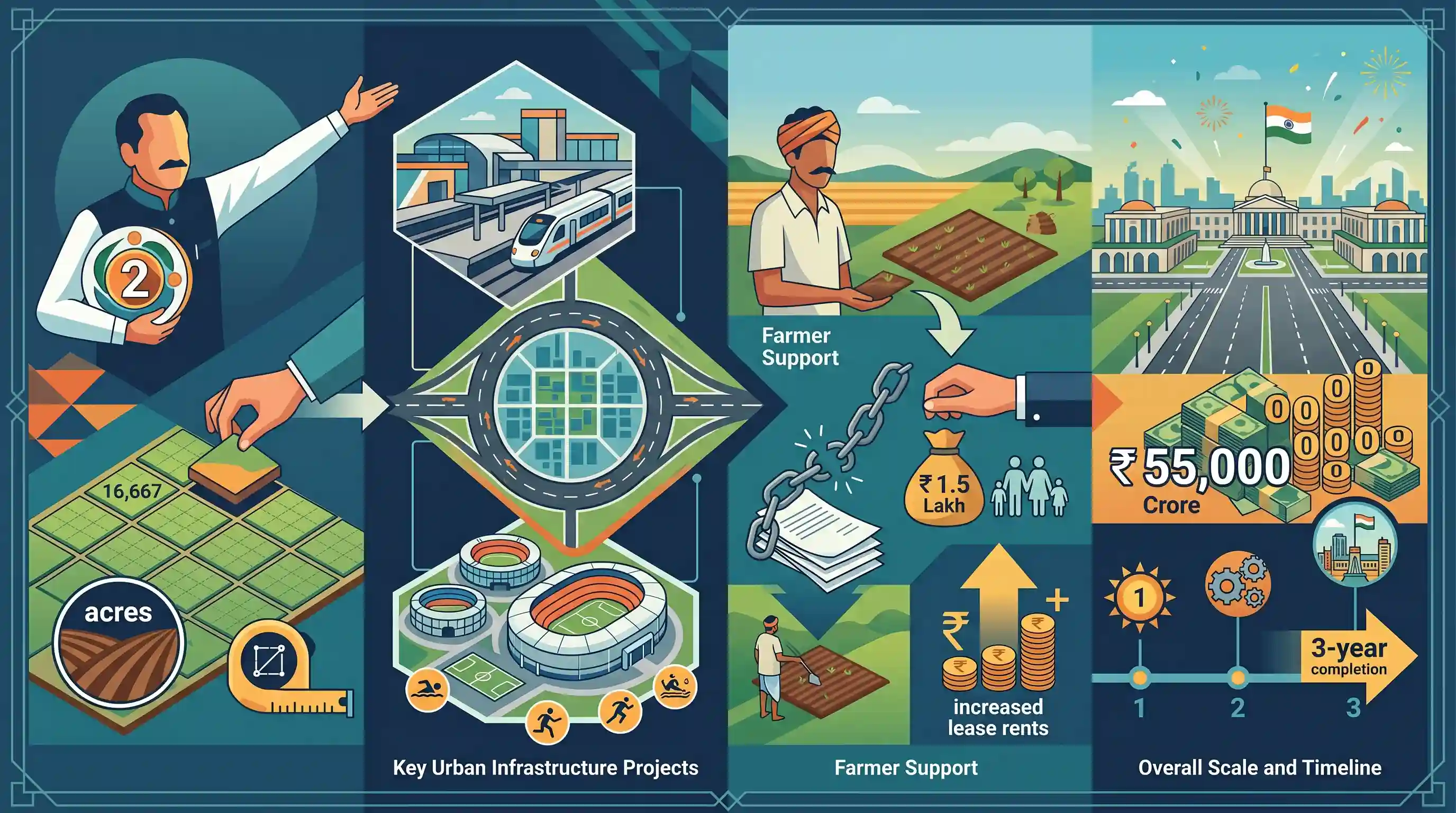
Andhra Pradesh's Municipal Administration Minister P. Narayana launched the Land Pooling Scheme-II (LPS 2.0) in Amaravati to aggregate 16,667 acres for key urban infrastructure projects, including a railway station, inner ring road, and sports city. To support contributing farmers, the government announced a debt waiver of ₹1.50 lakh per family and an increase in lease rents. The ongoing construction of the capital city involves projects worth ₹55,000 crore, with completion expected in three years.
Key Points
- The Andhra Pradesh government launched Land Pooling Scheme-II (LPS 2.0) in Amaravati to acquire 16,667 acres across seven revenue villages for new infrastructure projects.
- The pooled land will be used to construct the Amaravati railway station, an international sports city, an inner ring road, and a new railway line.
- To support farmers who surrendered their land, the State announced a farm debt waiver of up to ₹1.50 lakh for loans taken up to January 6, 2026.
- The lease rents payable to these farmers have been increased, ensuring better compensation and sustained livelihoods.
- Total ongoing capital construction works in Amaravati are estimated at ₹55,000 crore, targeted to be completed within three years.
Important Terms
Land Pooling Scheme (LPS)

A voluntary urban planning tool where landowners aggregate their land for infrastructure development, receiving a portion of the developed land back instead of a purely monetary compensation.
UPSC context
GS Paper II/III: Urbanization and land reforms. Tests knowledge of alternative land-acquisition models vs. the LARR Act 2013.
Land Pooling Scheme-II (LPS 2.0)
The second phase of Amaravati's land aggregation targeting 16,667 acres for projects like the Inner Ring Road and a 2,500-acre International Sports City.
UPSC context
GS Paper III: Infrastructure development and regional planning. Tests understanding of specific state-led developmental phases and socio-economic incentives.
Andhra Pradesh Capital Region Development Authority (APCRDA)
The statutory body responsible for planning, coordinating, and implementing the development of the Andhra Pradesh Capital Region, including the Land Pooling Scheme.
UPSC context
GS Paper II: Statutory bodies and governance. Tests knowledge of regional planning authorities and their administrative powers.
LARR Act 2013 vs. Land Pooling
A 2013 Act regulating compulsory land acquisition in India, requiring Social Impact Assessments and high compensation; land pooling is often cited as a faster, voluntary alternative.
UPSC context
GS Paper III: Land reforms. Compares compulsory acquisition with voluntary pooling models in terms of efficiency and farmer rights.
Greenfield Capital City
A planned city built from scratch on previously undeveloped (often agricultural) land, rather than expanding an existing urban area, allowing for modern infrastructure.
UPSC context
GS Paper I/III: Urbanization and Infrastructure. Relevant for discussing the challenges and benefits of creating new administrative hubs.
Agricultural Debt Waiver
A government measure to cancel the outstanding agricultural loans of farmers, used here as a fiscal incentive to encourage participation in the land pooling scheme.
UPSC context
GS Paper III: Issues related to direct/indirect farm subsidies and rural economy. Tests impact on state exchequer and rural welfare.
Prelims Trap
Land Pooling Schemes must strictly operate under the compensation and SIA framework of the central LARR Act 2013.
False. Land pooling is a voluntary alternative governed by State-specific acts, bypassing LARR 2013’s compulsory eminent domain and upfront monetary compensation models.
Static Concepts Connected
How does Land Pooling differ from traditional Land Acquisition?
- Mechanism: Acquisition relies on compulsory state eminent domain, whereas pooling is a voluntary aggregation of fragmented land parcels.
- Compensation Model: Acquisition pays upfront monetary compensation; Pooling returns a fraction of developed, infrastructure-ready land (plus annuity) back to the original owner.
- Displacement Impact: Pooling minimizes outright displacement and litigation, as original owners retain a stake in the newly urbanized space.
What are the macroeconomic consequences of farm loan waivers?
- Moral Hazard: Destroys credit discipline by penalizing honest borrowers who repay on time, incentivizing future willful defaults.
- Credit Squeeze: Banks become risk-averse due to rising NPAs, paradoxically restricting future formal credit access for marginal farmers.
- Fiscal Burden: Waivers strain state finances, crowding out productive capital expenditure (like irrigation and storage) in the agriculture sector.
Cross-Topic Patterns
Greenfield Urbanization vs. Ecological Security
Building massive urban infrastructure on fertile, multi-crop floodplains creates a direct conflict between GS1 urbanization trends and GS3 food/ecological security imperatives.
Excluded Stakeholders in Participatory Land Models
While landowners benefit from plot appreciation and annuities in pooling schemes, landless agricultural laborers often lose traditional livelihoods without statutory rehabilitation, linking to GS2 vulnerability topics.

Mains GS3 is highly likely to ask for a comparative evaluation of Land Pooling vs. LARR 2013 for resolving India's infra bottlenecks.
Linked PYQs · 3
Linked PYQs · 3
- 2025MainsGS1
How does smart city in India, address the issues of urban poverty and distributive justice?
- 2015MainsGS1
Smart cities in India cannot sustain without smart villages. Discuss this statement in the backdrop of rural urban integration.
- 2021MainsGS3
How did land reforms in some parts of the country help to improve the socio-economic conditions of marginal and small farmers?
