Human Organ Transplantation Bill: Assembly Amendment Passage
Source:medicalbuyer ↗
Why It Matters
Healthcare legislation and welfare measures are critical components of state governance. Amendments to organ transplantation laws reflect the ethical, legal, and administrative approaches taken by state governments to enhance public health, curb medical malpractices, and incentivize life-saving donations.
Summary
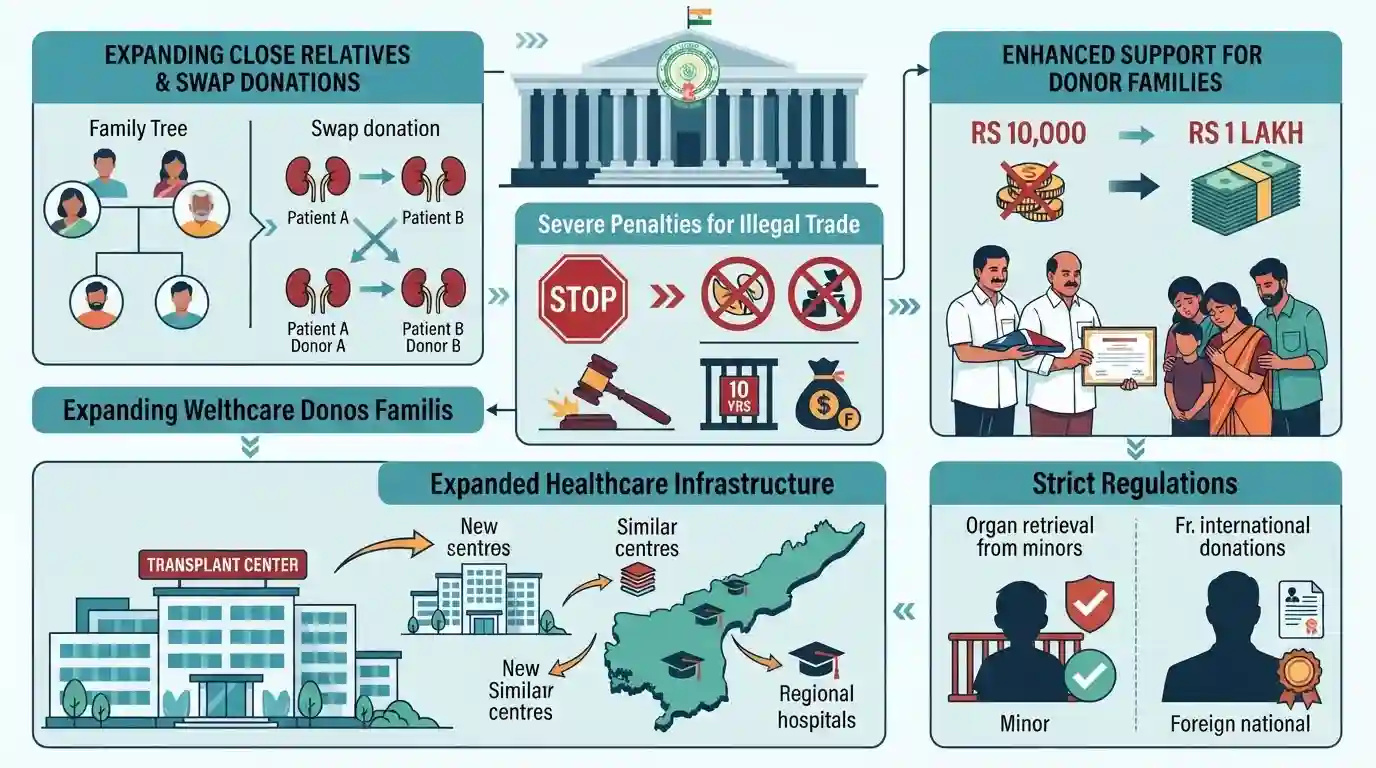
The Andhra Pradesh Legislative Assembly has passed the Human Organ Transplantation Amendment Bill-2026 to regulate organ donation and curb illegal organ trade. The bill expands the definition of 'close relatives' for organ donation, allows 'swap donations', and imposes severe penalties, including up to 10 years of imprisonment and significant fines for illegal organ removal and trade. Additionally, the state government proposed enhancing the financial assistance for families of brain-dead donors from Rs 10,000 to Rs 1 lakh, along with state honors for last rites. The legislation also outlines plans to establish more transplant centers across teaching hospitals and mandates strict regulations for organ retrieval from minors and donations involving foreigners.
Key Points
- The Andhra Pradesh Legislative Assembly passed the Human Organ Transplantation Amendment Bill-2026 to strengthen the regulatory framework surrounding organ donation and transplantation.
- The legislation introduces stringent penal provisions to curb the illegal trade and unauthorized removal of human organs.
- The amendment broadens the scope of eligible donors by expanding the definition of 'near relatives' to include grandparents and other family members, and legalizes swap donations in specific scenarios.
- The state government proposed to increase the financial assistance for the families of brain-dead organ donors from Rs 10,000 to Rs 1 lakh, and is exploring employment opportunities for eligible family members.
- The state plans to expand its healthcare infrastructure by increasing the number of transplant centers and mandating special permissions for organ donations involving foreign nationals.
Important Terms
Human Organ Transplantation Amendment Bill-2026

A 2026 state legislation that severely penalizes illegal organ trade, expands the legal definition of "close relatives," and legalizes swap donations to boost organ availability.
UPSC context
Essential for APPSC Group-1 (State Legislation & Public Health); demonstrates governance efforts to regulate medical ethics and infrastructure.
Swap Donation
An arrangement allowing two donor-recipient pairs to exchange organs when the donors are incompatible with their own family members but compatible with the opposite recipient.
UPSC context
Important for APPSC Science & Technology and Public Health; illustrates innovative policy solutions to reduce the organ shortage.
Brain-Dead Organ Donation
The retrieval of viable organs from a patient whose brain functions have permanently ceased. AP's 2026 bill proposed increasing financial aid for such donors' families.
UPSC context
Key for APPSC General Science and Healthcare Welfare programs, reflecting state initiatives to incentivize life-saving organ donations.
Close Relatives (Organ Donation)
Family members legally authorized to donate organs. The 2026 AP amendment broadened this category to include grandparents, maternal uncles, and aunts alongside immediate family.
UPSC context
Relevant for APPSC Polity and Governance, showing how legal definitions are amended to address public health challenges.
Prelims Trap
Organ donation is strictly restricted to parents and siblings, and foreign nationals are completely banned from donating.
The Bill actually expands 'near relatives' to include grandparents and aunts/uncles. It also allows foreign national donations under strict special permissions, rather than a blanket ban.
Static Concepts Connected
What is the constitutional and central legal framework for organ transplantation?
- THOA 1994: The Transplantation of Human Organs Act (1994) is the primary law. Since public health is a State List subject, states adopt or amend it via Assembly resolutions.
- Brain Death Legalized: The Act legally recognizes 'brain death' (permanent cessation of brain stem functions) as a form of death, a mandatory prerequisite for deceased organ extraction.
- NOTTO framework: National Organ and Tissue Transplant Organisation (NOTTO) sets up the registry and coordinates procurement/distribution at the central level, cascading to SOTTOs at the state level.
Cross-Topic Patterns
Organ donation and Dr. YSR Aarogyasri synergy
Promoting organ transplants intersects directly with state health schemes like Dr. YSR Aarogyasri, which covers costly post-operative immunosuppressive therapies, making end-stage organ failure treatments viable for BPL families.
State honors as behavioral nudges
Providing state honors for the last rites of brain-dead donors is a governance behavioral nudge, using administrative recognition to break deep-seated cultural taboos surrounding organ retrieval.

Expect a multi-statement question testing the expanded 'close relative' definition, legalization of swap donations, and Rs 1 lakh ex-gratia.
Linked PYQs · 1
Linked PYQs · 1
- 2024APPSC_PRELIMSGS1
Which of the following statements are valid regarding the interventions of the Government of Andhra Pradesh in the context of Healthcare ? I. Telemedicine facility is available in all Ayushman Bharat Health and Wellness Centres (AB-HWCs) to avail specialist services through district hub. II. The Family Doctor Programme has been planned to be implemented as a standalone project without the need to be integrated with Primary Health Centres (PHCs). III. Dr. YSR Aarogyasri Scheme has been revamped, by increasing the income limit from ₹ 2.5 lakh to ₹ 5 lakh per annum per family. IV. 'Aarogya Aasara' Scheme is intended to provide post-operative sustenance allowance with certain eligible conditions complied with. Select the correct answer using the codes given below :
