PMAY-Urban 2.0 AP Sanctions 17912 Houses with 6040 Funding Pattern
Source:theprint ↗
Why It Matters
For APPSC Group 1 Prelims, understanding the cooperative federalism dynamics of Centrally Sponsored Schemes (CSS) like PMAY-U 2.0 is crucial. Examiners frequently test details of welfare scheme funding patterns (such as the 60:40 Centre-State division), implementation agencies (APSHCL), and specific state-level targets for social infrastructure.
Summary
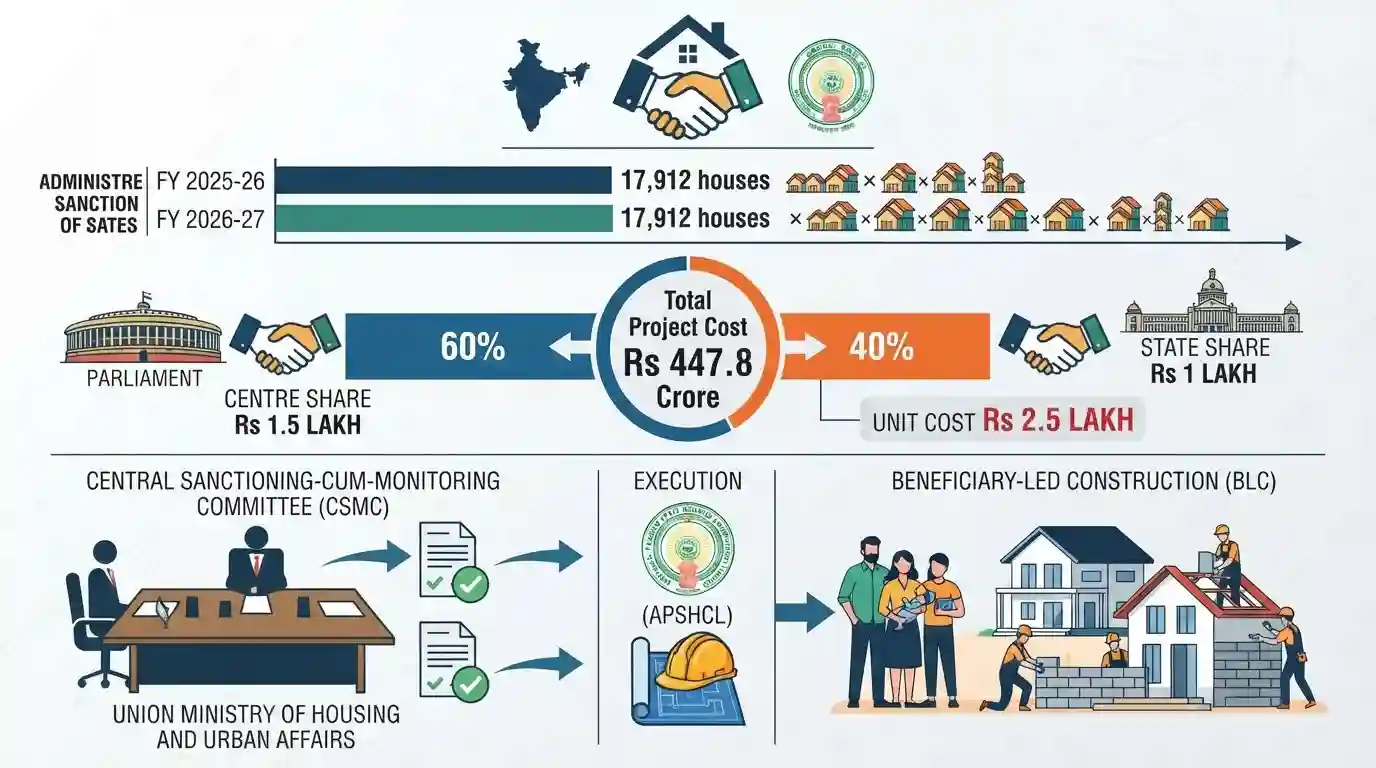
The Andhra Pradesh government has administratively sanctioned the construction of 17,912 houses under the Pradhan Mantri Awas Yojana-Urban (PMAY-U) 2.0 Beneficiary-led Construction (BLC) vertical for FY 2025-26 and FY 2026-27. With a total project cost of Rs 447.8 crore, the cost-sharing structure dictates a 60:40 ratio where the Centre provides Rs 1.5 lakh and the State government contributes Rs 1 lakh of the Rs 2.5 lakh unit cost. The executing body in the state is the Andhra Pradesh State Housing Corporation Limited (APSHCL), working in tandem with approvals from the Central Sanctioning-cum-Monitoring Committee (CSMC) under the Union Ministry of Housing and Urban Affairs.
Key Points
- The Andhra Pradesh government has granted administrative approval for the construction of 17,912 houses under the PMAY-Urban 2.0 Beneficiary-led Construction (BLC) component for FY 2025-26 and FY 2026-27.
- The total approved project cost is Rs 447.8 crore (approximately Rs 448 crore), with the unit cost of each house fixed at Rs 2.5 lakh.
- The funding pattern of the scheme follows a 60:40 ratio: 60% (Rs 1.5 lakh) is provided as central assistance by the Government of India, while the remaining 40% (Rs 1 lakh) is financed by the State Government of Andhra Pradesh. Any extra cost over Rs 2.5 lakh must be borne by the individual beneficiaries.
- The construction plan is divided into three segments: 893 houses (Rs 22 crore) and 4,649 houses (Rs 116 crore) for 2025-26, and 12,370 houses (Rs 309 crore) for 2026-27.
- The project was cleared following proposals from the Managing Director of the Andhra Pradesh State Housing Corporation Limited (APSHCL), which were previously evaluated by the Central Sanctioning-cum-Monitoring Committee (CSMC) of the Union Ministry of Housing and Urban Affairs (MoHUA).
Important Terms
Pradhan Mantri Awas Yojana-Urban 2.0 (PMAY-Urban 2.0)

A flagship central scheme launched in September 2024 to provide financial assistance to urban poor and middle-class families (EWS/LIG/MIG) to construct, purchase, or rent affordable pucca houses.
UPSC context
APPSC Group 1 & 2 Economic Development paper, testing welfare schemes, urban infrastructure, and housing policies.
Beneficiary-led Construction (BLC) scheme
A vertical under PMAY-U 2.0 providing direct financial assistance to Economically Weaker Section (EWS) families to build or upgrade pucca houses on their own self-owned land.
UPSC context
APPSC Group 1 & 2 Mains, testing urban housing verticals and micro-level implementation of welfare programs.
Andhra Pradesh State Housing Corporation Limited (APSHCL)
A state-owned company established in 1979 serving as the nodal agency to implement, coordinate, and provide technical and financial assistance for affordable housing schemes in Andhra Pradesh.
UPSC context
APPSC Economy of Andhra Pradesh paper, testing state public sector undertakings and welfare infrastructure.
Central Sanctioning-cum-Monitoring Committee (CSMC)
An apex national body chaired by the Secretary of the Ministry of Housing and Urban Affairs (MoHUA) that sanctions project proposals and monitors PMAY-Urban progress.
UPSC context
APPSC Indian Polity and Governance paper, illustrating center-state relations and administrative coordination.
Prelims Trap
All four verticals under the Pradhan Mantri Awas Yojana-Urban 2.0 are implemented as Centrally Sponsored Schemes.
While PMAY-U 2.0 is largely a Centrally Sponsored Scheme with a cost-sharing model, its Interest Subsidy Scheme (ISS) vertical is structured entirely as a Central Sector Scheme.
Static Concepts Connected
What is the role of the Andhra Pradesh State Housing Corporation Limited (APSHCL)?
- Origin & Mandate: Established in 1979 to formulate, coordinate, and execute housing programs for weaker sections in Andhra Pradesh.
- Nodal Status: Acts as the state-level nodal agency to execute mega housing schemes like PMAY-Urban/Gramin and NTR Housing / Navaratnalu schemes.
- Financial Flow: Manages the financial pipelines, coordinates with the Union MoHUA, and oversees beneficiary-led construction quality.
How do Central Sector Schemes differ from Centrally Sponsored Schemes?
- Central Sector: Funded 100% by the Union Government and implemented directly by Union ministries or central agencies.
- Centrally Sponsored: Cost is shared in fixed ratios (e.g., 60:40, 90:10) between the Centre and the States, with implementation managed by State governments.
Cross-Topic Patterns
Urban devolution and Centrally Sponsored Schemes
CSS funding structures like PMAY-U 2.0 (60:40) heavily impact AP's state fiscal headroom, requiring careful state budgeting to balance matching shares with central releases.
Housing as a multidimensional poverty tool
Affordable urban housing directly intersects with health, dignity, and wealth creation, forming a critical metric in AP's Multidimensional Poverty Index (MPI) reduction strategy.

Expect questions testing the distinct central-sector status of ISS within PMAY-U 2.0 and APSHCL's nodal role in AP's housing targets.
Linked PYQs · 3
Linked PYQs · 3
- 2023APPSC_PRELIMSGS1
One of the following welfare programmes implemented by Government of Andhra Pradesh is not part of Navaratnalu.
- 2024APPSC_PRELIMSGS1
Which of the following statements are valid regarding the interventions of the Government of Andhra Pradesh in the context of Healthcare ? I. Telemedicine facility is available in all Ayushman Bharat Health and Wellness Centres (AB-HWCs) to avail specialist services through district hub. II. The Family Doctor Programme has been planned to be implemented as a standalone project without the need to be integrated with Primary Health Centres (PHCs). III. Dr. YSR Aarogyasri Scheme has been revamped, by increasing the income limit from ₹ 2.5 lakh to ₹ 5 lakh per annum per family. IV. 'Aarogya Aasara' Scheme is intended to provide post-operative sustenance allowance with certain eligible conditions complied with. Select the correct answer using the codes given below :
- 2023APPSC_PRELIMSGS1
Government of Andhra Pradesh is implementing YSR Rythu Bharosa - PM Kisan Scheme for the benefit of farmers of Andhra Pradesh. Which of the following statements are correct about the above scheme ?
