Urban Local Body Elections: BC Reservation Approval by Cabinet
Source:etvbharat ↗
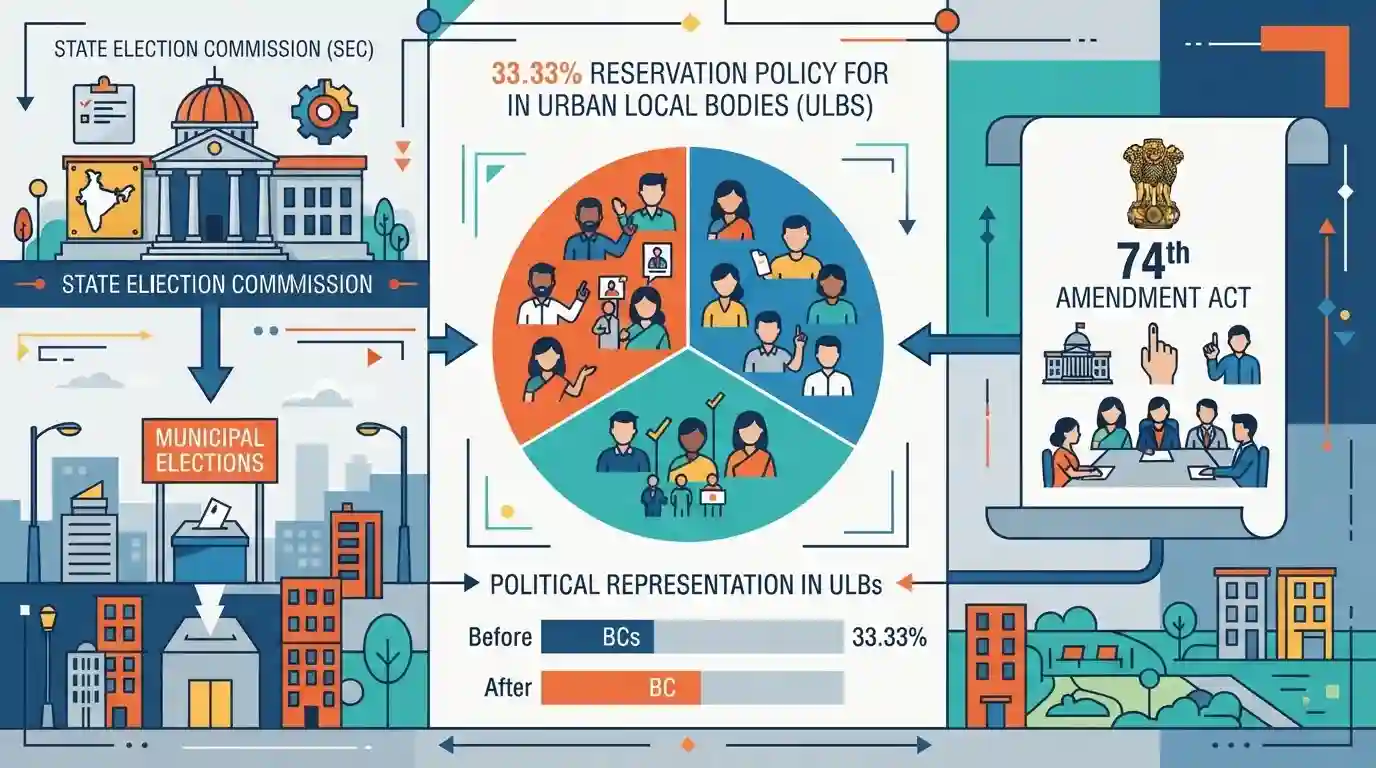
Why It Matters
The provision of reservations for Backward Classes in local bodies is a significant governance issue, often touching upon constitutional limits (such as the Supreme Court's 50% overall cap on reservations) and the triple-test mandate for empirical data. It is crucial for understanding the decentralization of power and state legislative powers under Part IXA of the Constitution.
Summary
The Andhra Pradesh government has approved the conduct of Urban Local Body (ULB) elections with a 33.33% reservation for Backward Classes (BCs). This decision facilitates the much-awaited municipal elections in the state, ensuring substantial political representation for BCs in local urban governance. The move falls under the constitutional framework of the 74th Amendment Act, which grants state legislatures the authority to mandate reservations for backward classes in municipalities.
Key Points
- The Andhra Pradesh government has granted approval to conduct Urban Local Body (ULB) elections with a 33.33% reservation for Backward Classes (BCs).
- This reservation policy aims to ensure adequate political representation for BCs in municipalities and municipal corporations across the state.
- Urban Local Bodies are governed by the 74th Constitutional Amendment Act, which mandates reservations for SCs, STs, and women, while empowering State Legislatures to make provisions for BC reservations.
- The elections will be overseen by the State Election Commission, responsible for the superintendence, direction, and control of electoral rolls and local body elections.
Important Terms
74th Constitutional Amendment Act

A 1992 constitutional amendment that gave statutory recognition to Urban Local Bodies in India by adding Part IXA, standardizing their administration, regular elections, and demographic reservations.
UPSC context
Crucial for APPSC Group 1 and 2 Polity; tests the evolution of local self-government, decentralized administration, and constitutional mandates.
Article 243T
A constitutional provision mandating seat reservations for SCs, STs, and women in municipalities. It explicitly empowers state legislatures to enact additional reservations for backward classes.
UPSC context
Highly relevant for APPSC Polity questions on social justice, affirmative action, and the legal framework governing local body elections.
Urban Local Bodies (ULBs)
Constitutionally recognized local self-governance institutions—including Municipal Corporations, Councils, and Nagar Panchayats—responsible for civic administration, urban planning, and development in cities and towns.
UPSC context
A core APPSC syllabus topic under Indian Polity testing decentralization, regional governance structures, and urban administration mechanisms.
State Election Commission
An independent constitutional body established at the state level to superintend, direct, and control the preparation of electoral rolls and conduct all local body elections.
UPSC context
Vital for APPSC Polity; tests constitutional bodies, electoral processes, and jurisdictional differences between the SEC and the Election Commission of India.
Prelims Trap
"The 74th Constitutional Amendment mandates a minimum reservation for Backward Classes in Urban Local Bodies."
Under the 73rd and 74th Amendments, SC/ST and Women (minimum 1/3rd) reservations are mandatory. Backward Class reservation is entirely discretionary, left to the State Legislature under Article 243T(6).
Static Concepts Connected
How does Article 243T govern reservations in Urban Local Bodies?
- Mandatory SC/ST: Seats must be reserved for SCs and STs in every Municipality in proportion to their population.
- Mandatory Women: Not less than one-third of total seats (including those reserved for SC/ST women) must be reserved for women.
- Discretionary BC: State legislatures have the discretionary power to enact reservations for backward classes (Article 243T(6)).
What are the powers and protections of the State Election Commission (SEC)?
- Constitutional Mandate: Articles 243K and 243ZA vest the SEC with the superintendence, direction, and control of all local body elections.
- Security of Tenure: Though appointed by the Governor, the SEC can only be removed in the same manner and on like grounds as a High Court Judge.
- Jurisdiction Limit: The SEC handles Panchayats and Municipalities, whereas the Election Commission of India (ECI) handles Presidential, Parliamentary, and State Assembly elections.
Cross-Topic Patterns
Political empowerment vs public employment quotas
While Articles 15 and 16 govern education and employment, local body reservations fall under Part IX/IX-A. They aim at "political empowerment" and are subject to the strict 50% ceiling (K. Krishna Murthy case).
SEC autonomy vs State Government influence
APPSC frequently tests the operational independence of the SEC. The State's power to dictate poll scheduling or delimitation versus the SEC's constitutional mandate to conduct elections is a recurring exam theme.

Expect a multi-statement question distinguishing mandatory (SC/ST/Women) vs discretionary (BCs) reservations under the 74th Amendment.
Linked PYQs · 3
Linked PYQs · 3
- 2024APPSC_PRELIMSGS1
Which of the following source/sources of revenue qualifies/qualify for being given to the Panchayats? I. The tax proceeds that are assigned to the States from the Centre may be again re-distributed to the Panchayats as recommended by the Central Finance Commission. II. Loans from the State Government. III. Under Article 243-I of the Constitution of India, the State Government is empowered to devolve its own funds to the Panchayats even in the absence of the State Finance Commission's recommendations. IV. Internal Resource Generation is facilitated only in the case of Panchayats situated in Scheduled Areas as per the Fifth Schedule. Select the correct answer using the codes given below:
- 2024APPSC_PRELIMSGS1
Consider the following Assertion (A) and Reason (R) and choose the correct code : Assertion (A) : In connection with their own resource collection, the Panchayats at the village level are better placed than the Panchayats at the Intermediate and the District levels. Reason (R) : The Gram Panchayats have their own tax domain whereas the other two tiers have to depend only on tolls, fees and non-tax revenue for internal resource generation. Code :
- 2024APPSC_PRELIMSGS1
Which of the following statement/statements can be attributed correctly to the exercise of Delimitation ? I. The principle of 'one man, one vote' reiterates the need for the exercise of Delimitation. II. The Government of India can set up a Delimitation Commission for the purpose of delimitation of Parliamentary and Assembly Constituencies in a select few States or UTs. III. The Delimitation Commission can only recommend the re-delimitation of territorial Parliamentary and Assembly Constituencies but cannot recommend on the reservation of seats for the Scheduled Castes and Scheduled Tribes. IV. The Nodal Ministry for the Delimitation Commission of India is the Ministry of Law and Justice. Select the correct answer using the codes given below :
