Visakhapatnam Economic Region Targets Massive Industrial Investments
Source:economic-times ↗
Why It Matters
Industrial corridors, port-led development (Blue Economy), and green energy policies are high-yield topics for APPSC Group 1 Prelims. The specifics of the Visakhapatnam Economic Region and Viability Gap Funding models directly align with the syllabus on state economy and infrastructure.
Summary
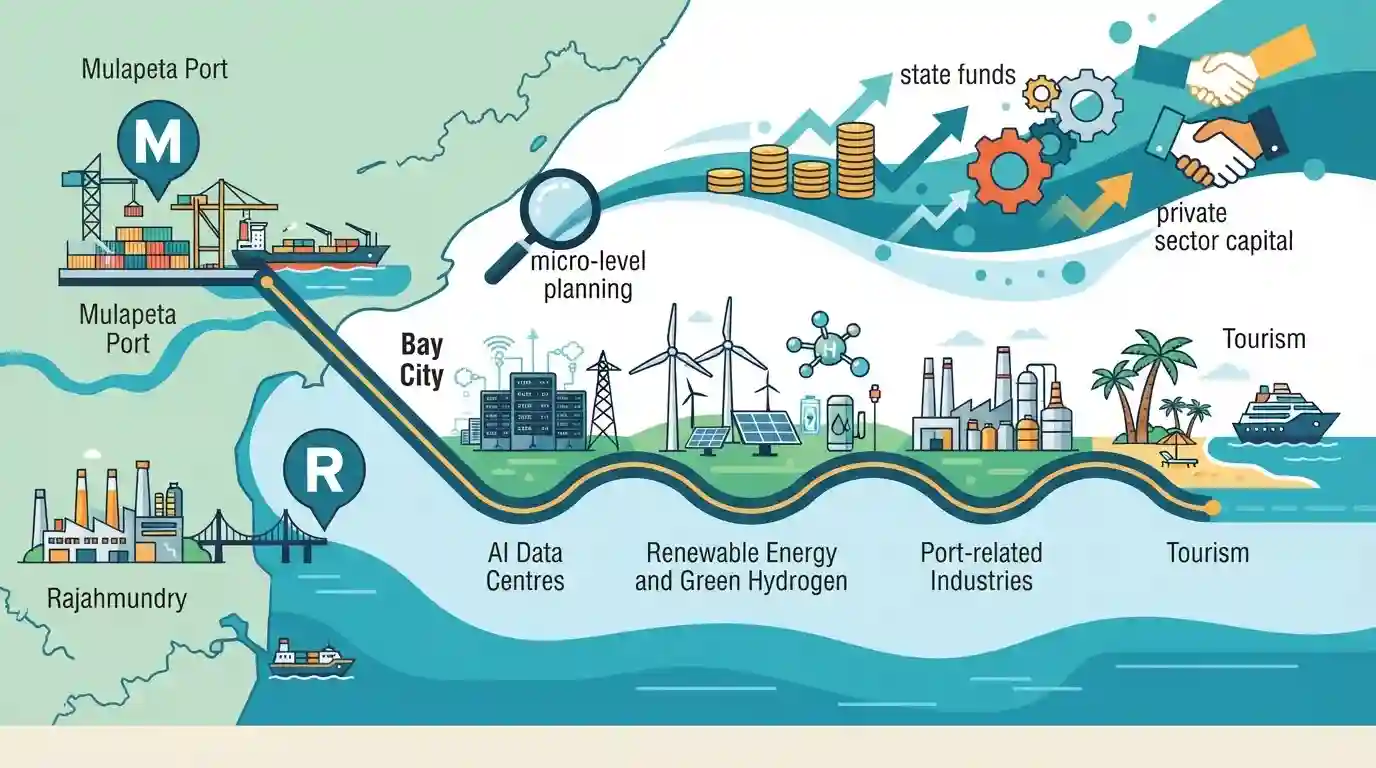
The Andhra Pradesh government has unveiled plans to develop the Visakhapatnam Economic Region (VER) with an anticipated investment of over Rs 9 lakh crore. The project, anchored by the 'Bay City' initiative, will stretch from Mulapeta Port to Rajahmundry. By combining state funds with private sector capital via Viability Gap Funding, the region aims to become a major hub for AI data centres, green hydrogen, clean energy, tourism, and port-related industries. Chief Minister N Chandrababu Naidu has emphasized micro-level planning to maximize the economic potential of this coastal corridor.
Key Points
- The Andhra Pradesh government targets up to Rs 9.3 lakh crore in investments for the new Visakhapatnam Economic Region (VER).
- State investment will be Rs 3.5-4 lakh crore, supplemented by expected private sector investments of Rs 5.3 lakh crore.
- The VER corridor will extend from the Mulapeta Port in Srikakulam to the Akhanda Godavari project in Rajahmundry.
- Key focus sectors include AI data centres, green hydrogen, clean-tech, port-led industrial growth, and tourism, utilizing Viability Gap Funding (VGF) to incentivize private capital.
Important Terms
Viability Gap Funding (VGF)

A financial grant provided by the government to support infrastructure projects that are economically justified but lack immediate financial viability, thereby encouraging private sector investment.
UPSC context
GS Paper III (Infrastructure/Investment Models); tests knowledge of government fiscal support strategies for public-private partnerships.
Public-Private Partnership (PPP)
A collaborative mechanism between government entities and private companies to jointly finance, construct, and operate public assets while sharing risks and responsibilities.
UPSC context
GS Paper III (Investment Models); tests understanding of structural frameworks used to bridge infrastructure funding gaps.
Visakhapatnam Economic Region (VER)
A major coastal development corridor in Andhra Pradesh stretching from Mulapeta Port to Rajahmundry, focused on high-tech industries, clean energy, and tourism.
UPSC context
GS Paper III (Regional Development); tests awareness of state-level economic corridors and industrial cluster initiatives.
Mulapeta Port
An under-construction greenfield deep-sea port in Srikakulam, Andhra Pradesh, designed to expand the state's maritime handling capacity and support regional industrial logistics.
UPSC context
GS Paper III (Infrastructure: Ports); tests knowledge of port-led development, maritime trade routes, and infrastructure growth.
Prelims Trap
Viability Gap Funding (VGF) is an ongoing operational subsidy provided to purely private commercial ventures.
VGF is a one-time capital grant during construction, not an operational subsidy. It is strictly for economically vital Public-Private Partnership (PPP) projects, not pure private commercial businesses.
Static Concepts Connected
What is the Viability Gap Funding (VGF) scheme and how is it structured in India?
- Core Purpose: Provides one-time capital grants to Public-Private Partnership (PPP) infrastructure projects that are economically vital but lack commercial viability.
- Funding Caps: The Central government provides up to 20% of the project cost, which can be matched by an additional 20% from the state.
- Nodal Body: Administered by the Department of Economic Affairs under the Ministry of Finance.
What are the core pillars of India's Sagarmala Programme?
- Port Modernization: Upgrading existing ports and developing new deep-sea greenfield ports to handle higher global trade capacities.
- Port-led Industrialization: Developing coastal economic zones, industrial clusters, and smart cities near ports to minimize manufacturing logistics costs.
- Coastal Connectivity: Integrating road, rail, and inland waterway networks to facilitate seamless, multi-modal coastal transit.
Cross-Topic Patterns
Green Hydrogen + Coastal SEZs
Coastal economic corridors leverage deep-sea port proximity for hydrogen export, aligning maritime logistics with India's National Green Hydrogen Mission.
Data Centres + Coastal Vulnerabilities
Setting up energy-intensive AI data centres on the coast balances high-speed subsea cable access against rising climate risks and cyclonic hazards.

Sub-national economic corridors utilizing VGF for green hydrogen and AI infrastructure will likely feature in Mains GS-3 industrial policy.
Linked PYQs · 4
Linked PYQs · 4
- 2024APPSC_PRELIMSGS1
Which of the following statement/statements is/are incorrect regarding the Andhra Pradesh Industrial Policy 2023 - 27? I. To achieve a minimum contribution of 25% by industry in the State GDP II. To provide end-to-end facilitation in 2 weeks III. To envisage ten (10) priorities of accomplishment IV. To focus on becoming a 'Plug and Play State' for investments V. Ensuring land allotment by APIIC within a period of 2 weeks upon receipt of application Select the answer using the codes given below :
- 2024APPSC_PRELIMSGS1
In connection with transport and infrastructure in Andhra Pradesh, which of the following statement/statements is/are valid? I. Andhra Pradesh's first riverine project has been proposed between Muktayala and Madipadu on Krishna river. II. The Bhogapuram Greenfield International Airport had been started with a corpus fund that is sourced from National Investment and Infrastructure Fund (NIIF). III. Infrastructure investments in Andhra Pradesh are strictly implemented only with reference to strategic investments like ports and industrial corridors, but not with reference to community assets. IV. Rail Over Bridges (ROBs) are being developed in Andhra Pradesh under the Setu Bandhan Scheme. Select the correct answer using the codes given below :
- 2024APPSC_PRELIMSGS1
The Interim Union Budget (FY25) has proposed initiatives to boost India's Green Energy Sector. Which of the following proposals are connected with developing India's Green Energy ? I. Viability Gap Funding (VGF) for utilizing solar energy projects II. To set up coal gasification and liquefaction capacity of 100MT by 2030 III. Optional blending of Compressed Bio Gas (CBG) in Compressed Natural Gas (CNG) for transport and Piped Natural Gas (PNG) for domestic purposes IV. Provision of financial assistance for procurement of biomass aggregation machinery V. Setting up of a payment security system for expanding the bio-manufacturing system in the country Select the correct answer using the codes given below :
- 2024APPSC_PRELIMSGS1
Which of the following statements are valid in connection with Andhra Pradesh Green Hydrogen and Green Ammonia Policy (2023)? I. The objective is to target Green Energy production up to the capacity of 1 MPTA (Million Tonnes Per Annum) or Green Ammonia production up to the capacity of 2-0 MTPA in the next five years. II. New and Renewable Energy Development Corporation of A.P. Ltd (NREDCAP) shall act as a Nodal Agency under this policy. III. All the Ports in the State have infrastructure for storing liquid nitrogen which can then be utilized for storing Green Hydrogen for exporting to other countries. IV. The Policy prohibits the production of Green Hydrogen/Green Ammonia by using Renewable Energy and/or Biomass from 'Third-Party/Power exchange'. Select the correct answer using the codes given below :
