Andhra Pradesh Kharif Paddy Procurement Target and MSP Policy
Source:newindianexpress ↗
Why It Matters
Paddy procurement targets and MSP implementation form a crucial part of agricultural economics and food security management in Andhra Pradesh, directly impacting rural livelihoods and state-level agricultural policy.
Summary
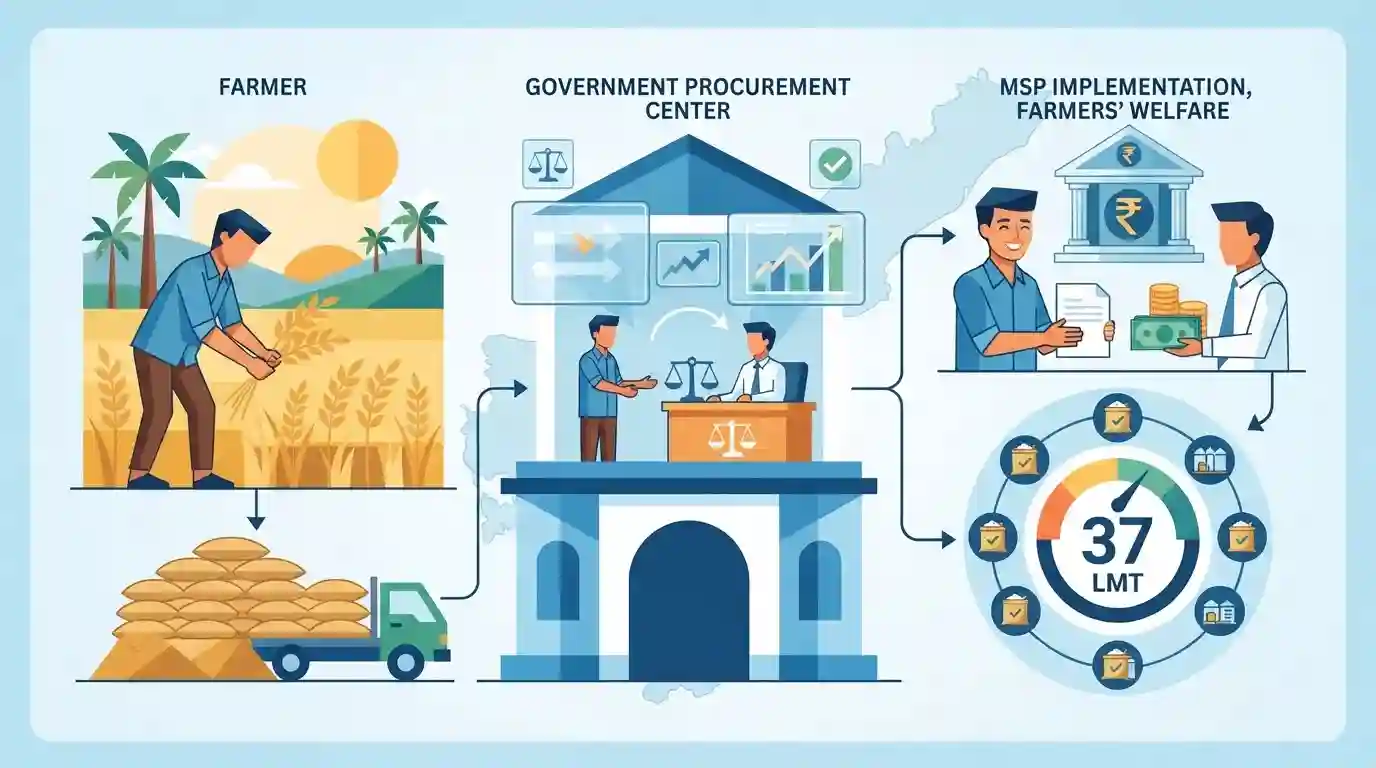
The Andhra Pradesh government has established a target of procuring 37 lakh metric tonnes of paddy for the Kharif season, aiming to protect farmers' interests through transparent procurement and Minimum Support Price (MSP) implementation across the state.
Key Points
- The Andhra Pradesh government has set an ambitious target to procure 37 lakh metric tonnes (LMT) of paddy during the Kharif marketing season.
- The procurement drive aims to ensure that farmers receive the Minimum Support Price (MSP) for their produce without exploitation by intermediaries.
- District administrations and the Civil Supplies Department have been instructed to set up adequate numbers of Rythu Bharosa Kendras (RBKs) or procurement centers to facilitate smooth operations.
- Measures are planned to address moisture content issues and ensure timely payments directly into farmers' bank accounts.
Important Terms
Minimum Support Price (MSP) scheme

A market intervention policy by the Central Government to protect agricultural producers against drastic price drops by guaranteeing a fixed purchase price for crops like paddy.
UPSC context
APPSC Group 1/2: Tests knowledge of agricultural policy, food security, and farmers' welfare mechanisms in the state and nation.
Andhra Pradesh Government
The state-level executive body responsible for policy formulation, administrative governance, and executing welfare schemes, including agricultural procurement targets and MSP implementation across districts.
UPSC context
APPSC Group 1/2 Polity & Economy: Evaluates understanding of state governance, administrative machinery, and welfare policy implementation.
Civil Supplies Department
The state government department tasked with managing food security, public distribution systems, and organizing large-scale foodgrain procurement operations like paddy harvesting seasons.
UPSC context
APPSC Group 2 Economy: Crucial for questions on public distribution, agricultural marketing, and administrative execution of food security in AP.
Prelims Trap
The Food Corporation of India (FCI) directly manages all Rythu Bharosa Kendras for paddy procurement in Andhra Pradesh.
Aspirants often confuse central procurement agencies like FCI with state-level civil supplies departments executing decentralized procurement drives through RBKs.
Static Concepts Connected
What are the key institutional mechanisms and pricing guidelines for paddy procurement in India?
- CACP Mandate: MSP recommendation body: The Commission for Agricultural Costs and Prices (CACP) recommends MSPs for 22 mandated crops plus sugarcane (FRP).
- DCP Scheme: Decentralised Procurement: States procure foodgrains on behalf of FCI, reducing transit losses and promoting local crop varieties.
- RBK Role: AP implementation: Rythu Bharosa Kendras (RBKs) function as one-stop shops for agri-inputs and grassroot procurement validation.
Cross-Topic Patterns
RBKs and Decentralised Food Procurement Models
Rythu Bharosa Kendras serve as integrated agricultural input-cum-procurement hubs, bridging grassroots welfare delivery with centralized food security procurement chains under AP state reorganisation frameworks.
DBT in Agricultural MSP Operations
Direct Benefit Transfers (DBT) for MSP payments connect AP state agricultural fiscal management with national digital public infrastructure and financial inclusion goals.

APPSC frequently asks specific quantitative targets and institutional mechanisms like RBKs for state agricultural procurement schemes.
Linked PYQs · 2
Linked PYQs · 2
- 2023APPSC_PRELIMSGS1
Government of Andhra Pradesh is implementing YSR Rythu Bharosa - PM Kisan Scheme for the benefit of farmers of Andhra Pradesh. Which of the following statements are correct about the above scheme ?
- 2024APPSC_PRELIMSGS1
In the context of India's fight against poverty, consider the following statements: I. Unlike the Global Multidimensional Poverty Index (MPI), the National Multidimensional Poverty Index (MPI) developed by NITI Aayog does not make use of 'Alkire-Foster' (AF) methodology. II. The urban population witnessed a larger decline in poverty as compared to the rural population. III. Pradhan Mantri Garib Kalyan Package (PMGKP) includes the coverage of food grain entitlements. IV. The Multidimensional Poverty Index (MPI) is computed by adding the incidence of multidimensional poverty and the intensity of poverty. Which of the above statement/statements is/are valid?
