Andhra Pradesh secures Rs 2,447 crore under National Health Mission
Source:economic-times ↗
Why It Matters
The article highlights the operational framework and financial structure (60:40 ratio) of the National Health Mission, an essential centrally sponsored scheme. It serves as a practical example of cooperative federalism in action while enumerating key national healthcare initiatives like JSY, JSSK, and Anaemia Mukt Bharat, which are crucial for Prelims and Mains (GS2) questions on health interventions and maternal/child mortality.
Summary
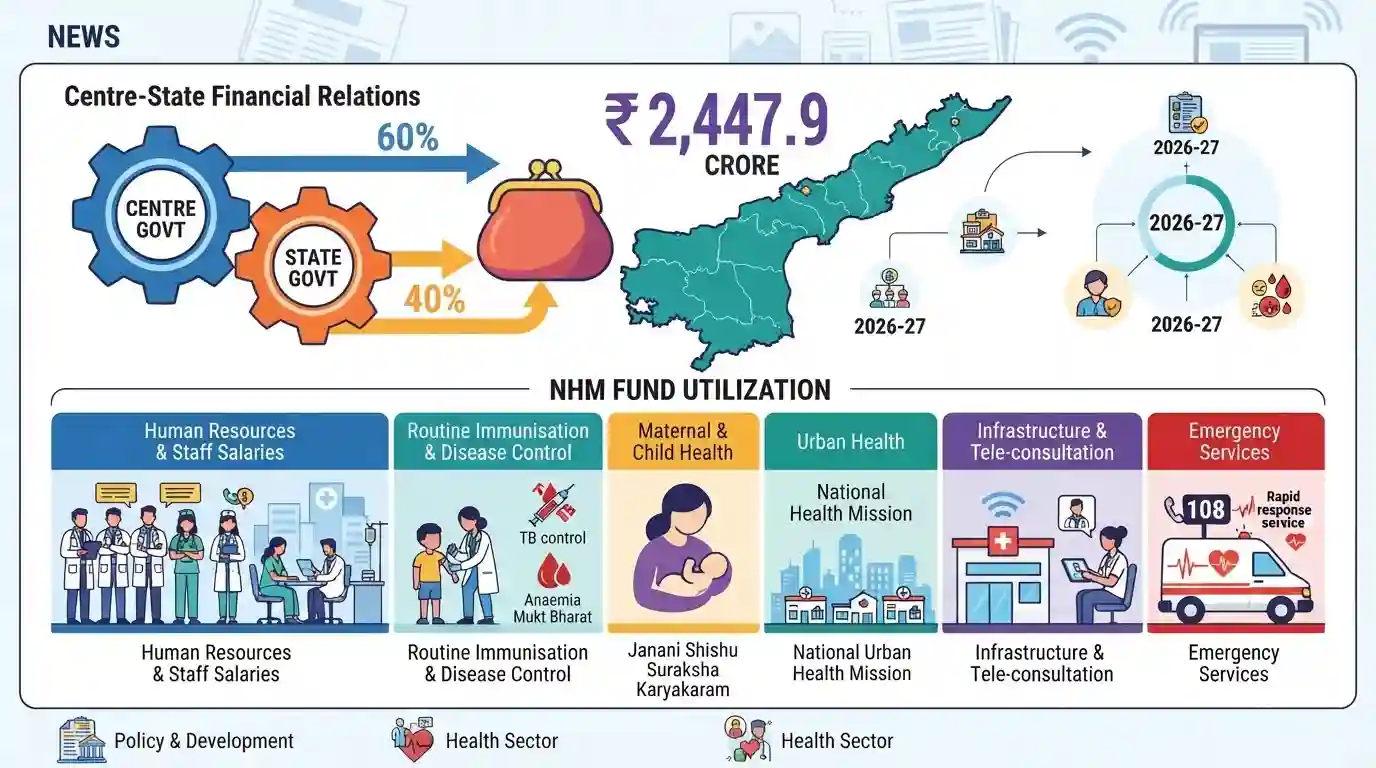
Andhra Pradesh has secured a total allocation of Rs 2,447.9 crore under the National Health Mission (NHM) for 2026-27, operating on a 60:40 funding ratio between the Centre and the State. State Health Minister Satya Kumar Yadav noted that the highest allocation focuses on human resources and staff salaries. The funds will sustain vital health initiatives such as routine immunisation, TB control, Anaemia Mukt Bharat, Janani Shishu Suraksha Karyakaram, and the National Urban Health Mission. Additionally, the allocation covers infrastructure maintenance, tele-consultation facilities, STEMI protocol implementation, and the functioning of 108 ambulance services across the state.
Key Points
- Andhra Pradesh has been allocated a total envelope of Rs 2,447.9 crore under the National Health Mission (NHM) for the financial year 2026-27.
- The funding follows a 60:40 Centre-State sharing ratio, comprising Rs 1,468.7 crore from the Centre and Rs 979.1 crore from the State.
- A major portion of the allocated funds is earmarked for human resources and staff salaries to bolster healthcare delivery.
- Key healthcare programmes funded under this allocation include routine immunisation, TB control, Janani Shishu Suraksha Karyakaram, Janani Suraksha Yojana, Anaemia Mukt Bharat, and the National Urban Health Mission.
- The funds will also support infrastructure maintenance, tele-consultations, STEMI medicines, health and wellness centres (HWCs), and the 108 ambulance service.
Important Terms
National Health Mission (NHM)

A flagship centrally sponsored scheme by the Ministry of Health and Family Welfare providing equitable, affordable, and quality healthcare. It encompasses rural and urban sub-missions, funding health infrastructure, human resources, and disease control programs.
UPSC context
GS Paper 2 (Health, Social Sector). Tests knowledge of major Centre-State healthcare schemes, public health infrastructure, and funding mechanisms.
Janani Shishu Suraksha Karyakaram (JSSK)
An initiative entitling all pregnant women delivering in public health institutions to absolutely free, cashless services, including C-sections. It also provides free transport, diet, diagnostics, and treatment for sick newborns up to 30 days.
UPSC context
GS Paper 2 (Health, Women & Child Development). Tests understanding of maternal mortality reduction, out-of-pocket expenditure elimination, and reproductive health.
National Urban Health Mission (NUHM)
A sub-mission of the National Health Mission addressing the primary healthcare needs of the urban poor and slum dwellers. It establishes Urban Primary Health Centres and utilizes community health workers to make services accessible.
UPSC context
GS Paper 2 (Health, Vulnerable Sections). Evaluates knowledge of urban governance, public health disparities, and targeted healthcare for marginalized populations.
Anaemia Mukt Bharat
Launched under POSHAN Abhiyaan, this MoHFW strategy aims to reduce anaemia prevalence by 3% annually in children, adolescents, and women through a 6x6x6 strategy involving targeted interventions like iron-folic acid supplementation and deworming.
UPSC context
GS Paper 2 (Health, Nutrition). Tests awareness of nutritional deficiencies, public health targets, and government strategies for maternal and child health.
Prelims Trap
"Janani Shishu Suraksha Karyakaram (JSSK) provides direct cash transfers for institutional deliveries."
JSSK ensures absolutely free, cashless delivery services (drugs, transport, diet). It is JSY (Janani Suraksha Yojana) that provides the direct cash incentive.
Static Concepts Connected
How do Centrally Sponsored Schemes (CSS) differ from Central Sector Schemes?
- CSS Funding: Funded jointly by Centre and States (usually 60:40 for general states like AP). NHM falls in this category.
- Central Sector Funding: 100% funded by the Union Government.
- Implementation: Both are usually executed by State Governments, but CSS typically pertains to subjects in the State or Concurrent List (like Health).
What are the core differences between JSY and JSSK?
- JSY (Cash Incentive): Janani Suraksha Yojana provides a direct benefit cash transfer to pregnant women to incentivize institutional deliveries.
- JSSK (Cashless Services): Janani Shishu Suraksha Karyakaram provides cashless entitlements (free drugs, diagnostics, diet, and transport) with zero out-of-pocket expenditure.
- Infant Coverage: JSSK also covers sick infants up to 1 year of age, expanding beyond just the maternal delivery period.
Cross-Topic Patterns
Health funding + Centre-State Finances
Funding constraints often limit healthcare delivery. NHM's 60:40 ratio forces states to match funds, directly linking public health capacity to AP’s fiscal consolidation and broader Centre-State financial relations.
Golden Hour interventions + NCD management
The STEMI protocol bridges emergency transport (108 ambulances) with high-end pharmaceuticals, reflecting a policy shift from basic maternal/child health toward managing critical non-communicable diseases (NCDs) like heart attacks.

Expect a multi-statement question contrasting JSY's cash incentives with JSSK's cashless entitlements under the broad NHM umbrella.
Linked PYQs · 2
Linked PYQs · 2
- 2024APPSC_PRELIMSGS1
In the context of Central Government programmes, which one of following statement/statements is/are incorrect ? I. The objective of Pradhan Mantri Anusuchit Jaati Abhyuday Yojana (PM-AJAY) is aimed at reducing poverty of the ST communities by generating additional employment opportunities. II. Under the Pradhan Mantri Shram Yogi Maan-dhan Yojana (PM-SYM), monthly contribution is payable by the beneficiary, the State Government and the Central Government. III. Under the 'FutureSkills Prime' Programme, Centre for Development of Advanced Computing (C-DAC) is the key implementing agency. IV. Mission Karmayogi comprises of eight key pillars that are intended to create functional and behavioural competencies among the civil servants. Select the answer using the codes given below :
- 2023APPSC_PRELIMSGS1
Which of the bodies recommends the distribution of the net proceeds of taxes to be shared between the Centre and the States, and allocation between the States, the respective shares of such proceeds?
