Andhra Pradesh Industrial Green Cover Environmental Policy Mandate
Source:theprint ↗
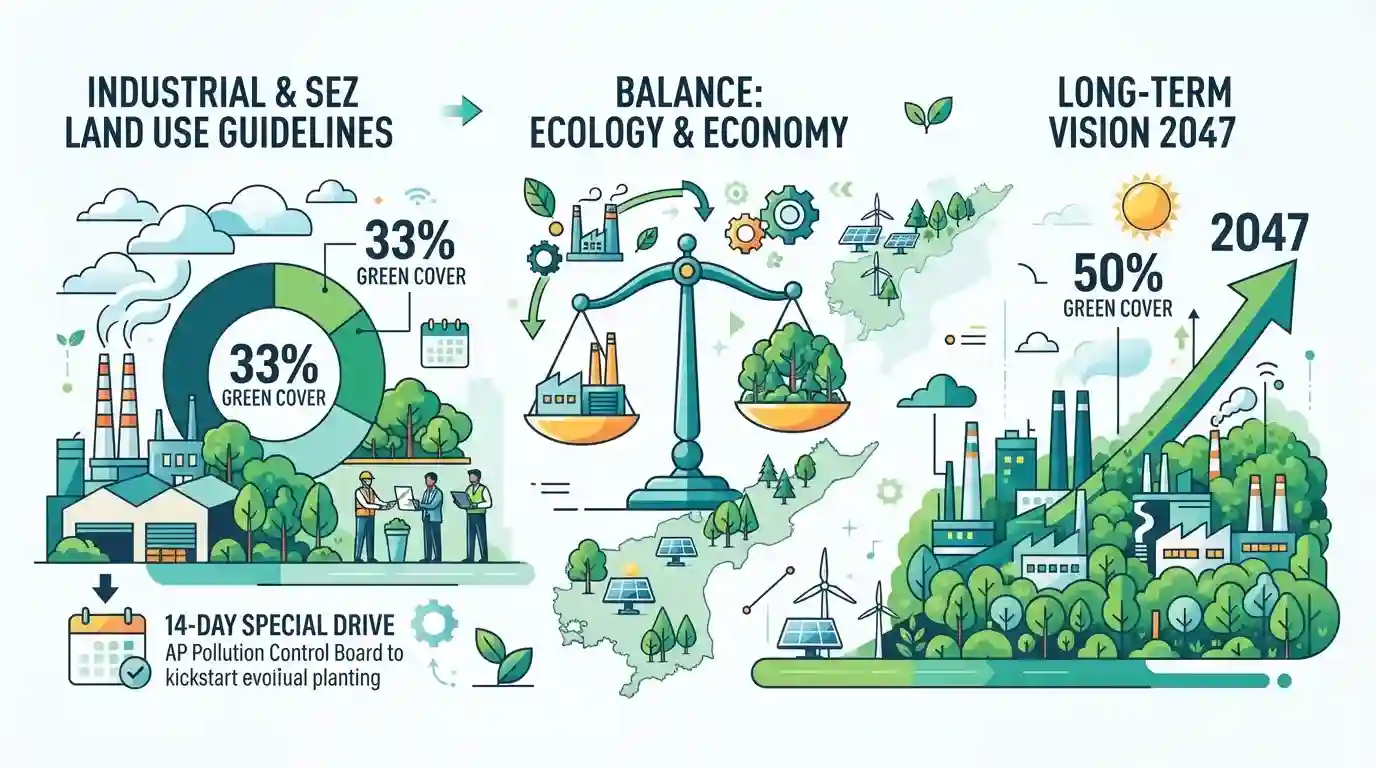
Why It Matters
This directive represents a significant policy push toward combining industrialization with sustainable ecological measures at the state level. It highlights regional attempts to meet environmental conservation goals (like the 33% standard derived from national forest policy targets) and aligns AP state industrial governance with green norms, which is a key focus area for APPSC Group 1 Prelims.
Summary
Andhra Pradesh Deputy CM Pawan Kalyan has urged industries and Special Economic Zones (SEZs) in the state to implement a minimum of 33% green cover on their premises, aligning with Pollution Control Board guidelines. Highlighting the balance between industrialization and ecology, he also set a long-term target of 50% green cover by 2047. The initiative comes following a 14-day special drive by the AP Pollution Control Board to improve green cover across select industries.
Key Points
- Andhra Pradesh Deputy CM Pawan Kalyan (holding the environment portfolio) has called on all industries in the state to implement at least 33% green cover on their premises.
- The directive aligns with the Pollution Control Board's guidelines, emphasizing that environmental conservation is as crucial as industrialization.
- A long-term target of achieving 50% green cover by the year 2047 has been proposed for the industrial premises.
- According to 2026 statistics, there are 3,400 industries spread across thousands of acres in Andhra Pradesh, all of which—including those in Special Economic Zones (SEZs)—are urged to comply.
- The state's Pollution Control Board recently executed a 14-day special drive to expand green cover across 26 industries spanning 129 acres.
Important Terms
Andhra Pradesh Pollution Control Board (APPCB)

A statutory body established in 1976 under the Water Act to implement environmental laws, regulate industrial emissions, and control pollution in Andhra Pradesh.
UPSC context
APPSC Paper-III (AP Economy & Environment); tests environmental governance and state-level pollution control mechanisms.
AP-GREEN
(Andhra Pradesh Society for Greening and Reforestation for Ecological Enrichment) An autonomous, state-level non-profit society formed in 2026 to lead afforestation and achieve 50% green cover by 2047.
UPSC context
APPSC Paper-III (AP Economy & Environment); tests understanding of ecological initiatives and sustainable state-level development plans.
Special Economic Zones (SEZs)
Specially delineated duty-free enclaves treated as foreign territories for trade and customs purposes, designed to boost exports, attract investment, and generate employment.
UPSC context
APPSC Paper-III (Indian & AP Economy); tests knowledge of industrial policies, infrastructure development, and trade enclaves.
National Forest Policy, 1988
An Indian environmental policy targeting a minimum of 33% of the total land area under forest or tree cover to maintain ecological stability and environmental balance.
UPSC context
APPSC Paper-I (Geography & Environment); tests awareness of national conservation guidelines and target forest covers.
Prelims Trap
Andhra Pradesh has already achieved 33% forest cover and is targeting 50% for all industries.
AP's actual notified forest area is currently 22.96%. The 33% is an interim target for 2030 and an immediate APPCB industrial mandate.
Static Concepts Connected
What is AP-GREEN and how does it drive state-wide ecological restoration?
- Institutional Mandate: Stands for Andhra Pradesh Society for Greening and Reforestation for Ecological Enrichment, coordinating multi-departmental plantation drives.
- Three-tier Governance: Operates under a structured three-tier system to manage grass-roots implementation up to state-level monitoring.
- Target Segments: Focuses on enhancing tree cover outside traditional forest areas, targeting industries, highways, and farm forestry.
What is the Coastal Great Green Wall of Andhra Pradesh?
- Objective and Scale: A planned 5-km wide natural green shield along AP's coastline to mitigate erosion and severe cyclone risks.
- Geographical Cover: Spans across the state's 1,053 km coastline, combining mangrove restoration with windbreak plantations.
- Livelihood Integration: Employs community-led agro-forestry to combine ecological protection with local sustainable livelihoods.
Cross-Topic Patterns
AP Industrial Policy vs. APPCB Norms
Integrates AP's Industrial Policy with environmental compliance, forcing SEZs to balance ease of doing business with strict APPCB green-belt regulations.
Coastal Green Wall + Cyclone Resilience
Aligns the Coastal Great Green Wall with the Union's MISHTI scheme, leveraging blue carbon credits for state disaster management.

AP's current forest cover (22.96%) contrasted against the 2047 target (50%) and AP-GREEN is highly likely for a Group I/II statement-type Q.
Linked PYQs · 3
Linked PYQs · 3
- 2024APPSC_PRELIMSGS1
Which of the following statement/statements is/are incorrect regarding the Andhra Pradesh Industrial Policy 2023 - 27? I. To achieve a minimum contribution of 25% by industry in the State GDP II. To provide end-to-end facilitation in 2 weeks III. To envisage ten (10) priorities of accomplishment IV. To focus on becoming a 'Plug and Play State' for investments V. Ensuring land allotment by APIIC within a period of 2 weeks upon receipt of application Select the answer using the codes given below :
- 2024APPSC_PRELIMSGS1
Which of the following statements are valid in connection with Andhra Pradesh Green Hydrogen and Green Ammonia Policy (2023)? I. The objective is to target Green Energy production up to the capacity of 1 MPTA (Million Tonnes Per Annum) or Green Ammonia production up to the capacity of 2-0 MTPA in the next five years. II. New and Renewable Energy Development Corporation of A.P. Ltd (NREDCAP) shall act as a Nodal Agency under this policy. III. All the Ports in the State have infrastructure for storing liquid nitrogen which can then be utilized for storing Green Hydrogen for exporting to other countries. IV. The Policy prohibits the production of Green Hydrogen/Green Ammonia by using Renewable Energy and/or Biomass from 'Third-Party/Power exchange'. Select the correct answer using the codes given below :
- 2023APPSC_PRELIMSGS1
According to the Indian Forest Act, 1927, which of the following is the most appropriate sequence which shows the degree of protection between different forest types ?
