Annadata Sukhibhava PM Kisan: Direct Benefit Transfer Payout
Source:theprint ↗
Why It Matters
Highlights the integration of Centrally Sponsored Schemes (like PM-Kisan) with state-level welfare programs to augment income support for farmers, a critical theme in governance and social justice for APPSC Prelims.
Summary
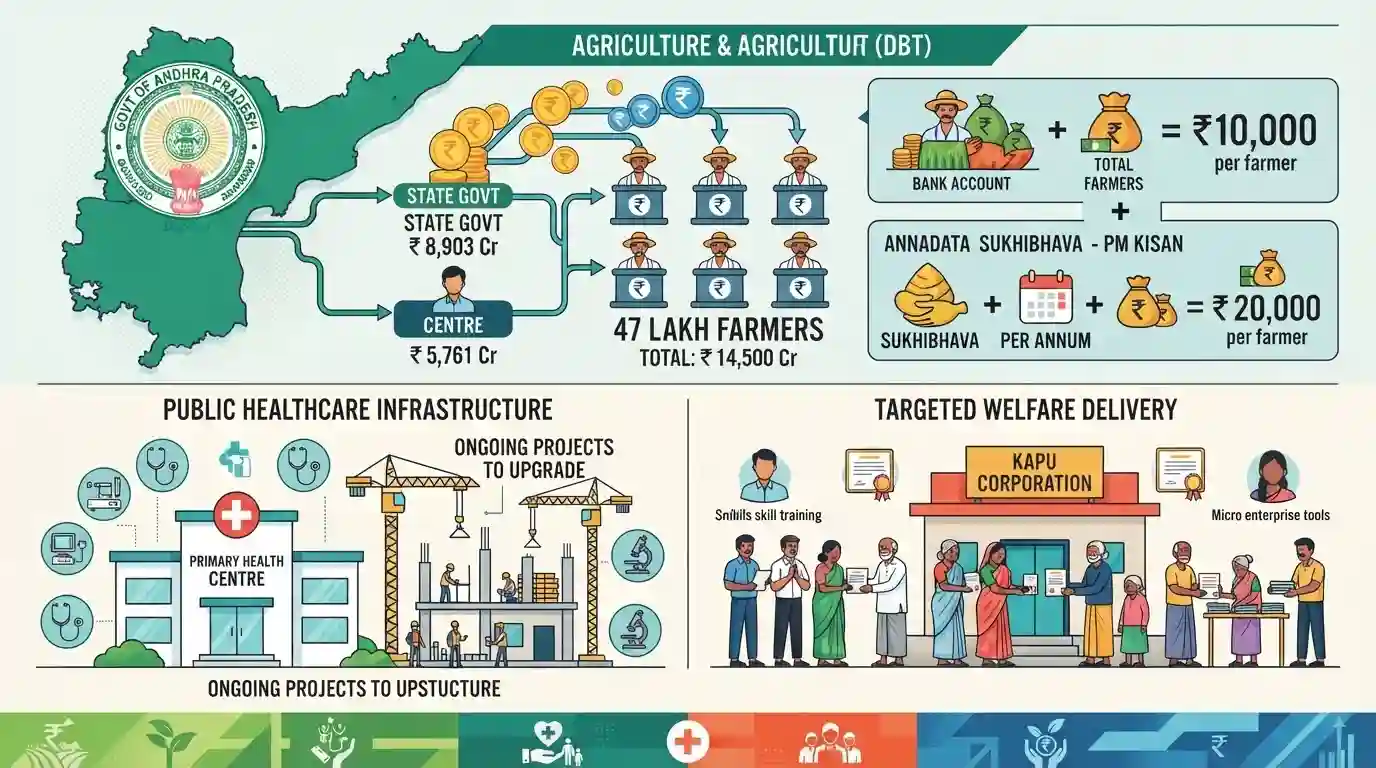
The Andhra Pradesh government has credited over Rs 14,500 crore directly into the bank accounts of 47 lakh farmers under the Annadata Sukhibhava-PM Kisan scheme, which provides Rs 20,000 per annum in financial aid. The payout features a substantial state contribution of Rs 8,903 crore alongside the Centre's Rs 5,761 crore. In tandem with agricultural support, state ministers emphasized ongoing projects to upgrade grassroots healthcare infrastructure via new Primary Health Centres and targeted welfare delivery through the Kapu Corporation.
Key Points
- The Andhra Pradesh government credited Rs 14,664 crore to 47 lakh farmers under the combined Annadata Sukhibhava-PM Kisan scheme.
- The scheme provides an enhanced annual financial assistance of Rs 20,000 to eligible farmers.
- The state's share in the recent disbursement amounted to Rs 8,903 crore, while the Centre's share was Rs 5,761 crore.
- The state is expanding public health infrastructure through the ongoing construction of Primary Health Centres (PHCs), Urban PHCs, and Village Health Clinics (VHCs).
- Targeted welfare benefits are being extended to backward classes through initiatives like the Kapu Corporation.
Important Terms
Annadata Sukhibhava Scheme

The "Annadata Sukhibhava" scheme is an Andhra Pradesh state government program that provides direct financial assistance to farmers. Together with the PM-KISAN scheme, it provides ₹20,000 annually per eligible farmer family.
UPSC context
Tests AP State Welfare Governance and Agriculture topics, specifically state interventions for farmer income support and integration with central schemes.
PM-Kisan Scheme
Pradhan Mantri Kisan Samman Nidhi (PM-KISAN) is a Central Sector Scheme providing income support of ₹6,000 per year to landholding farmer families across India, transferred via Direct Benefit Transfer.
UPSC context
Important for National Agriculture and Welfare Schemes. Candidates should know its funding structure, eligibility criteria, and integration with state programs.
Direct Benefit Transfer (DBT)
Direct Benefit Transfer (DBT) is an anti-poverty program mechanism by the Government of India that transfers subsidies and financial aid directly into the bank accounts of beneficiaries, reducing leakage and intermediaries.
UPSC context
A core component of Governance and Economy topics, highlighting transparency, technology in governance, and efficient subsidy delivery mechanisms.
Kapu Corporation
The Kapu Corporation (officially the AP Kapu Welfare and Development Corporation) is an Andhra Pradesh government body focused on the welfare, social, and economic development of the Kapu, Balija, Telaga, and Ontari communities.
UPSC context
Relevant for AP State Social Justice and Welfare Administration, highlighting targeted community development and affirmative action within the state.
Prelims Trap
"Annadata Sukhibhava is a purely State-funded scheme providing Rs 20,000 annually to farmers."
The Rs 20,000 payout is a combined figure. PM-KISAN (Central Sector) provides Rs 6,000, while the State tops it up with Rs 14,000 under Annadata Sukhibhava.
Static Concepts Connected
What distinguishes Central Sector Schemes from Centrally Sponsored Schemes?
- Central Sector: 100% funded and implemented by the Union Government (e.g., PM-KISAN).
- Centrally Sponsored: Jointly funded by the Centre and States (variable ratios), but primarily implemented by State governments.
What is the three-tier rural public health infrastructure system in India?
- Sub-Centres: The most peripheral contact point (like AP's VHCs), typically serving a population of 5,000 (3,000 in hilly/tribal areas).
- Primary Health Centres: The first referral unit for 6 Sub-Centres, serving a population of 30,000 (20,000 in hilly/tribal areas) with an assigned medical officer.
- Community Health Centres: 30-bed hospitals equipped with specialists, serving as referrals for 4 PHCs (roughly 1.2 lakh population).
Cross-Topic Patterns
DBTs and AP's Fiscal Constraints
Combined farmer support schemes heavily inflate the state's revenue expenditure, often tested in AP Economy alongside FRBM Act compliance, revenue deficits, and the debt-to-GSDP ratio.
Caste-based Welfare Corporations
AP uses statutory corporations (like Kapu Corporation) to channel skill and economic schemes. This links AP Economy topics directly to the Social Justice and AP Society syllabus.

Expect multi-statement questions testing the exact State/Centre funding split (14k/6k) and eligibility criteria for Annadata Sukhibhava.
Linked PYQs · 2
Linked PYQs · 2
- 2023APPSC_PRELIMSGS1
Government of Andhra Pradesh is implementing YSR Rythu Bharosa - PM Kisan Scheme for the benefit of farmers of Andhra Pradesh. Which of the following statements are correct about the above scheme ?
- 2024APPSC_PRELIMSGS1
Which of the following statements are valid regarding the interventions of the Government of Andhra Pradesh in the context of Healthcare ? I. Telemedicine facility is available in all Ayushman Bharat Health and Wellness Centres (AB-HWCs) to avail specialist services through district hub. II. The Family Doctor Programme has been planned to be implemented as a standalone project without the need to be integrated with Primary Health Centres (PHCs). III. Dr. YSR Aarogyasri Scheme has been revamped, by increasing the income limit from ₹ 2.5 lakh to ₹ 5 lakh per annum per family. IV. 'Aarogya Aasara' Scheme is intended to provide post-operative sustenance allowance with certain eligible conditions complied with. Select the correct answer using the codes given below :
