Amaravati greenfield capital city infrastructure project deadlines
Source:economic-times ↗
ఇది ఎందుకు ముఖ్యం
The development of Amaravati is a cornerstone of Andhra Pradesh's economic and urban strategy following the state's bifurcation. It represents one of India's largest greenfield urban infrastructure and land pooling projects, highly relevant for APPSC questions on state-specific geography, economy, and infrastructure planning.
సారాంశం
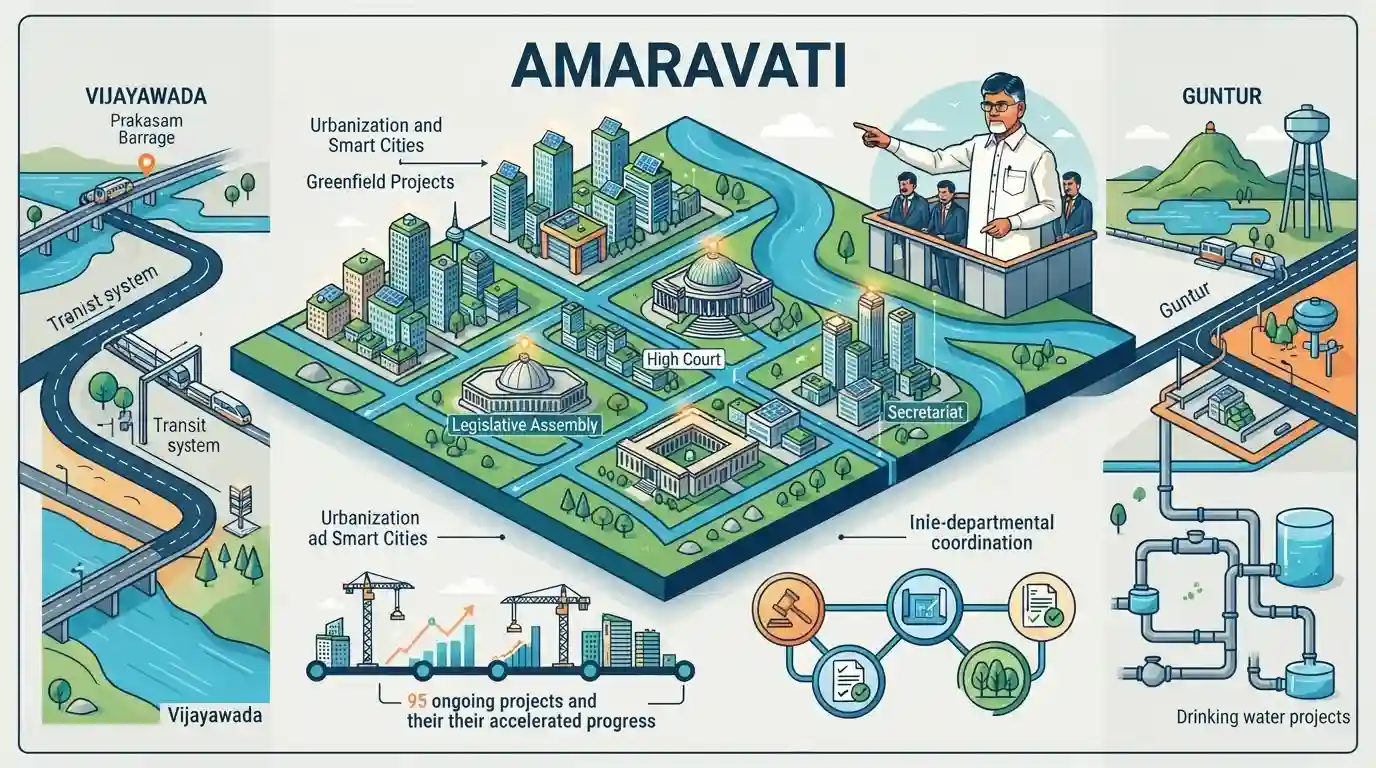
Andhra Pradesh Chief Minister N Chandrababu Naidu has instructed officials to accelerate the construction and development of Amaravati, the state's greenfield capital city. During a comprehensive review of 95 ongoing projects estimated at Rs 50,999 crore, the CM prioritized the swift completion of crucial administrative buildings such as the Legislative Assembly, High Court, and Secretariat. He emphasized seamless inter-departmental coordination to clear technical and legal hurdles, resolve land acquisition issues, and secure environmental clearances. Furthermore, Naidu highlighted the strategic need to integrate Amaravati with neighboring cities like Vijayawada and Guntur, pushing for comprehensive urban planning, robust transport networks, and drinking water projects to foster holistic regional development.
ముఖ్య అంశాలు
- Andhra Pradesh Chief Minister N Chandrababu Naidu has ordered the fast-tracking of construction work for the Amaravati greenfield capital city.
- The state government is reviewing 95 major infrastructure projects in Amaravati with a combined estimated cost of Rs 50,999 crore.
- Top priority has been assigned to completing critical administrative infrastructure, including the State Secretariat, Legislative Assembly, and High Court complexes.
- The Chief Minister emphasized the integration of Amaravati with neighboring urban centers like Vijayawada and Guntur to ensure holistic regional planning and development.
- Officials have been directed to swiftly resolve any pending legal, technical, and environmental clearance issues related to land acquisition and project funding.
ముఖ్యమైన పదాలు
Amaravati Greenfield Capital Project

Amaravati is the newly planned, greenfield capital city of Andhra Pradesh. Built from scratch on the banks of the Krishna River, it integrates sustainable urban design, administrative infrastructure, and natural flood management.
UPSC context
Relevant for GS1 (Urbanization) and GS3 (Infrastructure). It serves as a test case for large-scale planned greenfield urban development.
Land Pooling Scheme
A voluntary land consolidation mechanism where landowners surrender land to a development agency in exchange for a portion of the fully developed residential or commercial plots, avoiding forced evictions and ensuring fair compensation.
UPSC context
Crucial for GS3 (Land Reforms). It tests alternatives to traditional, conflict-prone land acquisition methods in large infrastructure projects.
Andhra Pradesh Capital Region Development Authority (APCRDA)
A statutory urban planning agency established to plan, coordinate, and execute the development of the Amaravati Capital Region. It manages the land pooling scheme, infrastructure projects, and inter-departmental clearances.
UPSC context
Important for GS2 (Statutory Bodies) and GS3 (Urban Planning). Demonstrates the institutional framework required to implement massive greenfield mega-city projects.
ప్రిలిమ్స్ ఉచ్చు
The Sivaramakrishnan Committee recommended developing Amaravati as a single greenfield super-city capital.
The central government-appointed Sivaramakrishnan Committee explicitly opposed a 'single super city' model due to environmental and economic concerns, recommending decentralized governance instead.
అనుసంధానమైన స్థిర భావనలు
What are the key characteristics of the Amaravati School of Art?
- Indigenous Patronage: Flourished in the Krishna-Godavari valley under the patronage of the Satavahanas and Ikshvakus, representing completely indigenous development without foreign influence.
- Material and Themes: Extensively utilized white marble. It focused on dynamic narrative art depicting the Jataka tales and events from Buddha's life.
- Mahayana Influence: Reflects the transition to Mahayana Buddhism, depicting the Buddha both in human form and through earlier symbols like the Bodhi tree and footprints.
How does a Land Pooling Scheme (LPS) differ from traditional land acquisition?
- Voluntary Participation: Landowners voluntarily transfer ownership rights to a development authority, contrasting with the coercive state-driven acquisition under eminent domain principles.
- Return of Developed Land: Instead of just cash compensation, owners are given back a smaller fraction of fully developed land equipped with urban infrastructure, which commands a higher market value.
- Reduced Fiscal Burden: It minimizes the massive upfront cash expenditure for the state and bypasses the prolonged litigation often seen under the 2013 Land Acquisition Act.
అంతర-అంశ నమూనాలు
AP Reorganisation Act & Federal Friction
With Hyderabad's joint capital status ending in 2024, unresolved institutional asset divisions under Schedules 9 & 10 of the AP Reorganisation Act remain a persistent federal flashpoint.
Land Pooling vs. Land Acquisition
Amaravati bypassed the 2013 Land Acquisition Act by successfully executing a massive Land Pooling Scheme (LPS), a model now widely studied for overcoming infrastructure bottlenecks.

Amaravati's revival makes the AP Reorganisation Act, land pooling mechanisms, and Satavahana-era Buddhist art prime targets for 2026.
అనుసంధాన PYQలు · 4
అనుసంధాన PYQలు · 4
- 2024APPSC_PRELIMSGS1
In connection with transport and infrastructure in Andhra Pradesh, which of the following statement/statements is/are valid? I. Andhra Pradesh's first riverine project has been proposed between Muktayala and Madipadu on Krishna river. II. The Bhogapuram Greenfield International Airport had been started with a corpus fund that is sourced from National Investment and Infrastructure Fund (NIIF). III. Infrastructure investments in Andhra Pradesh are strictly implemented only with reference to strategic investments like ports and industrial corridors, but not with reference to community assets. IV. Rail Over Bridges (ROBs) are being developed in Andhra Pradesh under the Setu Bandhan Scheme. Select the correct answer using the codes given below :
- 2024APPSC_PRELIMSGS1
In connection with the Urban Infrastructure Development Fund (UIDF), which of the following statement/statements is/are valid? I. The fund will be established through reserved bonds taken from the G-Sec market. II. The fund is to be exclusively availed by private agencies to create urban infrastructure in Tier 2 and Tier 3 cities. III. Eligible activities for UIDF shall be connected to the Missions and Programmes of the Ministry of Housing | Urban Affairs (MoHUA). IV. The fund will be collectively managed by a cluster of Municipal Cooperative Banks. Select the correct answer using the codes given below:
- 2024APPSC_PRELIMSGS1
Which of the following statement/statements is/are valid regarding the National Infrastructure Pipeline (NIP)? I. NIP includes only economic infrastructure projects but not social infrastructure projects. II. NIP is aimed to focus on key greenfield projects alone. Brownfield projects are excluded from the NIP's coverage. III. NIP aims to offer investment opportunities in India's infrastructure sector, and to attract investments into India. IV. India Investment Grid (IIG) as a platform has ceased to facilitate the NIP and instead 'Invest India' is presently facilitating NIP. Select the correct answer using the codes given below:
- 2023APPSC_PRELIMSGS1
How many Schedules are there in the Andhra Pradesh Reorganisation Act?
