Amaravati Connectivity Boosted with New Seed Access Road and Bridge
Source:theprint ↗
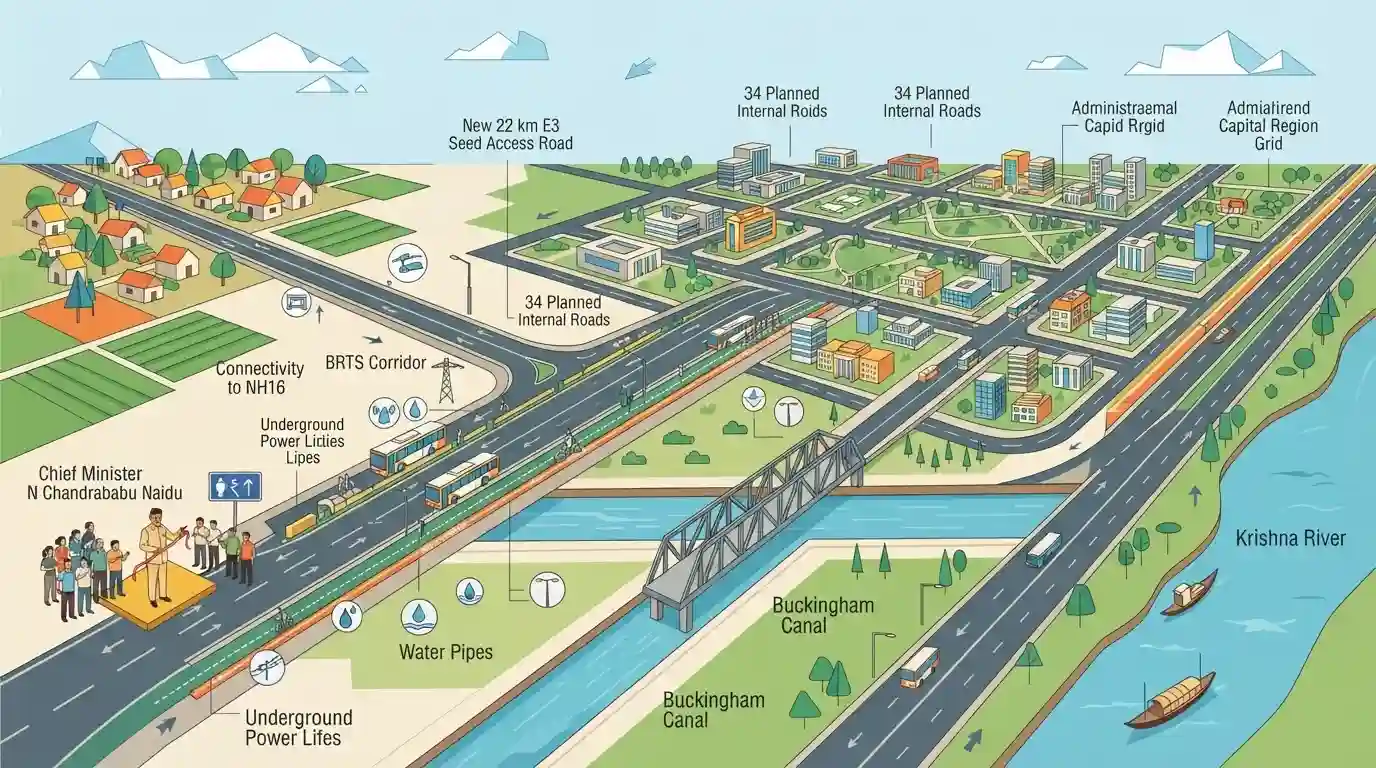
Why It Matters
Highlights the regional geographical landmarks (Buckingham Canal, Krishna River) and the execution of major trunk infrastructure projects crucial for the development of Amaravati as a greenfield capital city.
Summary
Andhra Pradesh Chief Minister N Chandrababu Naidu will inaugurate crucial infrastructure linking the greenfield capital Amaravati, including the E3 seed access road and a steel bridge over the Buckingham Canal. The 22 km access road, built for Rs 1,520 crore, connects key villages to NH16 and features advanced urban utilities, a cycle track, and a BRTS corridor. This network will ease congestion along the Krishna River and integrate a grid of 34 roads planned within the capital region.
Key Points
- Andhra Pradesh CM N Chandrababu Naidu is set to inaugurate the E3 seed access road and a steel bridge, bolstering connectivity to the capital city Amaravati.
- The 22 km E3 road connects Dondapadu to NH16 in Guntur district, built at a cost of Rs 1,520 crore with a 60-metre width and a dedicated BRTS corridor.
- A steel bridge over the Buckingham Canal in Undavalli village links the seed access road to the Vijayawada-Mangalagiri highway.
- This infrastructure will alleviate traffic congestion on the Krishna River 'karakatta' road and provide seamless trunk infrastructure for the greenfield capital.
Important Terms
Amaravati

The sole capital of Andhra Pradesh, built as a greenfield city on the Krishna River. Historically, it was the Satavahana dynasty's capital and a prominent Mahayana Buddhist center known for its distinct school of art.
UPSC context
Covers GS-1 (Art & Culture) and GS-2 (Polity - State Reorganisation). Tests knowledge of historical sites and administrative restructuring.
Greenfield Development
Infrastructure or urban projects constructed from scratch on entirely undeveloped land. This approach allows for modern, sustainable, and well-planned layouts without the constraints of existing built environments.
UPSC context
Key topic in GS-1 (Urbanization) and GS-3 (Infrastructure). Tests understanding of smart cities, investment models, and sustainable planning.
Buckingham Canal
A 796-km navigation canal running parallel to the Coromandel Coast from Andhra Pradesh to Tamil Nadu. While heavily polluted today, it historically facilitated trade and acts as a natural buffer against cyclones and tsunamis.
UPSC context
Important for GS-1 (Geography) and GS-3 (Environment, Disaster Management). Tests knowledge of coastal topography and urban ecological buffers.
Bus Rapid Transit System (BRTS)
A high-capacity public mass transit system featuring dedicated bus lanes, off-board fare collection, and fast operations. It offers a cost-effective, metro-level efficiency solution to reduce urban traffic congestion and pollution.
UPSC context
Vital for GS-3 (Infrastructure, Urban Mobility). Tests awareness of sustainable transport policies and modern urban planning solutions.
National Waterway 4 (NW-4)
A 1,095-km inland waterway network linking Telangana, Andhra Pradesh, Tamil Nadu, and Puducherry. It integrates the Buckingham Canal with stretches of the Godavari and Krishna rivers to facilitate affordable freight transport.
UPSC context
Relevant for GS-1 (Economic Geography) and GS-3 (Infrastructure). Tests knowledge of India's inland water transport networks and connectivity.
Prelims Trap
"The Buckingham Canal is an inland waterway located entirely within the state of Andhra Pradesh."
The Buckingham Canal does not flow exclusively in Andhra Pradesh. It is a coastal canal running from Kakinada in AP all the way to Villupuram district in Tamil Nadu.
Static Concepts Connected
Which water bodies constitute National Waterway 4 (NW-4)?
- Major Rivers: Stretches of the east-flowing Godavari and Krishna rivers in the peninsular region.
- Canal System: The Kakinada-Puducherry canal system, of which the historic Buckingham Canal is a major component.
- States Covered: The waterway integrates transport across Andhra Pradesh, Tamil Nadu, and the UT of Puducherry.
What are the defining characteristics of the Amaravati School of Art?
- Patronage: Flourished under the Satavahanas and Ikshvakus in the Krishna River Valley, deeply centered around Buddhism.
- Material Used: Sculptures were predominantly carved out of distinctive greenish-white limestone found in the region.
- Narrative Focus: Famous for its dynamic, narrative art depicting Jataka tales with a strong emphasis on human figures rather than individual Buddha statues initially.
Cross-Topic Patterns
Modern Urban Infra vs Ancient Hubs
Amaravati's modern greenfield infrastructure is superimposed on the ancient Satavahana capital, blending modern urban planning requirements with the challenges of heritage conservation around the Great Stupa.
Peninsular Rivers & Inland Waterways Integration
The bridge over Buckingham Canal highlights the ongoing efforts to revive and integrate artificial coastal navigation canals with natural peninsular river systems like Krishna and Godavari under NW-4.

Expect a mapped multi-statement Prelims question integrating NW-4, the Buckingham Canal, and historical Satavahana sites in Krishna Valley.
Linked PYQs · 3
Linked PYQs · 3
- 2024APPSC_PRELIMSGS1
In connection with transport and infrastructure in Andhra Pradesh, which of the following statement/statements is/are valid? I. Andhra Pradesh's first riverine project has been proposed between Muktayala and Madipadu on Krishna river. II. The Bhogapuram Greenfield International Airport had been started with a corpus fund that is sourced from National Investment and Infrastructure Fund (NIIF). III. Infrastructure investments in Andhra Pradesh are strictly implemented only with reference to strategic investments like ports and industrial corridors, but not with reference to community assets. IV. Rail Over Bridges (ROBs) are being developed in Andhra Pradesh under the Setu Bandhan Scheme. Select the correct answer using the codes given below :
- 2023APPSC_PRELIMSGS1
Apex Council of Godavari and Krishna river water resources and their management consists of
- 2024APPSC_PRELIMSGS1
Within India, Ganga river basin has the largest catchment area. After that, following is the correct sequence in the decreasing order:
