Nethanna Sevalo Scheme Launched to Support Handloom Weavers
Source:theprint ↗
ఇది ఎందుకు ముఖ్యం
Questions on state-specific welfare schemes, particularly those launched by the Andhra Pradesh government, are very common in the APPSC Group 1 Prelims (as seen in recent PYQs). Understanding the target beneficiaries, financial outlays, and additional components of schemes like 'Nethanna Sevalo' is crucial for the exam.
సారాంశం
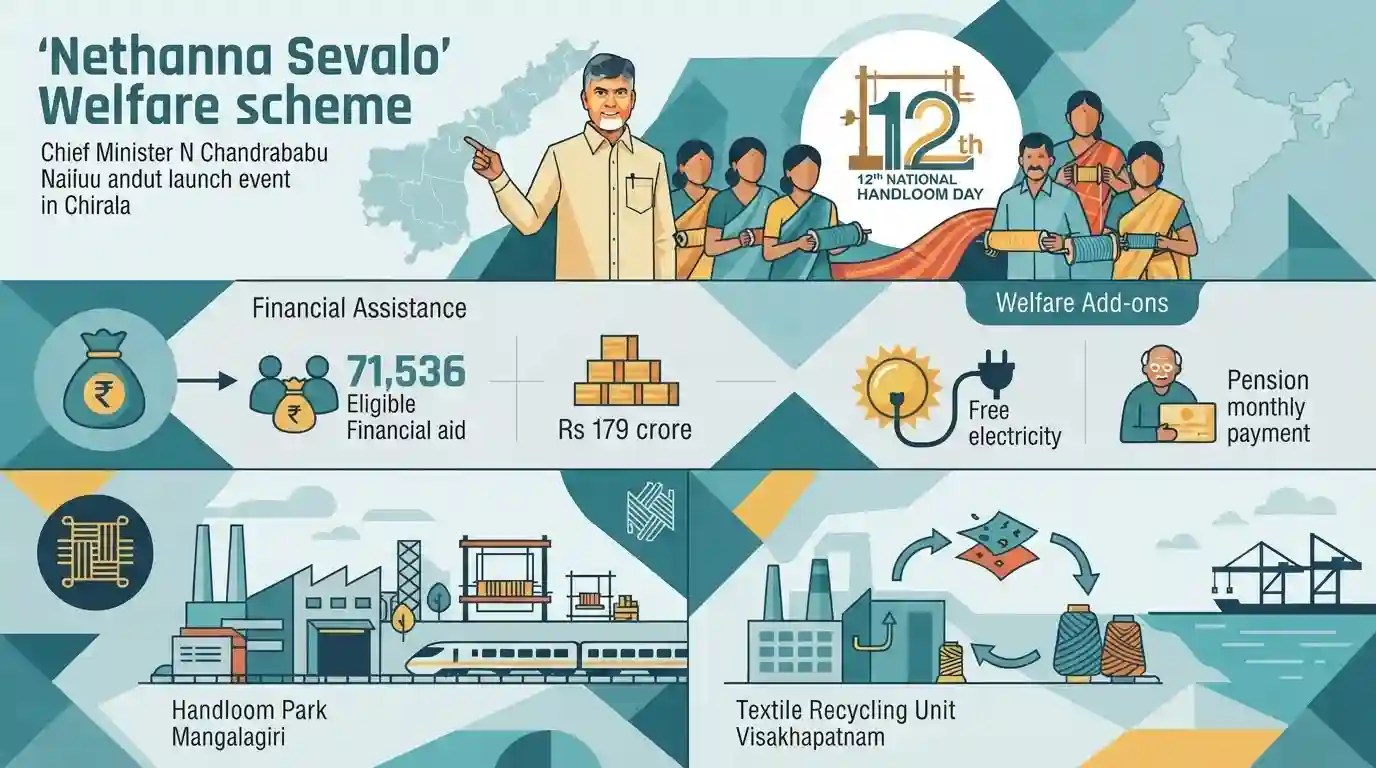
Andhra Pradesh Chief Minister N Chandrababu Naidu is launching the 'Nethanna Sevalo' scheme to provide financial assistance of Rs 25,000 to eligible handloom families. The scheme, aimed at supporting the weaver community, will be launched on the 12th National Handloom Day in Chirala. The initiative involves an allocation of Rs 179 crore for 71,536 families and includes additional benefits like free electricity and a monthly pension for older weavers. Furthermore, the government plans to develop infrastructure to support the handloom and textile sector, including a handloom park in Mangalagiri and a textile recycling unit in Visakhapatnam.
ముఖ్య అంశాలు
- Andhra Pradesh CM N Chandrababu Naidu is set to launch the 'Nethanna Sevalo' scheme on August 7, coinciding with the 12th National Handloom Day, in the Chirala assembly constituency.
- The scheme provides a financial aid of Rs 25,000 to eligible handloom families, benefiting a total of 71,536 families at an estimated cost of Rs 179 crore.
- Additionally, the state government will supply 200 units of free power to handloom weaver families and 500 units to power loom units.
- A monthly pension of Rs 4,000 will be provided to 85,000 handloom weavers aged 50 years and above.
- The government has proposed establishing a handloom park at Mangalagiri, a handloom and handicrafts museum at Shakamuru in Amaravati, and a sustainable textile recycling unit in Visakhapatnam.
ముఖ్యమైన పదాలు
Nethanna Sevalo

An Andhra Pradesh welfare scheme offering Rs 25,000 annual financial aid to eligible handloom weaver families to ensure livelihood security. Launch coincided with the 12th National Handloom Day in 2026.
UPSC context
Important for GS-2 (Welfare Schemes) and GS-3 (Inclusive Growth), illustrating direct benefit transfers for traditional artisan communities and unorganized sectors.
National Handloom Day
An annual observance on August 7 to honor weavers and promote the handloom industry. The date commemorates the 1905 launch of the Swadeshi Movement, emphasizing indigenous goods.
UPSC context
Tests GS-1 (Modern History/Swadeshi Movement) and GS-3 (Economy/Employment). Frequently features in Prelims regarding dates, historical background, and current themes.
Mangalagiri Handloom Park
An upcoming mega infrastructure project in Mangalagiri, Guntur district, Andhra Pradesh. It aims to provide year-round livelihood and workspace for local weavers famous for GI-tagged Mangalagiri cotton.
UPSC context
Relevant to GS-3 (Industrial Policy, Infrastructure) and GS-1 (Art & Culture/GI Tags), highlighting cluster development strategies for traditional industries.
Textile Recycling Unit
A planned sustainable facility in Visakhapatnam, Andhra Pradesh, intended to process textile waste into reusable fibers. It represents a major step toward circular economy practices in India's textile industry.
UPSC context
Crucial for GS-3 (Environment, Sustainable Development) linking waste management, green manufacturing, and sustainable infrastructure investments.
ప్రిలిమ్స్ ఉచ్చు
National Handloom Day commemorates the launch of the Non-Cooperation Movement and Gandhi's Khadi campaign in August 1920.
National Handloom Day was declared in 2015 to honor the Swadeshi Movement (1905). Candidates often confuse this with the Non-Cooperation Movement (1920) or the Quit India Movement (August 1942).
అనుసంధానమైన స్థిర భావనలు
What is the historical significance of August 7, 1905, in India's freedom struggle?
- Swadeshi Proclamation: The Swadeshi Movement was formally proclaimed on this day at the Calcutta Town Hall with the passage of the historic Boycott Resolution.
- Economic Resistance: It promoted indigenous industries, particularly handloom weaving, as a tool of economic resistance against the British decision to partition Bengal.
- Commemorative Legacy: To honor this heritage and its impact on rural weavers, the Government of India declared August 7 as National Handloom Day in 2015.
What are the unique characteristics and GI status of Mangalagiri sarees?
- GI Protection: The Mangalagiri Sarees and Fabrics received geographical indication protection in 2013 under the GI of Goods (Registration and Protection) Act, 1999.
- Weaving Technique: Woven traditional style on pit looms using combed cotton yarn, featuring a plain body without woven designs.
- Nizam Border: Characterized by a unique 'Nizam border' that features closely-knit, tiny gopuram (temple) motifs running along the edges.
అంతర-అంశ నమూనాలు
Swadeshi Spirit & Modern MSME Welfare
Links 1905 economic self-reliance (Swadeshi) with modern decentralized welfare, demonstrating how traditional cottage industries remain key to rural livelihood security and women's economic empowerment.
GI Tags & Sustainable Rural Livelihoods
Connects intellectual property protection (like Mangalagiri's GI status) to local economic development, illustrating how IP rights prevent cultural plagiarism and bolster export-oriented artisanal clusters.

Historical origin of National Handloom Day paired with GI-tagged traditional weaves likely to be tested in a multi-statement Prelims question.
అనుసంధాన PYQలు · 2
అనుసంధాన PYQలు · 2
- 2023APPSC_PRELIMSGS1
One of the following welfare programmes implemented by Government of Andhra Pradesh is not part of Navaratnalu.
- 2023APPSC_PRELIMSGS1
The following App developed by Government of Andhra Pradesh is an SOS service for women in distress or danger.
