Amaravati Seed Access Road and Infrastructure Projects
Source:newindianexpress ↗
Why It Matters
Understanding the infrastructure specifics of the Amaravati capital region is crucial for APPSC Prelims, especially regarding regional connectivity, urban transport systems like BRTS, and sustainable state development projects managed by APCRDA.
Summary
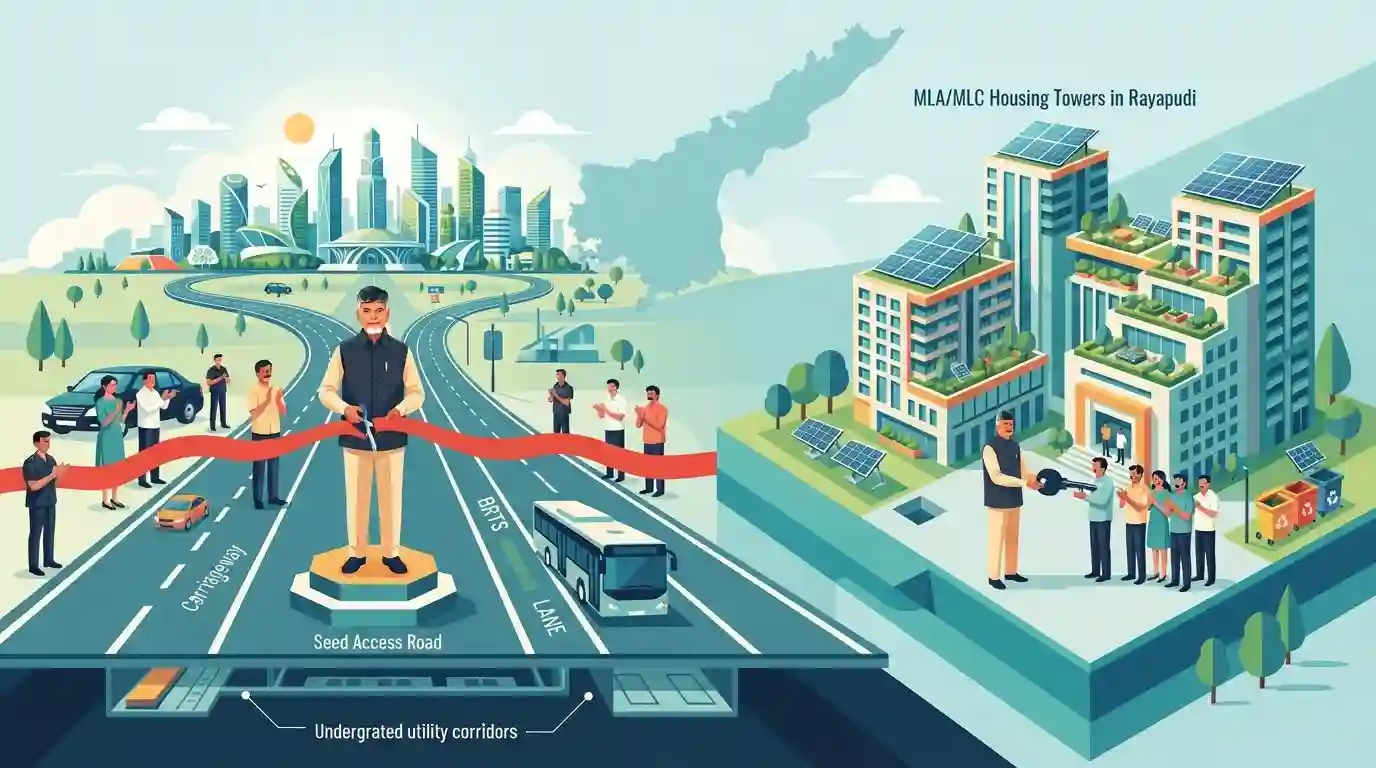
Andhra Pradesh Chief Minister N. Chandrababu Naidu is set to inaugurate the 21.77 km Seed Access Road in the Amaravati Capital Region on August 13, 2026. The road serves as a central spine for the capital, featuring advanced urban infrastructure such as a nine-lane carriageway, a Bus Rapid Transit System (BRTS), and underground utility corridors. Concurrently, the CM will formally hand over the eco-friendly MLA/MLC Housing Towers in Rayapudi, which incorporate sustainable amenities like solar power generation and independent waste management systems.
Key Points
- Andhra Pradesh Chief Minister N. Chandrababu Naidu will inaugurate the 21.77-km Seed Access Road (Sub-Arterial E3) in Amaravati, connecting Dondapadu village to NH-16.
- The road features a nine-lane carriageway with a dedicated Bus Rapid Transit System (BRTS) corridor and underground plug-and-play utility corridors for power, telecom, and gas.
- The Chief Minister will also hand over the MLA/MLC Housing Towers at Rayapudi, comprising nine high-rise towers built on 10.46 acres.
- The housing complex integrates sustainable urban planning elements, including an independent Sewage Treatment Plant (STP), solar power grids, solar water heaters, and organic waste converters.
- Infrastructure execution is overseen by the Amaravati Development Corporation (ADC) and the AP Capital Region Development Authority (APCRDA).
Important Terms
AP Capital Region Development Authority (APCRDA)

A statutory planning body established in 2014 by the Andhra Pradesh government to oversee urban planning, development, and massive land pooling (over 33,000 acres) for the Amaravati Capital Region.
UPSC context
Important for GS Paper 2 (Governance) and GS Paper 3. Illustrates state-level models for large-scale land pooling schemes and regional urban administration.
Amaravati Development Corporation (ADC)
A state government-owned public company incorporated in 2015 to execute and construct infrastructure projects, including the Seed Access Road and sustainable housing towers, in Amaravati.
UPSC context
Links to GS Paper 3 (Infrastructure) and GS Paper 2 (PSUs). Highlights the role of special purpose vehicles in executing greenfield urban projects.
Seed Access Road
A 21.77 km sub-arterial corridor acting as the primary central spine of Amaravati. It features a nine-lane carriageway, a dedicated BRTS corridor, and underground utilities.
UPSC context
Relevant for GS Paper 3 (Infrastructure/Urbanization). Demonstrates modern greenfield smart city planning, addressing urban mobility and integrated utility management.
Bus Rapid Transit System (BRTS)
A high-quality mass transit system delivering fast, cost-effective services through dedicated bus-only lanes, specialized stations, and advanced traffic management to bypass regular urban road congestion.
UPSC context
Essential for GS Paper 3 (Infrastructure) and GS Paper 1 (Urbanization). Showcases sustainable public transit solutions to reduce emissions and traffic.
Underground Utility Corridors
A consolidated sub-surface infrastructural system encasing multiple utility networks—like stormwater drains, water supply, optical fibers, and power lines—improving safety and reducing recurring road excavations.
UPSC context
Relevant for GS Paper 3 (Infrastructure/Smart Cities). Tests knowledge of sustainable urban planning and modernizing civic infrastructure for resilience.
Prelims Trap
Amaravati and Hyderabad serve as the joint capitals of Andhra Pradesh and Telangana.
Hyderabad was the joint capital for a maximum of 10 years (ended June 2024). Amaravati is now the sole capital of Andhra Pradesh.
Static Concepts Connected
How does a Land Pooling Scheme (LPS) differ from traditional Land Acquisition?
- Voluntary mechanism: LPS relies on the voluntary surrender of land parcels by owners, unlike traditional acquisition which is a forced government purchase.
- Developed land return: Instead of cash compensation, landowners receive a smaller fraction of fully developed urban land, gaining from infrastructure appreciation.
- LARR 2013 bypass: LPS effectively bypasses the lengthy Social Impact Assessments and monetary payout rigidities of the LARR Act 2013.
What is the geographical significance of National Highway 16 (NH-16)?
- Golden Quadrilateral: It forms the vital eastern flank of India's Golden Quadrilateral highway network.
- East Coast Route: It runs parallel to the east coast, connecting West Bengal, Odisha, Andhra Pradesh, and Tamil Nadu.
Cross-Topic Patterns
Urban infrastructure vs Land Acquisition
Amaravati's model links GS-1 urbanization challenges to GS-3 infrastructure, showing how 'land pooling' effectively circumvents typical LARR 2013 hurdles for greenfield cities.
Smart Cities & Utility Corridors
The integration of 'plug-and-play' underground utilities prevents recurring road excavations, addressing a major pain point in India's urban governance and aligning with the Smart Cities Mission.

Expect a comparative mains question on Land Pooling Scheme (LPS) vs LARR Act 2013, citing Amaravati as a greenfield urban case study.
Linked PYQs · 3
Linked PYQs · 3
- 2024APPSC_PRELIMSGS1
In connection with transport and infrastructure in Andhra Pradesh, which of the following statement/statements is/are valid? I. Andhra Pradesh's first riverine project has been proposed between Muktayala and Madipadu on Krishna river. II. The Bhogapuram Greenfield International Airport had been started with a corpus fund that is sourced from National Investment and Infrastructure Fund (NIIF). III. Infrastructure investments in Andhra Pradesh are strictly implemented only with reference to strategic investments like ports and industrial corridors, but not with reference to community assets. IV. Rail Over Bridges (ROBs) are being developed in Andhra Pradesh under the Setu Bandhan Scheme. Select the correct answer using the codes given below :
- 2023APPSC_PRELIMSGS1
Part V of the Andhra Pradesh Reorganisation Act deals with
- 2019APPSC_PRELIMSGS1
"Sustainable Development is the development that meets the needs of the present without compromising on the ability of future generations to meet their own needs." Who has given this definition ?
