AP Cabinet Clears PPP Policy and Amaravati Capital Projects
Source:theprint ↗
Why It Matters
This development highlights major policy shifts in Andhra Pradesh regarding infrastructure financing via PPP, capital city planning in Amaravati, and legislative changes involving women's safety bills, which are core governance topics for APPSC aspirants.
Summary
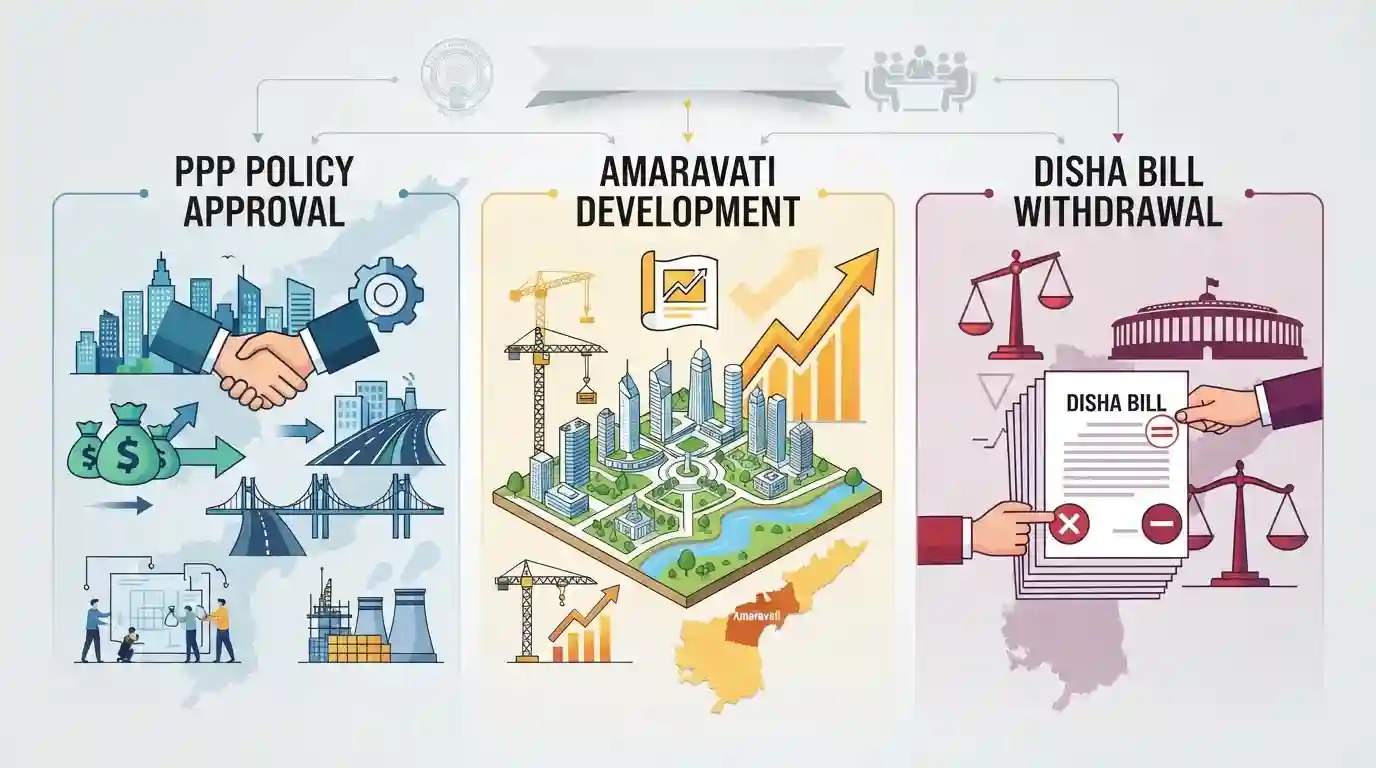
The Andhra Pradesh Cabinet has approved a comprehensive Public-Private Partnership (PPP) policy to accelerate state infrastructure, cleared pending key projects for the development of Amaravati capital city, and formally decided to withdraw the controversial Disha Bill.
Key Points
- The Andhra Pradesh Cabinet approved a new Public-Private Partnership (PPP) policy to boost infrastructure development.
- The Cabinet formally decided to withdraw the Disha Bill (Andhra Pradesh Criminal Law (Amendment) Bill, 2019).
- Key infrastructure projects related to the development of Amaravati as the capital city were cleared by the Cabinet.
Important Terms
Public-Private Partnership (PPP) policy

A framework approved by the Andhra Pradesh government to attract private investment and viability gap funding for state infrastructure sectors like transport, ports, and renewable energy.
UPSC context
APPSC Group 1/2: Tests knowledge of state economic policies, infrastructure funding mechanisms, and private sector participation in AP development.
Disha Bill
A proposed legislative measure formally withdrawn by the AP Cabinet following the implementation of national criminal laws like the BNS, which rendered its special provisions redundant.
UPSC context
APPSC Group 1/2: Tests understanding of state legislative actions, criminal justice reforms, and women-centric legal frameworks in Andhra Pradesh.
Andhra Pradesh Cabinet
The executive decision-making body of Andhra Pradesh led by the Chief Minister, responsible for framing state policies, approving budgets, and clearing major infrastructure projects.
UPSC context
APPSC Group 1/2: Tests polity and governance concepts regarding the executive branch and state-level policy formulation in Andhra Pradesh.
Static Concepts Connected
What is Viability Gap Funding (VGF) in Public-Private Partnership infrastructure projects?
- Capital Grant: Financial Support: A grant provided by the government to bridge the viability gap of infrastructure projects that are economically justified but financially unviable.
- Funding Limit: Standard Norms: Typically supports up to 20 percent of the total project cost from the government, with additional support possible based on specific state or central schemes.
- Risk Mitigation: Private Sector: Attracts private capital into sectors with long gestation periods and high capital costs like ports, highways, and urban infrastructure.
Cross-Topic Patterns
State Legislative Bills vs Central Criminal Codes
The withdrawal of state-specific criminal law amendments following central enactment of the BNS and BNSS highlights the interplay between state legislative autonomy and central penal codes.
PPP Policy and Capital City Financing
Utilizing PPP models and VGF schemes for capital city infrastructure illustrates modern fiscal federalism and debt management strategies by state governments.

Expect statement-based questions on the withdrawal of the Disha Bill, its relation to BNS/BNSS 2023, and Amaravati capital funding structures.
Linked PYQs · 1
Linked PYQs · 1
- 2023APPSC_PRELIMSGS1
Polavaram Project is a
