Andhra Pradesh Cabinet Policy Approvals and Bill Withdrawal
Source:theprint ↗
Why It Matters
Important for APPSC aspirants tracking major policy shifts, administrative changes, and capital infrastructure developments in Andhra Pradesh.
Summary
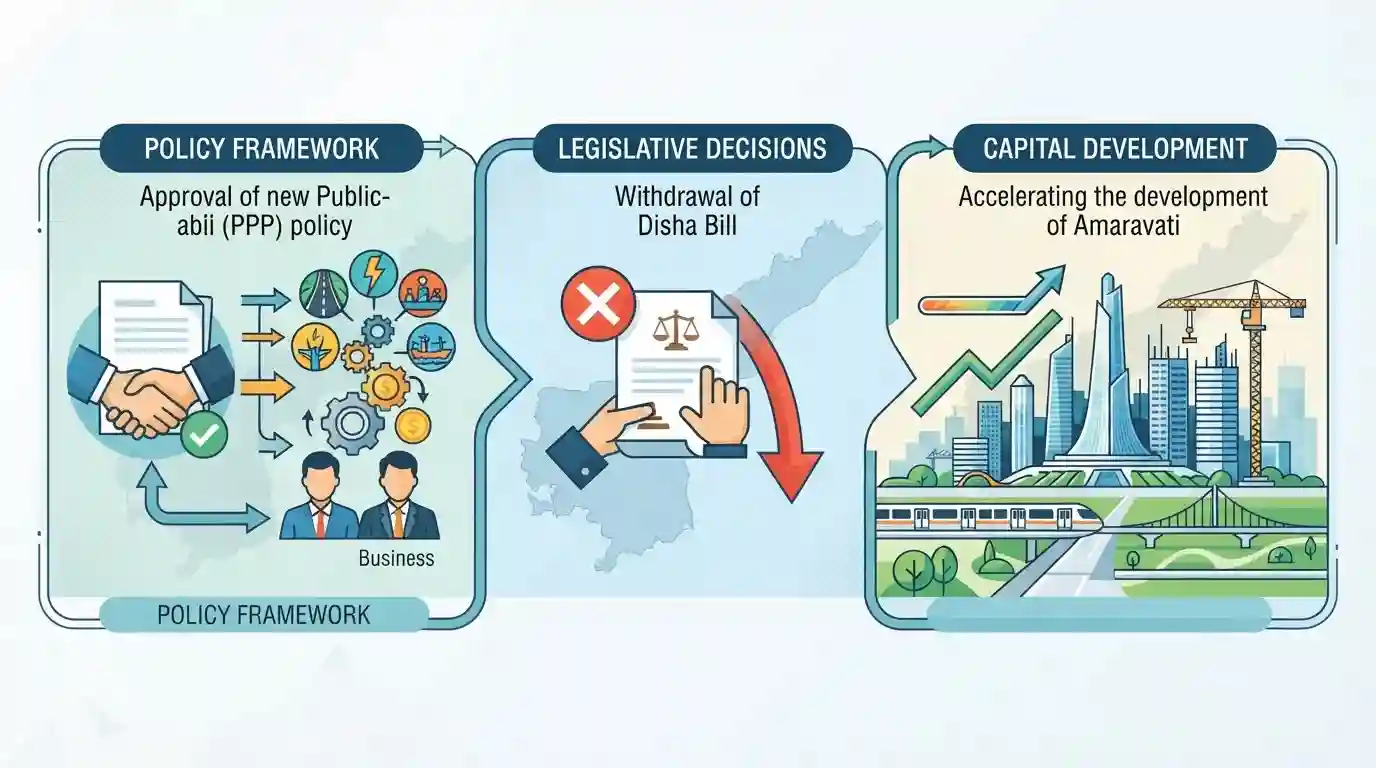
The Andhra Pradesh cabinet chaired key policy decisions, including the approval of a new Public-Private Partnership (PPP) policy, the withdrawal of the Disha Bill, and the clearance of crucial projects to accelerate the development of Amaravati as the state capital.
Key Points
- The Andhra Pradesh cabinet approved a new Public-Private Partnership (PPP) policy to boost infrastructure development.
- The cabinet officially decided to withdraw the contentious Disha Bill passed by the previous regime.
- Key development projects and infrastructure works relating to the capital city Amaravati were cleared for resumption.
Important Terms
APCRDA

A statutory body established to plan, coordinate, execute, and promote the construction and development of the new capital city and region of Amaravati in Andhra Pradesh.
UPSC context
Important for APPSC Group examinations under Andhra Pradesh economy, geography, and urban governance/infrastructure development.
PPP Policy
A framework introduced to attract private sector investment in public infrastructure and social sectors through funding mechanisms like Viability Gap Funding (VGF) and bridge funds.
UPSC context
Relevant for APPSC state-level economic policies, infrastructure financing, and governance reforms.
Disha Bill
A legislative measure proposed in 2019 to expedite trials and mandate stricter punishments, including the death penalty, for heinous crimes against women and children, later withdrawn following central advisory.
UPSC context
Important for APPSC Polity and Governance regarding state legislation, criminal justice reforms, and Centre-State relations.
Prelims Trap
The Disha Bill was successfully enacted into law by the previous regime to enforce capital punishment within 21 days.
The Disha Bill was officially withdrawn following MHA advice and central criminal law changes, not enacted into law as it required presidential assent.
Static Concepts Connected
What is the mechanism of Viability Gap Funding (VGF) in Public-Private Partnership (PPP) projects?
- Capital Grant: Financial support is provided as a capital grant during construction to make commercially unviable infrastructure projects economically attractive.
- Funding Limit: Typically administered by the Ministry of Finance, central VGF scheme provides up to 20% of total project cost.
- State Supplement: State governments often supplement central VGF with additional state-level grants or viability gap provisions.
What is the role and constitutional status of Capital Region Development Authorities like APCRDA in Andhra Pradesh?
- Statutory Body: Established under specific state legislative acts for planned urban development and land pooling schemes in designated capital areas.
- Land Pooling: Operates via land pooling to acquire land without direct coercive acquisition, offering developed plots back to landowners.
- Core Mandate: Functions include master planning, infrastructure financing, and execution of civil works for the state capital.
Cross-Topic Patterns
State Bills vs Central Criminal Codes (Article 254)
The withdrawal of state-level criminal bills in favor of central penal codes (BNS/BNSS) illustrates the interplay between state legislative autonomy and Union Ministry of Home Affairs oversight under Article 254.
Capital City Financing & Fiscal Federalism (Art 293)
Amaravati capital development loans and APCRDA funding mechanisms connect directly to fiscal federalism, state debt ceilings under Article 293(3), and institutional capital financing.

Andhra Pradesh capital region development and PPP viability gap funding are prime candidates for APPSC Group-1 economic policy questions.
Linked PYQs · 3
Linked PYQs · 3
- 2024APPSC_PRELIMSGS1
Which of the following statements are valid in connection with Andhra Pradesh Green Hydrogen and Green Ammonia Policy (2023)? I. The objective is to target Green Energy production up to the capacity of 1 MPTA (Million Tonnes Per Annum) or Green Ammonia production up to the capacity of 2-0 MTPA in the next five years. II. New and Renewable Energy Development Corporation of A.P. Ltd (NREDCAP) shall act as a Nodal Agency under this policy. III. All the Ports in the State have infrastructure for storing liquid nitrogen which can then be utilized for storing Green Hydrogen for exporting to other countries. IV. The Policy prohibits the production of Green Hydrogen/Green Ammonia by using Renewable Energy and/or Biomass from 'Third-Party/Power exchange'. Select the correct answer using the codes given below :
- 2024APPSC_PRELIMSGS1
Which of the following statement/statements is/are valid regarding the socio-economic status of Andhra Pradesh ? I. Andhra Pradesh won the Best State Award of ICAR - National Research Center for Banana (NRCB) for export promotion. II. Andhra Pradesh GSDP growth rate has been registering a decline in recent times owing to repeated lower returns in certain sub-sectors of the Service Sector. III. For the FY 2024 - 25, the Revenue Deficit is budgeted higher than the Fiscal Deficit in terms of percentage of Andhra Pradesh GSDP. IV. The technology used by the Government of Andhra Pradesh while conducting resurvey of landholdings is referred to as 'Continuously Operating Reference Stations (CORS)' technology. Select the correct answer using the codes given below :
- 2024APPSC_PRELIMSGS1
The strategic objective of Asset Monetization Programme may be explained as :
