AP Cabinet Decisions: New PPP Policy Approved and Disha Bill Withdrawn
Source:theprint ↗
Why It Matters
This article highlights major administrative policy shifts in Andhra Pradesh, including infrastructure funding models via PPP and key decisions regarding state capital development, which are critical for APPSC aspirants tracking state governance and economic policies.
Summary
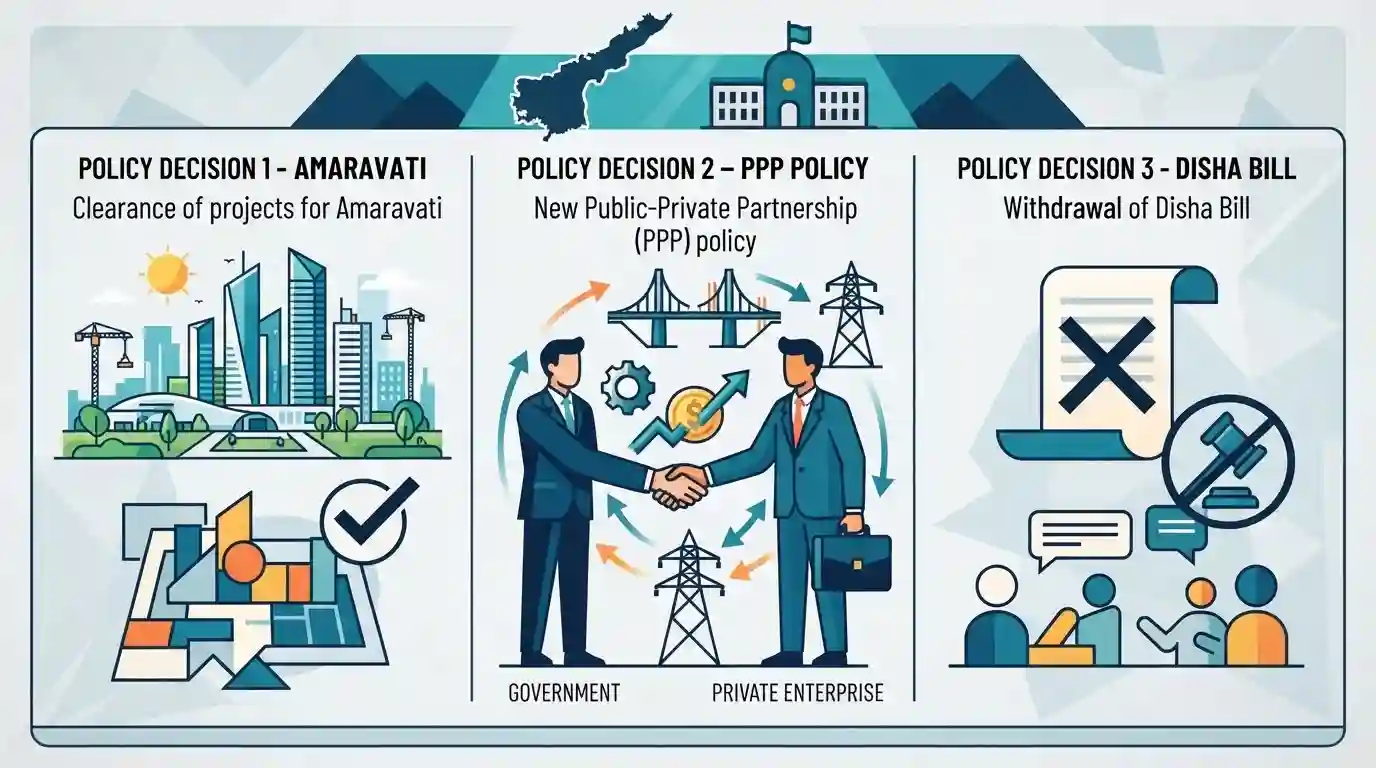
The Andhra Pradesh Cabinet took major policy decisions, including the approval of a new Public-Private Partnership (PPP) policy to drive state infrastructure, the withdrawal of the controversial Disha Bill, and the clearance of key development projects for the capital city of Amaravati.
Key Points
- The Andhra Pradesh Cabinet approved a new Public-Private Partnership (PPP) policy aimed at boosting infrastructure development in the state.
- The cabinet formally withdrew the Disha Bill, which had been previously introduced for women's safety legislation.
- Key infrastructure and development projects related to the capital city Amaravati were cleared by the cabinet to resume construction and expansion.
Important Terms
Disha Bill

A state legislative measure initially introduced in 2019 to accelerate trials and impose stringent penalties for crimes against women, formally withdrawn following central enactment of the BNS and BNSS.
UPSC context
APPSC Group 1/2: Tests knowledge of state legislation, women's safety policies, and legal alignment with central criminal laws.
PPP Policy Andhra Pradesh
A state policy framework designed to channel private investments into infrastructure sectors like transport, ports, and renewable energy, backed by viability gap funding and bridge funds.
UPSC context
APPSC Group 1/2: Relevant for state economic development, infrastructure financing, and public-private partnership models.
Andhra Pradesh Cabinet
The apex executive decision-making body of the state government headed by the Chief Minister, responsible for formulating administrative policies, legislative bills, and capital development projects.
UPSC context
APPSC Polity: Tests understanding of state executive powers, cabinet governance, and administrative decision-making in Andhra Pradesh.
Prelims Trap
The cabinet approval of the Disha Bill withdrawal means the state law has instantly ceased to exist without central assent protocols.
Aspirants often confuse executive cabinet policy approvals with final legislative enactments or constitutional assent processes.
Static Concepts Connected
What is Viability Gap Funding (VGF) in Public-Private Partnership (PPP) projects?
- Definition: Financial support provided by the government as a grant to capital-infrastructure projects that are economically justified but financially unviable.
- Funding Limit: Typically covers up to 20% of the total project cost from the government, with the private partner bringing in the rest.
- Objective: Aimed at attracting private sector participation in high-cost infrastructure where immediate commercial returns are low.
Cross-Topic Patterns
PPP Policy + Fiscal Federalism & Infrastructure
The shift from state-funded doles to PPP models in core infrastructure mirrors national economic transitions seen in NITI Aayog's Asset Monetisation Pipeline.
Disha Bill Withdrawal + Legislative Overlap
Withdrawal of state-specific criminal legislation following Union Ministry of Home Affairs advice highlights the dynamics of President's assent and Union-State legislative harmony under Article 254.

Expect multi-statement questions on AP Cabinet decisions: Amaravati funding mechanisms (VGF, Bridge Fund) vs. central criminal law alignments.
Linked PYQs · 2
Linked PYQs · 2
- 2023APPSC_PRELIMSGS1
Polavaram Project is a
- 2024APPSC_PRELIMSGS1
Which of the following statement/statements is/are incorrect regarding the Andhra Pradesh Industrial Policy 2023 - 27? I. To achieve a minimum contribution of 25% by industry in the State GDP II. To provide end-to-end facilitation in 2 weeks III. To envisage ten (10) priorities of accomplishment IV. To focus on becoming a 'Plug and Play State' for investments V. Ensuring land allotment by APIIC within a period of 2 weeks upon receipt of application Select the answer using the codes given below :
