Andhra Pradesh Cabinet Clears Amaravati Projects and PPP Policy
Source:theprint ↗
Why It Matters
This article covers significant policy shifts in Andhra Pradesh governance, including economic policy frameworks like PPP models, administrative legislative rollbacks (Disha Bill), and urban development initiatives for Amaravati, which are vital for APPSC Group 1 aspirants focusing on state-specific administration and development.
Summary
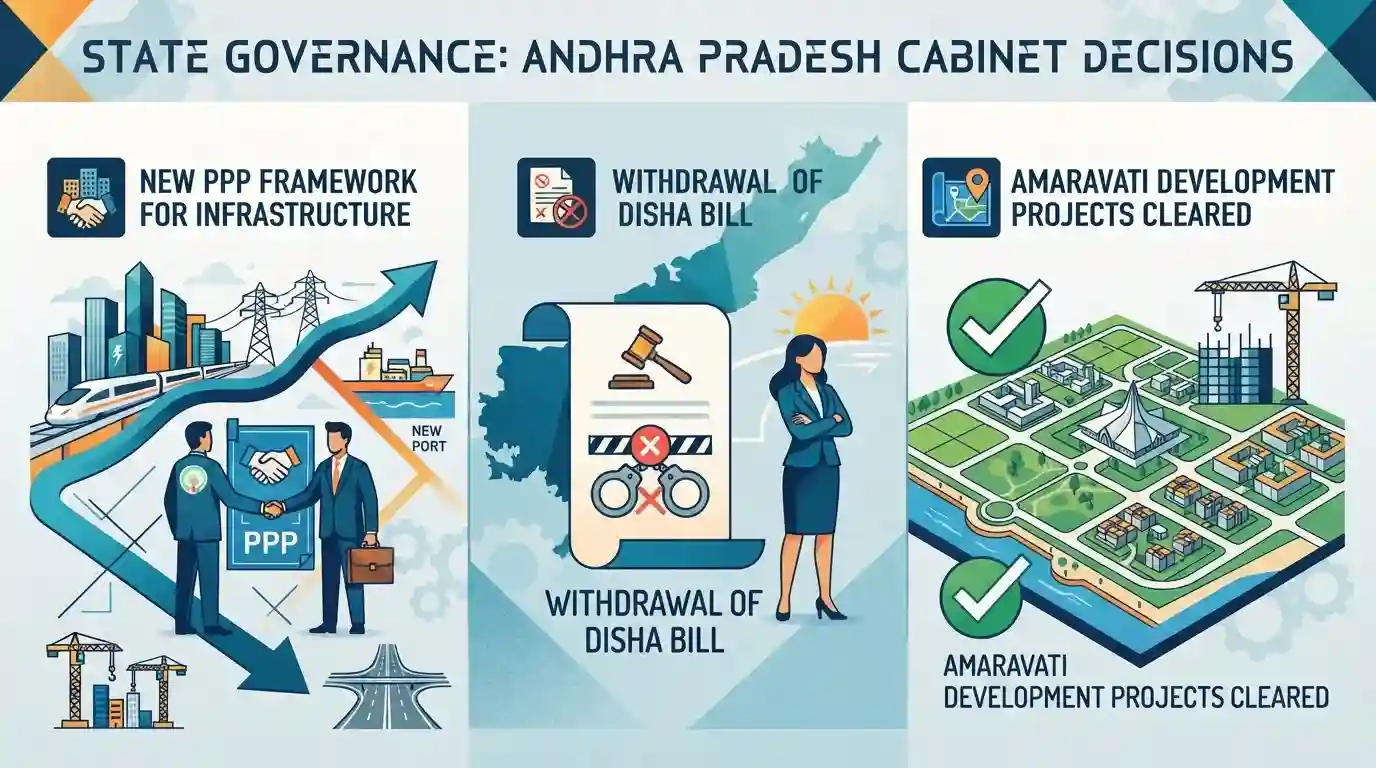
The Andhra Pradesh Cabinet approved several major policy decisions, including a new Public-Private Partnership (PPP) framework for infrastructure, the withdrawal of the controversial Disha Bill, and the clearance of key development projects for the capital city Amaravati.
Key Points
- The Andhra Pradesh Cabinet approved a new Public-Private Partnership (PPP) policy to boost infrastructure investment in the state.
- The Cabinet formally decided to withdraw the Disha Bill (Andhra Pradesh Criminal Law (Amendment) Act, 2019).
- Key development and infrastructure projects related to the capital city Amaravati were cleared, reviving the region's urban development roadmap under APCRDA.
Important Terms
APCRDA

A statutory body established for the planning, coordination, execution, and promotion of the greenfield capital city of Amaravati and its surrounding capital region.
UPSC context
Important for APPSC Group 1/2 (Andhra Pradesh Geography & Governance), testing knowledge of urban planning and capital development bodies.
Disha Bill
A legislative initiative proposed by the Andhra Pradesh government aimed at providing swifter trial and harsher penalties for crimes against women, which was later withdrawn to align with updated central criminal laws.
UPSC context
Crucial for APPSC polity and governance papers, testing understanding of state legislation, center-state relations, and women safety laws.
PPP Policy Andhra Pradesh
A policy framework approved by the Andhra Pradesh government to encourage private sector investment in infrastructure projects through mechanisms like Viability Gap Funding and bridge funds.
UPSC context
Important for APPSC Economy and Public Policy topics, testing economic reforms, infrastructure financing, and public-private partnerships in the state.
Prelims Trap
The Disha Bill was repealed by the Andhra Pradesh Legislative Assembly after being fully operationalized.
The Disha Bill was not enacted into law as it required and failed to receive Presidential assent due to conflicts/overlap with central criminal statutes.
Static Concepts Connected
What is the statutory role and mandate of the APCRDA in Andhra Pradesh urban planning?
- Statutory Basis: Statutory body established under the AP Capital Region Development Authority Act, 2014 for planning and development of the capital region.
- Land Pooling: Employs a land pooling system where landowners contribute land and receive developed reconstituted plots along with annuities.
- Core Mandate: Responsible for trunk infrastructure, zoning, and urban land management in the designated Amaravati capital city area.
Cross-Topic Patterns
Land Pooling & Urban Governance Models
APCRDA land pooling models and annuity revisions connect state urban planning with agrarian compensation frameworks tested in previous Group-1 exams.
Centre-State Legislative Overlap & Presidential Assent
State withdrawal of bills awaiting Presidential assent due to central law overrides highlights Article 254 federal legislative dynamics.

APCRDA annuity revisions, VGF schemes, and the legal status of central criminal codes overriding state bills are high-yield APPSC areas.
Linked PYQs · 2
Linked PYQs · 2
- 2023APPSC_PRELIMSGS1
Polavaram Project is a
- 2024APPSC_PRELIMSGS1
Which of the following statement/statements is/are incorrect regarding the Andhra Pradesh Industrial Policy 2023 - 27? I. To achieve a minimum contribution of 25% by industry in the State GDP II. To provide end-to-end facilitation in 2 weeks III. To envisage ten (10) priorities of accomplishment IV. To focus on becoming a 'Plug and Play State' for investments V. Ensuring land allotment by APIIC within a period of 2 weeks upon receipt of application Select the answer using the codes given below :
