Andhra Pradesh Cabinet Approves PPP Policy and Amaravati Projects
Source:theprint ↗
Why It Matters
Crucial for understanding administrative shifts, capital city planning, and governance policy revisions in Andhra Pradesh.
Summary
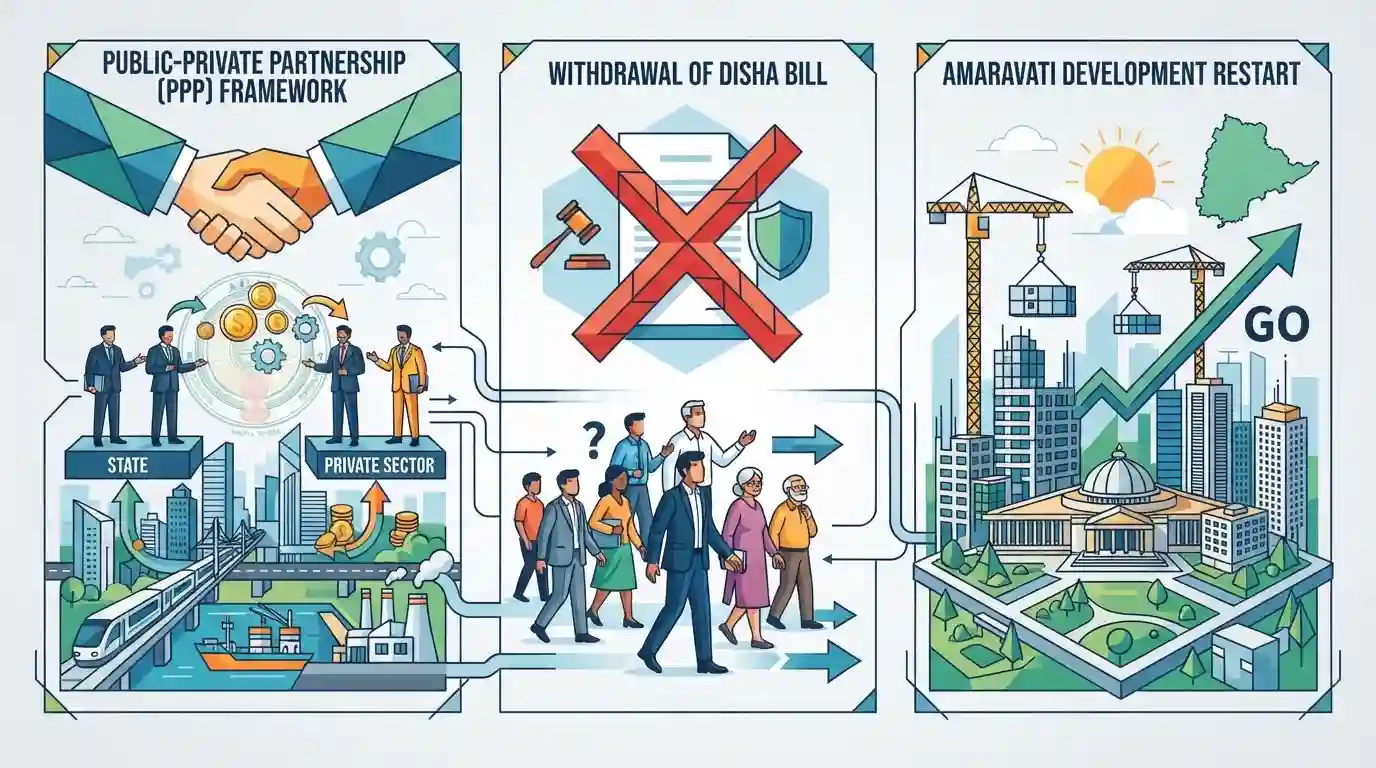
The Andhra Pradesh state cabinet approved major policy shifts, including a comprehensive Public-Private Partnership (PPP) framework for infrastructure development, the withdrawal of the controversial Disha Bill, and the clearance of crucial projects to restart development work in the capital city of Amaravati.
Key Points
- The Andhra Pradesh Cabinet approved a new Public-Private Partnership (PPP) policy to attract private investments into state infrastructure projects.
- The Cabinet decided to formally withdraw the Disha Bill (Andhra Pradesh Criminal Law (Amendment) Act / related bills) introduced by the previous government.
- Key infrastructure projects in the capital city Amaravati, including stalled constructions and administrative buildings, were cleared for resumption under APCRDA.
Important Terms
Public-Private Partnership (PPP) Policy

A collaborative funding model between government and private entities to finance, build, and operate infrastructure projects, leveraged in AP to boost private investments and accelerate capital development.
UPSC context
APPSC Group 1/2: Tests knowledge of state economic policies, infrastructure financing, and governance models.
Disha Bill
Legislation originally passed in 2019 to provide stricter punishments and expedited trials for crimes against women, withdrawn after Union Home Ministry noted objectives are covered by new central criminal codes.
UPSC context
APPSC Group 1/2: Tests state legislation, women's safety laws, and Centre-State legal coordination.
APCRDA
The statutory planning and development authority established for the planning, coordination, execution, and financing of the capital city of Amaravati in Andhra Pradesh.
UPSC context
APPSC Group 1/2 (AP History & Economy): Tests institutional mechanisms for urban development and regional planning in AP.
Static Concepts Connected
What are the key models of Public-Private Partnership (PPP) used in Indian infrastructure projects?
- BOT (Build-Operate-Transfer): Private entity finances, builds, and operates the facility for a concession period before transferring it back to the government.
- OMT (Operate-Maintain-Transfer): Government builds and owns the asset, then contracts a private entity to operate and maintain it for a fee.
- BLT (Build-Lease-Transfer): Private partner finances and builds the facility, leases it to the government for a fee, and transfers ownership later.
- DBFOT Model: Private sector designs, builds, finances, and operates the asset while collecting user fees directly.
Cross-Topic Patterns
Amaravati PPP + Fiscal Federalism (Article 293)
Amaravati's capital redevelopment intersects with fiscal federalism and state debt ceilings under Article 293, making infrastructure financing models a favorite for both APPSC Group 1 mains and prelims.
Disha Bill Withdrawal + BNS/BNSS 2023
The withdrawal of the state-level Disha Bill due to the enactment of BNS and BNSS links state legislative powers with central criminal law reforms.

APPSC Group 1 Mains: Examine the viability and risk-sharing mechanisms of the AP PPP Policy 2026 vis-à-vis traditional public sector borrowing.
Linked PYQs · 3
Linked PYQs · 3
- 2024APPSC_PRELIMSGS1
In connection with transport and infrastructure in Andhra Pradesh, which of the following statement/statements is/are valid? I. Andhra Pradesh's first riverine project has been proposed between Muktayala and Madipadu on Krishna river. II. The Bhogapuram Greenfield International Airport had been started with a corpus fund that is sourced from National Investment and Infrastructure Fund (NIIF). III. Infrastructure investments in Andhra Pradesh are strictly implemented only with reference to strategic investments like ports and industrial corridors, but not with reference to community assets. IV. Rail Over Bridges (ROBs) are being developed in Andhra Pradesh under the Setu Bandhan Scheme. Select the correct answer using the codes given below :
- 2024APPSC_PRELIMSGS1
The strategic objective of Asset Monetization Programme may be explained as :
- 2023APPSC_PRELIMSGS1
The following App developed by Government of Andhra Pradesh is an SOS service for women in distress or danger.
