AP Cabinet Approves PPP Policy and Amaravati Infrastructure Projects
Source:theprint ↗
Why It Matters
Understanding state-level policy shifts—such as the creation of a dedicated PPP framework, alignment of state laws with new central criminal codes, and significant infrastructure/solar energy initiatives—is crucial for questions on governance, economic development, and Centre-State relations in APPSC Group 1.
Summary
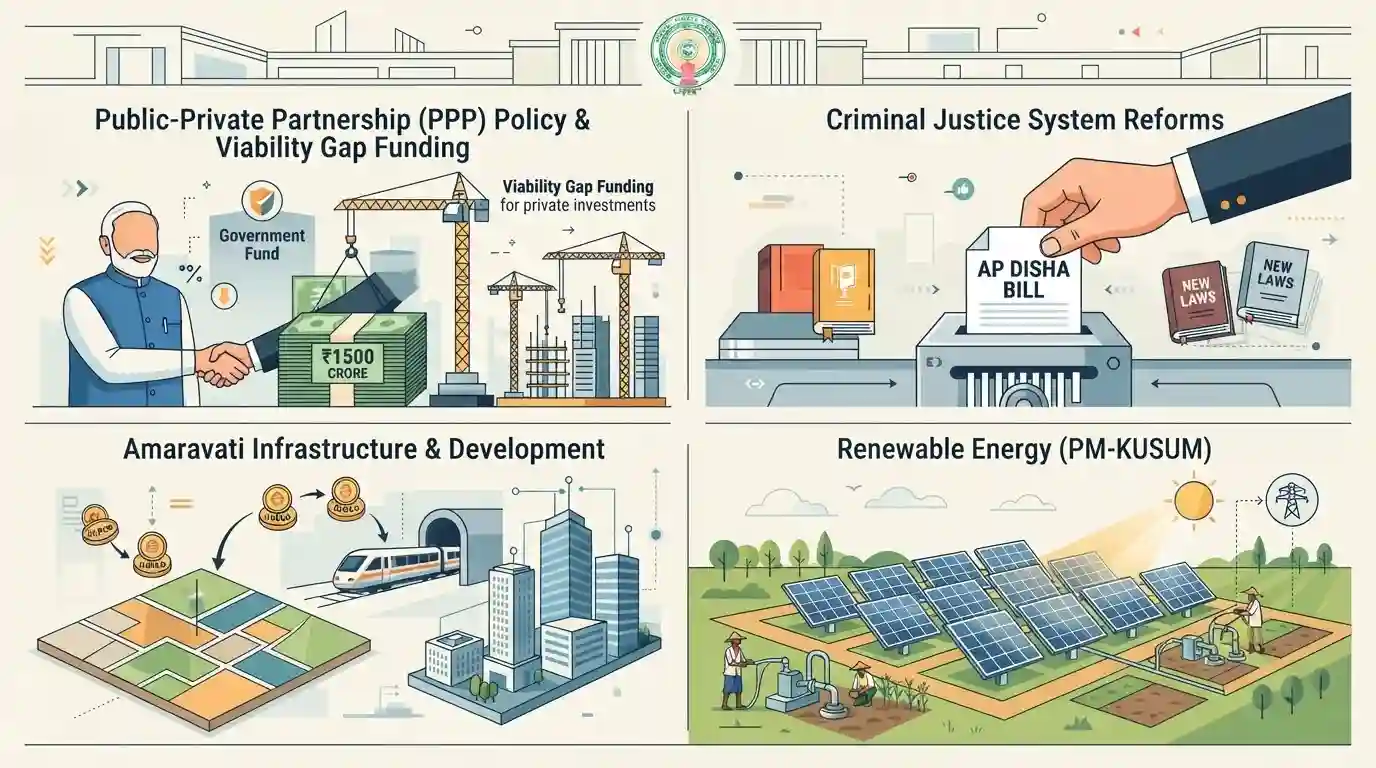
The Andhra Pradesh Cabinet, chaired by Chief Minister N. Chandrababu Naidu, approved several significant policy and infrastructure initiatives. A major highlight is the Draft Public-Private Partnership (PPP) Policy 2026, which introduces a Viability Gap Funding of Rs 1,500 crore to spur private investments. The Cabinet also decided to withdraw the AP Disha Bill due to the recent implementation of new central criminal laws. Furthermore, substantial progress was green-lit for the Amaravati capital region, including land pooling for railway lines, tech park towers, and loans from HUDCO for development. Renewable energy received a boost with land transfers for solar projects under the PM-KUSUM scheme.
Key Points
- The AP Cabinet approved the Draft PPP Policy 2026, creating an empowered committee and allocating Rs 1,500 crore for Viability Gap Funding (VGF) along with a Bridge Fund to attract private investments.
- The government decided to withdraw the Andhra Pradesh Disha Bill, citing its redundancy following the enactment of new central criminal laws like the Bharatiya Nyaya Sanhita.
- Key Amaravati infrastructure projects were cleared, including the Amaravati Eye project, twin towers in the Quantum Valley Tech Park, and land pooling for a new 56.53-km railway line.
- Land will be transferred for a 220 MW solar power plant by SECI and an 800 MW plant by APGECL under the central government's PM-KUSUM scheme.
- Rs 210.06 crore was sanctioned for constructing bathing ghats and upgrading infrastructure ahead of the Godavari Pushkaralu-2027.
- A tariff subsidy of Rs 1.5 per unit was approved for aquaculture farmers across 54,635 connections in the state.
Important Terms
AP Disha Bill

A 2019 Andhra Pradesh bill proposing the death penalty for rape and expedited trials. It was withdrawn in 2026 as its objectives are now covered under India's new central criminal laws.
UPSC context
GS-2 (Polity): Highlights Centre-State legislative alignment (Article 254) and systemic criminal justice reforms concerning women's safety.
Draft PPP Policy 2026
An Andhra Pradesh policy framework designed to attract private investment by introducing ₹1,500 crore in Viability Gap Funding (VGF) and a Bridge Fund for financially unviable projects with long-term potential.
UPSC context
GS-3 (Infrastructure, Investment Models): Demonstrates how states utilize financial structuring tools like VGF to facilitate Public-Private Partnerships.
Bharatiya Nyaya Sanhita, 2023
The central criminal code that replaced the Indian Penal Code, 1860. It strengthens penalties for crimes against women and children, prompting states to withdraw redundant local laws like the Disha Bill.
UPSC context
GS-2 (Governance): Represents the modernization of India's substantive criminal laws and broader criminal justice system reforms.
Bharatiya Nagarik Suraksha Sanhita, 2023
The procedural criminal code replacing the Code of Criminal Procedure (CrPC), 1973. It establishes modern legal procedures, time-bound investigations, and regulates the functioning of law enforcement agencies and courts.
UPSC context
GS-2 (Judiciary): Central to systemic procedural reforms, aiming for swifter trials and modernized law enforcement practices.
PM-KUSUM Scheme
A flagship Central scheme promoting solar energy adoption among farmers by supporting the installation of standalone solar pumps and grid-connected agricultural solar power plants on barren lands.
UPSC context
GS-3 (Renewable Energy, Agriculture): Vital for achieving agricultural energy security, reducing carbon footprints, and boosting farm incomes.
Omnibus Ease of Doing Business Law
A comprehensive legislative measure cleared by the Andhra Pradesh government to simplify regulatory compliances, streamline approvals, and eliminate bureaucratic bottlenecks to attract regional industrial investments.
UPSC context
GS-3 (Economic Development): Illustrates state-level structural economic reforms and competitive federalism to improve the local business environment.
Prelims Trap
Viability Gap Funding (VGF) is structured as a low-interest long-term loan or equity stake provided by the government.
VGF is strictly a one-time, non-repayable capital grant (subsidy) aimed at rendering infrastructure projects commercially viable; it is never a loan or equity investment.
Static Concepts Connected
What is the mechanism of Viability Gap Funding (VGF) for infrastructure in India?
- Core Nature: A one-time capital grant administered by the Ministry of Finance to support economically essential but financially unviable PPP projects.
- Funding Limit: Normally capped at 20% of the Total Project Cost (TPC) by the Central Government, with an option for states to match.
- Eligibility: Projects must be implemented by private developers selected through open competitive bidding, providing services to the public.
How does Article 254(2) govern conflicts between Central and State laws?
- Concurrent List: Applies specifically when a state law is repugnant to a central law on a subject under the Concurrent List (List III).
- Presidential Exception: The state law prevails within that state if it has been reserved for and received the assent of the President.
- Parliamentary Supremacy: Parliament retains the ultimate power to override such state law by enacting subsequent legislation on the same matter.
Cross-Topic Patterns
Criminal Law Reforms and State Autonomy
Explores the tension between central codification (like BNS) and state-specific criminal legislations (like Disha), highlighting the limits of asymmetric federalism.
Decentralized Solar and PM-KUSUM Reforms
Highlights how state-level land allocation for solar projects directly feeds into agricultural subsidy reduction, transforming farm electricity from a fiscal drain to green energy.

Analysis of Article 254(2) and parliamentary override limits will likely frame a 2026 Mains question on asymmetric federalism.
Linked PYQs · 3
Linked PYQs · 3
- 2024APPSC_PRELIMSGS1
The Interim Union Budget (FY25) has proposed initiatives to boost India's Green Energy Sector. Which of the following proposals are connected with developing India's Green Energy ? I. Viability Gap Funding (VGF) for utilizing solar energy projects II. To set up coal gasification and liquefaction capacity of 100MT by 2030 III. Optional blending of Compressed Bio Gas (CBG) in Compressed Natural Gas (CNG) for transport and Piped Natural Gas (PNG) for domestic purposes IV. Provision of financial assistance for procurement of biomass aggregation machinery V. Setting up of a payment security system for expanding the bio-manufacturing system in the country Select the correct answer using the codes given below :
- 2024APPSC_PRELIMSGS1
The strategic objective of Asset Monetization Programme may be explained as :
- 2023APPSC_PRELIMSGS1
Government of Andhra Pradesh is implementing YSR Rythu Bharosa - PM Kisan Scheme for the benefit of farmers of Andhra Pradesh. Which of the following statements are correct about the above scheme ?
