Andhra Pradesh Ranks High in Rooftop Solar Scheme Implementation
Source:theprint ↗
Why It Matters
This development is highly relevant for APPSC Group 1 Prelims as it combines India's national renewable energy push (PM Surya Ghar Muft Bijli Yojana) with Andhra Pradesh's state-specific execution and targeted welfare models (Utility-Led Aggregation for SC/ST and BCs). Candidates must track the state's progress in green energy and its unique subsidy interventions.
Summary
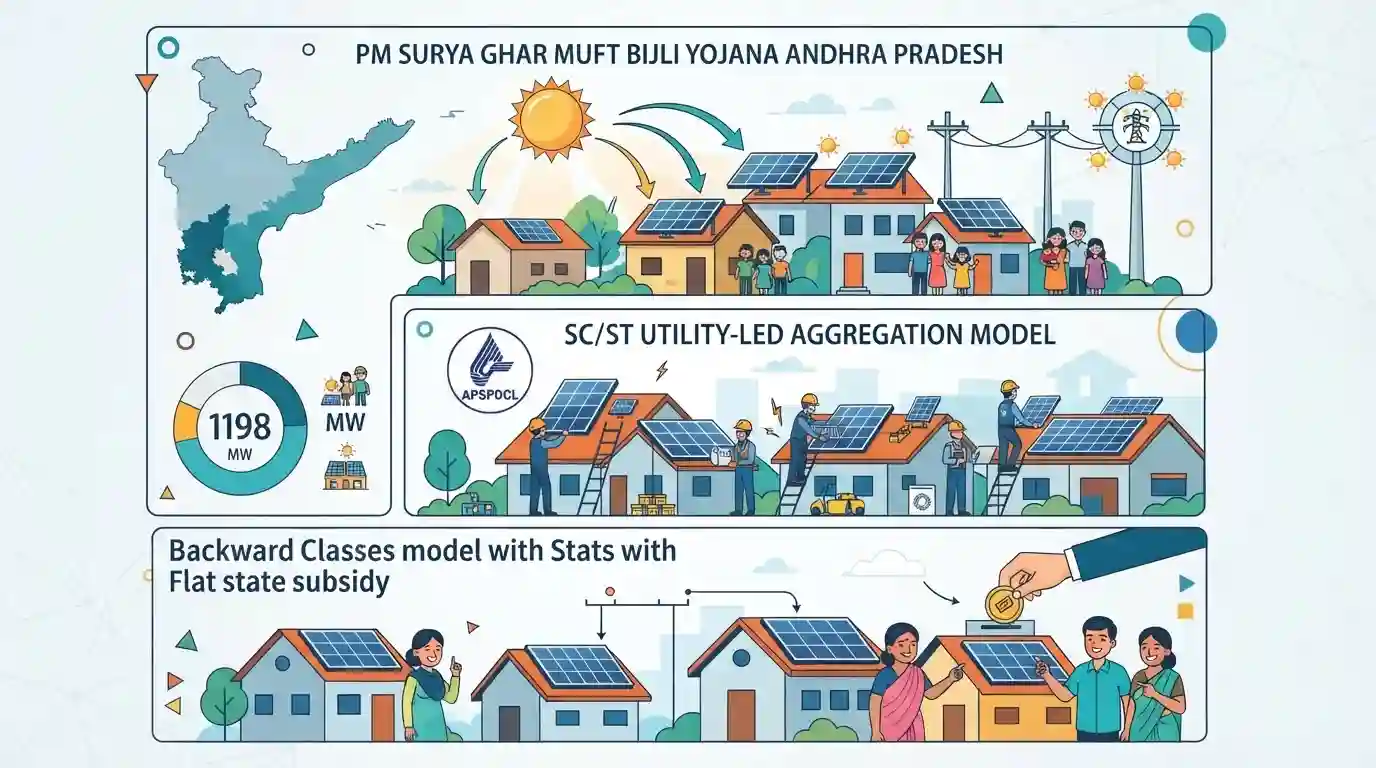
Andhra Pradesh has emerged as a leading state in implementing the Centre's PM Surya Ghar Muft Bijli Yojana, targeting a cumulative rooftop solar capacity of 1198 MW under the SC/ST Utility-Led Aggregation Model. With over 4 lakh systems covered and APSPDCL leading execution among state DISCOMs, the state government is also proposing a dedicated utility-led aggregation model for Backward Classes, featuring a flat state subsidy.
Key Points
- Andhra Pradesh ranks among the top four states in India in the implementation of the PM Surya Ghar Muft Bijli Yojana, covering over 4 lakh rooftop solar systems.
- The state targets a cumulative solar capacity of 1198 MW under the SC/ST Utility-Led Aggregation Model.
- Among state power distributors, APSPDCL recorded the highest implementation progress at 47%, followed by APCPDCL and APEPDCL.
- The Andhra Pradesh government has proposed a similar Utility-Led Aggregation Model for Backward Classes, offering a one-time subsidy of Rs 20,000 for every 2 kW rooftop system.
Important Terms
PM Surya Ghar Muft Bijli Yojana

A 2024 central government scheme providing subsidies up to ₹78,000 for installing residential rooftop solar systems, aiming to solarize one crore households and provide up to 300 units of free electricity monthly.
UPSC context
GS Paper 3 (Renewable Energy/Infrastructure). Tests government initiatives for energy security and clean energy transition.
Utility-Led Aggregation Model
An implementation model where state electricity DISCOMs handle demand aggregation, vendor management, and financing for rooftop solar installations, primarily aimed at enabling access for low-income and small-capacity households.
UPSC context
GS Paper 3 (Energy). Highly relevant for understanding policy implementation models and inclusive infrastructure deployment.
APSPDCL (Andhra Pradesh Southern Power Distribution Company Limited)
The state-owned electricity distribution company serving southern Andhra Pradesh and Rayalaseema, responsible for implementing policies like net metering and rooftop solar subsidies in its jurisdiction.
UPSC context
GS Paper 3 (Infrastructure/Energy) and State PSCs. Tests understanding of DISCOMs' role in executing national renewable schemes locally.
Prelims Trap
"PM Surya Ghar relies solely on Central funds, barring states from providing additional state-level subsidies."
States are permitted to add top-up subsidies. Andhra Pradesh’s proposed one-time flat subsidy of ₹20,000 for Backward Classes under the aggregation model exemplifies state-level interventions supplementing Central funds.
Static Concepts Connected
What are the core features of the PM Surya Ghar Muft Bijli Yojana?
- Target: Aims to provide up to 300 units of free electricity every month to 1 crore residential households.
- Financial support: Central scheme with a ₹75,021 crore outlay, offering up to 60% subsidy for 2kW systems and 40% for the next 1kW.
- Nodal agencies: State DISCOMs act as the primary implementation agencies at the ground level, ensuring grid integration and net-metering.
What is the Utility-Led Aggregation (ULA) model for rooftop solar?
- Demand pooling: DISCOMs aggregate rooftop solar demand across numerous consumers in a specific area to achieve economies of scale and standardized procurement.
- Capex mitigation: Helps overcome the high upfront capital cost barrier, making solar adoption viable for low-income households (like SC/STs).
- Grid stability: Allows distribution utilities better control over distributed generation, minimizing voltage fluctuations and transformer overloading.
Cross-Topic Patterns
Green Transition + Social Welfare
Utility-led aggregation shifts solar from a premium good to a welfare tool, bypassing capital barriers for marginalized SC/ST/BC households and linking GS3 environment goals with GS2 social justice.
DISCOM Finances + Distributed Energy
Subsidizing rooftop solar for low-income households reduces the aggregate cross-subsidy burden on DISCOMs, simultaneously boosting renewable capacity and improving utility financial health.

Expect a 2026 Prelims multi-statement question combining PM Surya Ghar subsidy tiers with RESCO and Utility-Led Aggregation models.
Linked PYQs · 2
Linked PYQs · 2
- 2024APPSC_PRELIMSGS1
Which of the following statements are valid in connection with Andhra Pradesh Green Hydrogen and Green Ammonia Policy (2023)? I. The objective is to target Green Energy production up to the capacity of 1 MPTA (Million Tonnes Per Annum) or Green Ammonia production up to the capacity of 2-0 MTPA in the next five years. II. New and Renewable Energy Development Corporation of A.P. Ltd (NREDCAP) shall act as a Nodal Agency under this policy. III. All the Ports in the State have infrastructure for storing liquid nitrogen which can then be utilized for storing Green Hydrogen for exporting to other countries. IV. The Policy prohibits the production of Green Hydrogen/Green Ammonia by using Renewable Energy and/or Biomass from 'Third-Party/Power exchange'. Select the correct answer using the codes given below :
- 2024APPSC_PRELIMSGS1
The Interim Union Budget (FY25) has proposed initiatives to boost India's Green Energy Sector. Which of the following proposals are connected with developing India's Green Energy ? I. Viability Gap Funding (VGF) for utilizing solar energy projects II. To set up coal gasification and liquefaction capacity of 100MT by 2030 III. Optional blending of Compressed Bio Gas (CBG) in Compressed Natural Gas (CNG) for transport and Piped Natural Gas (PNG) for domestic purposes IV. Provision of financial assistance for procurement of biomass aggregation machinery V. Setting up of a payment security system for expanding the bio-manufacturing system in the country Select the correct answer using the codes given below :
