Mesopotamian Ancient Pottery Revealing Early Mathematical Concepts
Source:Indian Express ↗
Why It Matters
It showcases the evolutionary roots of human cognition and abstract thinking, illustrating how the intersection of art and mathematics shaped early human cultural development. This provides context for the study of prehistoric art and early scientific achievements.
Summary
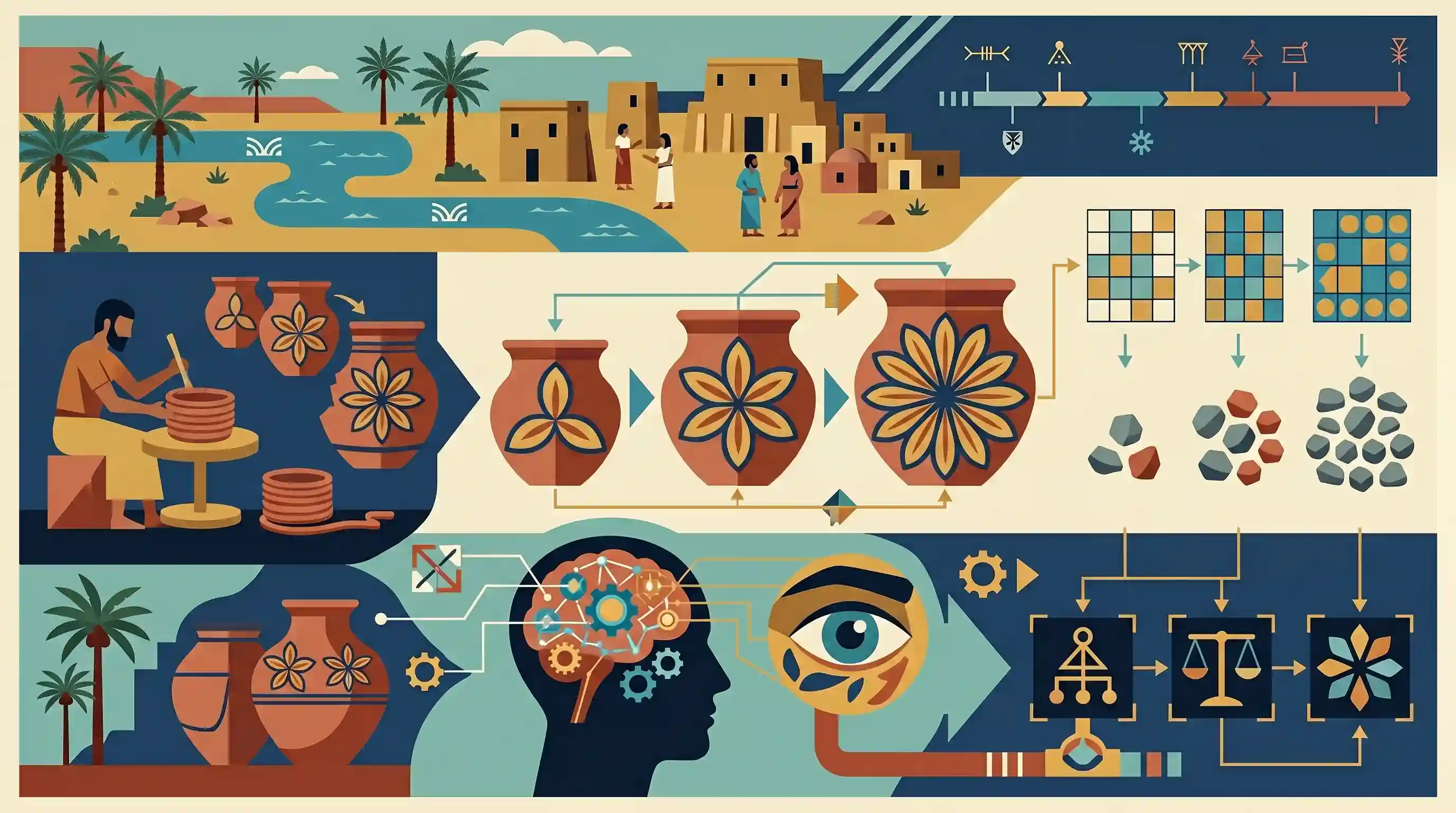
Ancient pottery from the Mesopotamian Halafian culture (6200 BC - 5500 BC) reveals intricate flower patterns with petals doubling in numbers, suggesting early human understanding of complex mathematical concepts like scaling and proportionality. These findings imply that ancient artistic and aesthetic endeavors served as early vehicles for mathematical thinking, long before the invention of written numeric systems.
Key Points
- Halafian culture (6200-5500 BC) in Mesopotamia produced painted pottery featuring repeating flower motifs with petals numbering 4, 8, 16, 32, or 64.
- These patterns suggest early mathematical thinking focused on doubling, scaling, and proportionality, predating written numbers or equations by thousands of years.
- The findings imply that ancient humans utilized artistic and aesthetic ornamentation to explore and express abstract mathematical concepts.
- While scholars debate whether this reflects structured mathematical cognition or just aesthetic design, the artifacts highlight how foundational mathematics evolved from spatial understanding.
Prelims Trap
The Halafian culture of the Indus Valley provides the earliest written evidence of a mathematical binary system.
Halafian culture is Mesopotamian, not Harappan. Furthermore, its mathematics is expressed through aesthetic pottery patterns, entirely predating actual written numeric systems.
Static Concepts Connected
What characterized the standardized weight system of the Harappan Civilization?
- Material and Shape: Typically made of chert stone, the weights were cubical in shape and fundamentally devoid of any written markings.
- Binary Lower Weights: Lower denominations strictly followed a binary system (1, 2, 4, 8, 16, 32), conceptually mirroring geometric doubling seen in earlier cultures.
- Decimal Higher Weights: Higher denominations shifted to a decimal system, showcasing advanced mathematical structuring designed to support extensive macro-economic trade.
What archaeological evidence proves Harappan-Mesopotamian trade relations?
- Mesopotamian Texts: Ancient cuneiform inscriptions explicitly refer to trade with 'Meluhha', a term historians widely identify as the Indus Valley region.
- Harappan Artifacts: Distinctive Harappan seals, etched carnelian beads, and specific dice have been excavated at Mesopotamian sites like Ur and Susa.
Cross-Topic Patterns
Mathematics in ancient aesthetics
Just as Mesopotamian pottery reveals early geometric scaling, Indian temple architecture utilizes fractal geometry and precise proportional symmetry, demonstrating how art historically served as a canvas for scientific thought.
Standardization and ancient trade
The transition from aesthetic binary patterns (Halafian) to functional binary weights (Harappan) illustrates how abstract mathematical cognition was eventually utilized to build trans-regional, standardized economic trade networks.

Expect a multi-statement prelims question comparing Harappan standardized binary weight systems with contemporary Mesopotamian trade links.
Linked PYQs · 2
Linked PYQs · 2
- 2024PrelimsGS1
Consider the following information (Archaeological Site — State — Description): 1. Chandraketugarh — Odisha — Trading port town 2. Inamgaon — Maharashtra — Chalcolithic site 3. Mangadu — Kerala — Megalithic site 4. Salihundam — Andhra Pradesh — Rock-cut cave shrines In which of the above rows is the given information correctly matched?
- 2020MainsGS1
The rock-cut architecture represents one of the most important sources of our knowledge of early Indian art and history. Discuss.
