Customs Seizes Ancient Kushan and Mughal Era Coins at Mumbai Airport
Source:Indian Express ↗
Why It Matters
Numismatics is a fundamental topic in UPSC GS Paper 1 for understanding ancient and medieval history. The smuggling of historical artifacts also touches upon the safeguarding of Indian art heritage, making the Antiquities and Art Treasures Act highly relevant for both Prelims and Mains.
Summary
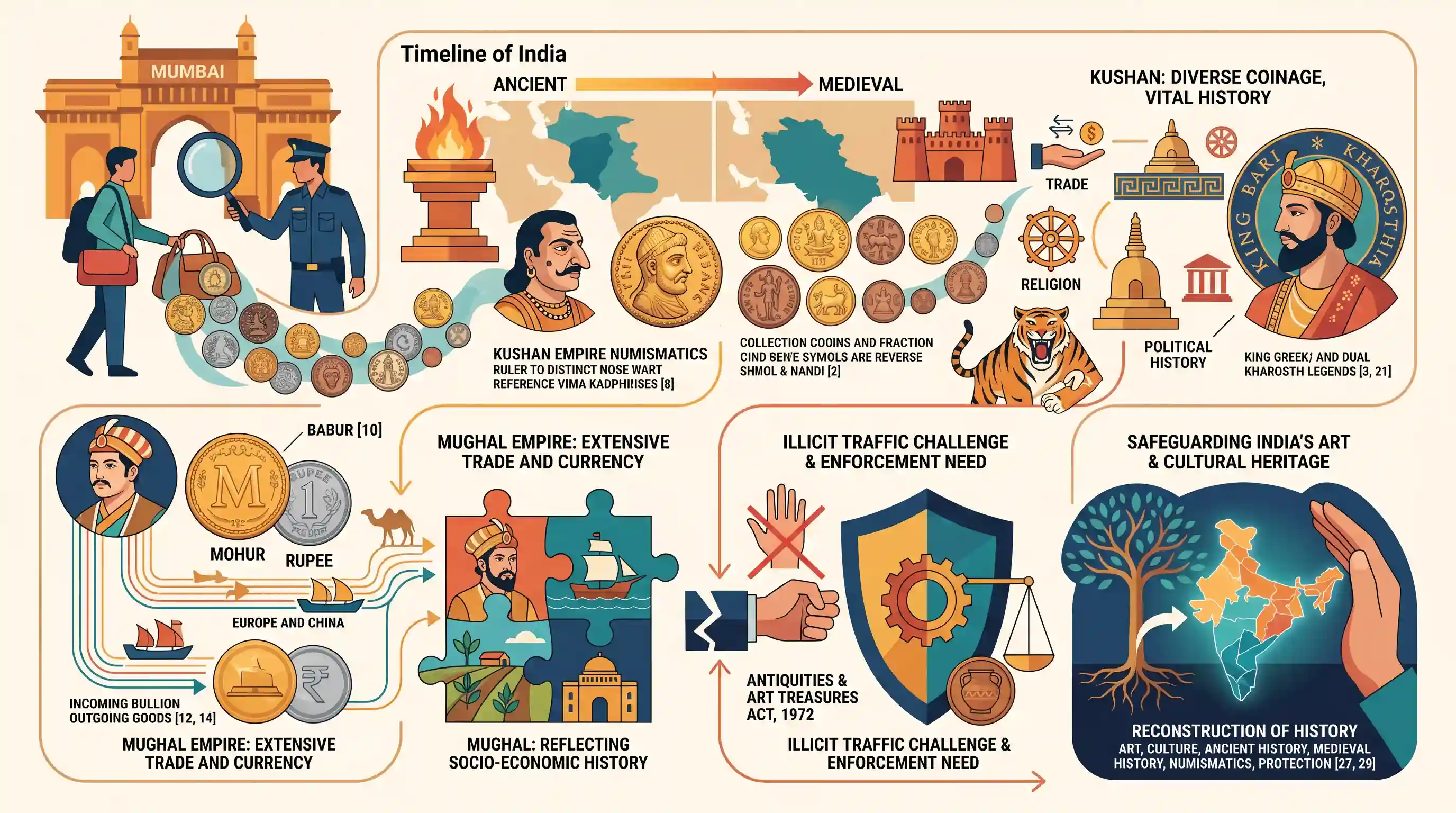
Customs authorities at the Mumbai airport seized a collection of ancient Kushan Empire and medieval Mughal-era coins from a passenger attempting to smuggle them. These coins are invaluable numismatic sources that help reconstruct the socio-economic, political, and cultural history of ancient and medieval India. The Kushan period is particularly noted for its diverse coinage, while Mughal currency reflects the extensive trade networks of the era. The seizure brings to light the ongoing challenges in preventing the illicit trafficking of historical artifacts and emphasizes the critical need to enforce the Antiquities and Art Treasures Act, 1972, to safeguard India's rich art and cultural heritage.
Key Points
- Customs officials at Mumbai airport seized ancient coins belonging to the Kushan Empire and the Mughal era from a passenger.
- The Kushan coins represent a significant period in ancient Indian numismatics, known for featuring a blend of Indian, Greek, and Iranian deities on gold and copper currency.
- Mughal-era coins are vital artifacts of medieval history, providing insights into the economic and administrative systems of the time.
- The incident underscores the persistent threat of antiquities smuggling and the illicit trade of India's cultural artifacts.
- Such seizures highlight the enforcement of the Antiquities and Art Treasures Act, 1972, which prohibits the illegal export of antiquities and cultural heritage items.
Important Terms
Antiquities and Art Treasures Act, 1972

A legislation regulating the trade and export of objects older than 100 years (antiquities) to prevent smuggling and preserve India's cultural wealth.
UPSC context
GS Paper I (Art & Culture); tests knowledge of heritage protection laws and the legal definition of an 'antiquity.'
Archaeological Survey of India (ASI)
The premier government agency under the Ministry of Culture responsible for archaeological research, excavation, and the conservation of over 3,600 national monuments.
UPSC context
GS Paper I & II; tests understanding of institutional frameworks for heritage management and conservation.
Kushan Coinage
The first major Indian currency to feature substantial gold issues, depicting a syncretic pantheon of Greek, Iranian, and Indian deities, reflecting extensive Silk Road trade.
UPSC context
GS Paper I (Ancient History); tests knowledge of historical sources, trade connectivity, and early coinage evolution.
Mughal Coinage
A standardized tri-metallic currency system (gold Mohur, silver Rupee, copper Dam) celebrated for its high purity and role in the empire's robust trade economy.
UPSC context
GS Paper I (Medieval History); tests understanding of Mughal administration, fiscal standardization, and economic history.
Numismatics
The scientific study of coins and currency, serving as a critical primary source for reconstructing the political, economic, and religious history of India.
UPSC context
GS Paper I (History); tests the use of material evidence to verify and supplement literary historical records.
Customs Act, 1962
The primary law governing the import and export of goods in India, providing the legal framework to prevent smuggling and collect customs duties.
UPSC context
GS Paper III (Internal Security/Economy); tests knowledge of border management and the prevention of illicit cross-border trade.
Prelims Trap
"The Kushan Empire was the first dynasty to introduce gold coins in ancient India."
The Indo-Greeks were the first to issue gold coins in India. The Kushans were the first to issue gold coins on a *large scale* and with high purity.
Static Concepts Connected
What are the distinguishing features of Kushan coinage?
- Cultural Syncretism: Coins displayed remarkable religious syncretism, featuring Indian (e.g., Shiva, Buddha), Greek, and Iranian deities side-by-side.
- Bilingual Scripts: Coin legends were predominantly inscribed using Greek and Kharoshthi scripts.
- Gold Purity: They were the first Indian dynasty to mint high-purity gold coins on a massive scale, reflecting robust trade networks.
What defines an 'antiquity' under the Antiquities and Art Treasures Act, 1972?
- Age Criteria: Any coin, sculpture, painting, or epigraph that has existed for at least 100 years. For manuscripts and records, the threshold is 75 years.
- Export Restriction: Strict prohibition on export by private individuals. Only the Central Government or its authorized agencies can legally export antiquities.
- Mandatory Registration: Private owners must mandatorily register specified categories of antiquities with the Archaeological Survey of India (ASI).
Cross-Topic Patterns
Numismatics & Medieval Economic History
UPSC frequently tests coins as economic indicators, seen in the 2022 Prelims question on 'Fanam' and recurring themes around the standardized tri-metallic Mughal currency system.
Heritage Smuggling & Border Security
Antiquities smuggling bridges GS1 Heritage with GS3 Transnational Organized Crime, highlighting enforcement gaps in the Antiquities Act and the role of Customs at international borders.

Expect a paired-matching Prelims question linking specific rulers (Jahangir's zodiac, Kushans' syncretic deities) to coin innovations.
Linked PYQs · 3
Linked PYQs · 3
- 2017MainsGS1
How do you justify the view that the level of excellence of the Gupta numismatic art is not at all noticeable in later times?
- 2022PrelimsGS1
In medieval India, the term "Fanam" referred to:
- 2018MainsGS1
Safeguarding the Indian art heritage is the need of the moment. Discuss.
