Adivasi Women Property Rights and Constitutional Gender Equality
Source:Indian Express ↗
Why It Matters
It addresses the intersection of gender justice, tribal customary laws, and constitutional supremacy, which is crucial for questions on fundamental rights and tribal welfare in GS Paper 2.
Summary
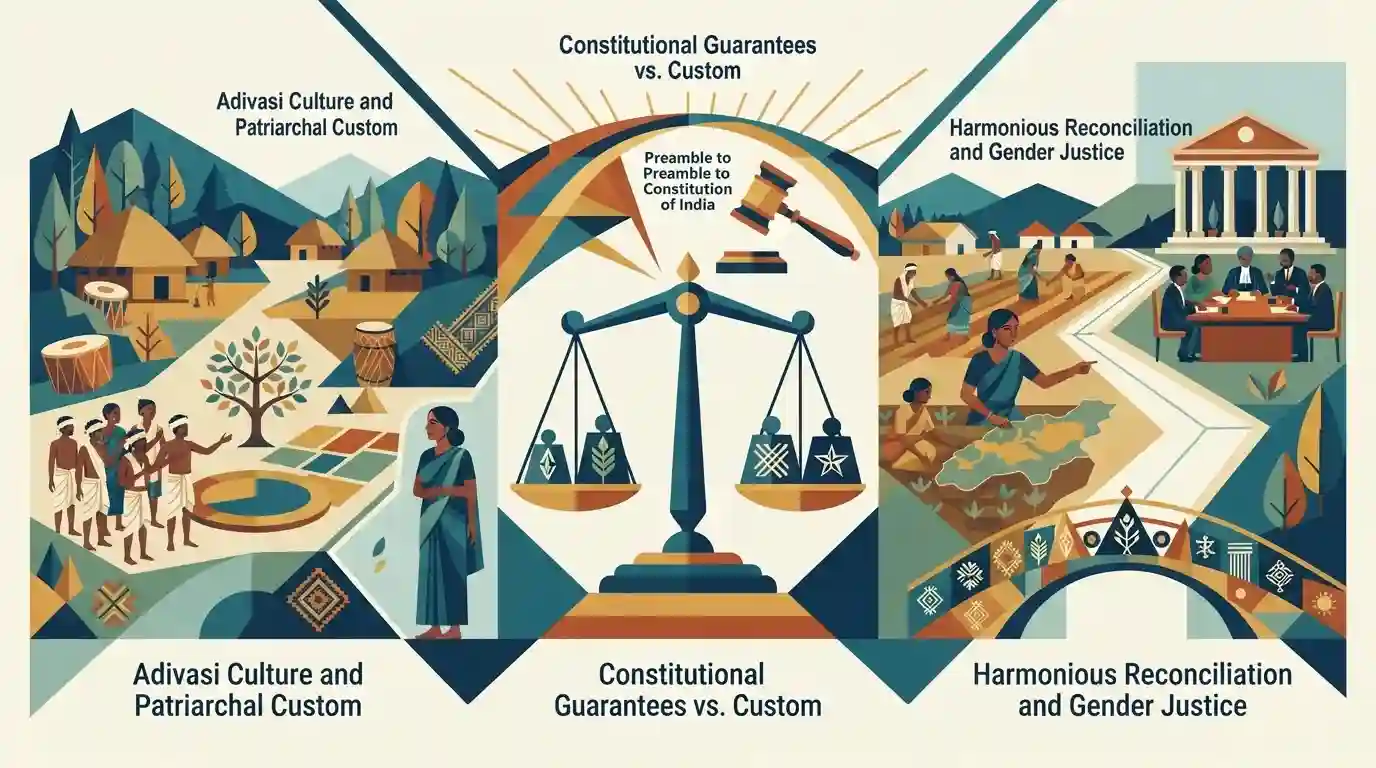
The article examines the critical issue of ancestral property rights for Adivasi women, highlighting the tension between constitutional guarantees of gender equality and patriarchal customary laws. It underscores how indigenous traditions often deny women inheritance rights, calling for a harmonious reconciliation that upholds constitutional morality while respecting tribal culture.
Key Points
- Adivasi women face systemic discrimination regarding ancestral property rights due to patriarchal customary laws that override constitutional guarantees of gender equality.
- Customary practices often supersede statutory protections for tribal women, creating a clash between constitutional principles and tribal traditions.
- Balancing the protection of indigenous cultural identity with the fundamental right to gender equality remains a complex legal and social challenge in India.
- Judicial and legislative reforms are imperative to ensure that Adivasi women secure fair property and inheritance rights without compromising constitutional morality.
Important Terms
Constitution of India

The supreme law of India establishing the structural framework, fundamental rights, directive principles, and duties of government organs, balancing constitutional morality with progressive gender justice and tribal rights.
UPSC context
UPSC Prelims/Mains (GS Paper II): Tests core polity concepts, fundamental rights, constitutionalism, and the interplay between fundamental rights and customary practices.
Fifth Schedule
A constitutional provision under Article 244(1) providing special governance and administrative mechanisms for Scheduled Areas in states other than Assam, Meghalaya, Tripura, and Mizoram to protect tribal interests.
UPSC context
UPSC Prelims/Mains (GS Paper II): Crucial for polity and governance, federalism, tribal administration, and protection of vulnerable sections.
Sixth Schedule
Provisions under Article 244(2) and Article 275(1) providing for Autonomous District Councils (ADCs) to protect tribal autonomy, land rights, and culture in the Northeastern states of Assam, Meghalaya, Tripura, and Mizoram.
UPSC context
UPSC Prelims/Mains (GS Paper II): Important for federalism, decentralisation, regional autonomy, and protection of tribal cultures in Northeast India.
Supreme Court of India
The apex judicial body of India empowered under Article 141 to declare law, protect fundamental rights, and reconcile constitutional morality with customary laws affecting marginalized groups like Adivasi women.
UPSC context
UPSC Mains (GS Paper II): Evaluates judicial review, judicial activism, gender justice jurisprudence, and rights of Scheduled Tribes.
Prelims Trap
The Hindu Succession Act, 1956 automatically secures equal ancestral property rights for all women in India, including Scheduled Tribe women.
Aspirants often assume central secular family laws like the Hindu Succession Act apply uniformly across all Indian citizens, missing that Section 2(2) expressly excludes Scheduled Tribes.
Static Concepts Connected
What are the constitutional provisions governing Scheduled Tribes and customary law in India?
- Hindu Succession Act: Excludes STs from Hindu personal laws under Section 2(2), leaving their inheritance to customary law unless a notification extends central statutes.
- Sixth Schedule autonomy: Provides administration of tribal areas in states like Assam, Meghalaya, Tripura, and Mizoram, granting district councils wide legislative power over social customs and inheritance.
- Fifth Schedule power: Gives the Governor power to direct that any particular central or state act shall not apply to a Scheduled Area or apply with specified modifications.
Cross-Topic Patterns
Scheduled Tribes vs. Gender Equality Jurisprudence
While the Constitution shields tribal customs via the Fifth and Sixth Schedules, fundamental rights under Part III guarantee gender equality, creating an ongoing judicial balancing act.
Hindu Succession Act and Customary Exemptions
The explicit exclusion of STs from the Hindu Succession Act mirrors debates in the Uniform Civil Code, where religious and customary exemptions conflict with gender justice.

Adivasi women's property rights vs Fifth Schedule autonomies will be tested in a multi-statement Prelims question on statutory vs customary law.
Linked PYQs · 2
Linked PYQs · 2
- 2023MainsGS2
Explain the constitutional perspectives of Gender Justice with the help of relevant Constitutional Provisions and case laws.
- 2022PrelimsGS1
If a particular area is brought under the Fifth Schedule of the Constitution of India, which one of the following statements best reflects the consequence of it ?
