Ancestral Property Rights for Adivasi Women and Customary Law
Source:Indian Express ↗
Why It Matters
It addresses the intersection of gender justice and tribal rights, a vital theme under GS Paper 2 (Constitution, Vulnerable Sections, and Social Justice) and GS Paper 1 (Indian Society).
Summary
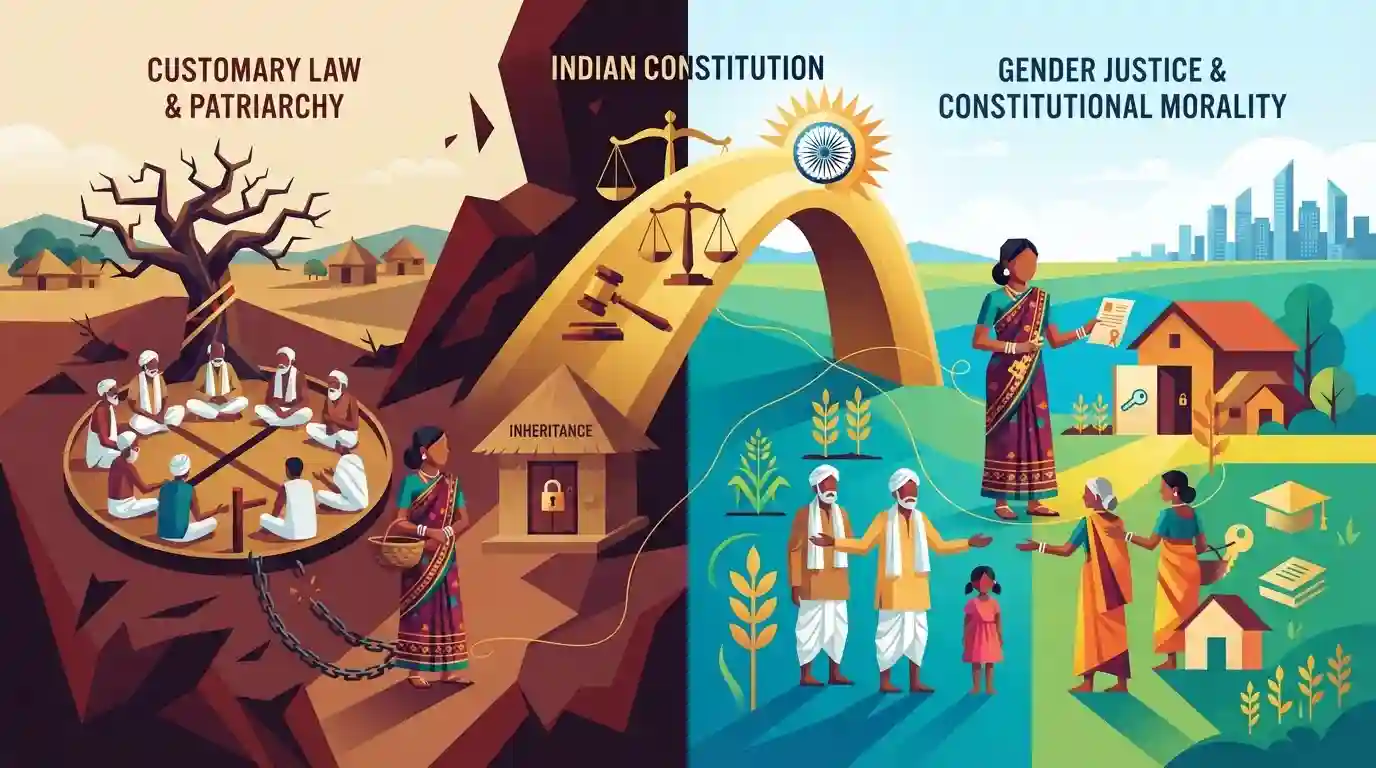
The editorial discusses the critical issue of ancestral property rights for Adivasi women, highlighting the tension between constitutional promises of gender equality and patriarchal customary laws that deny women inheritance rights. It underscores the need to harmonize cultural preservation with gender justice under the framework of the Indian Constitution.
Key Points
- Adivasi women in India often face systemic exclusion from ancestral property rights due to patriarchal customary laws that override statutory protections.
- While constitutional guarantees promise equality and non-discrimination based on gender (Articles 14 and 15), tribal customary practices frequently enjoy legal protections or exemptions under specific schedules and personal laws.
- Balancing the preservation of unique tribal cultures and customary laws with the fundamental right to gender justice remains a critical constitutional challenge.
- Judicial interventions and progressive legal reforms are necessary to bridge the gap between constitutional mandates of equality and lived realities of tribal women.
Important Terms
Constitution of India

The supreme law of India that guarantees fundamental rights, including gender equality and non-discrimination, serving as the benchmark against which patriarchal customary laws must be evaluated.
UPSC context
GS Paper II (Indian Constitution - features, amendments, and basic structure). Tests understanding of constitutional supremacy and fundamental rights vs personal/customary laws.
Supreme Court of India
The apex judicial body of India responsible for interpreting the Constitution, which has increasingly emphasized gender justice by ruling in favor of Adivasi women's ancestral property rights over regressive customs.
UPSC context
GS Paper II (Judiciary, Constitutional interpretation, and Public Interest Litigation). Tests knowledge of judicial review and protection of vulnerable sections.
Prelims Trap
Hindu Succession Act, 1956 applies universally to all citizens of India, including Scheduled Tribes and indigenous communities.
Aspirants often assume central civil codes like the Hindu Succession Act automatically apply uniformly across all Indian citizens, missing the explicit statutory exclusion under Section 2(2).
Static Concepts Connected
What are the key constitutional protections and statutory exemptions governing Scheduled Tribes' property rights in India?
- Statutory Exclusion: Section 2(2) exclusion explicitly keeps Scheduled Tribes outside the purview of the Hindu Succession Act, 1956, unless specifically notified by the Centre.
- Schedule Protections: Fifth and Sixth Schedules provide distinct protective governance frameworks for tribal areas, preserving local unwritten customs and land transfer restrictions.
- Constitutional Test: Article 13 defines law to include customs or usages having the force of law, making discriminatory practices vulnerable to judicial review.
Cross-Topic Patterns
Tribal Inheritance Laws and Schedule Governance
Exclusion of Scheduled Tribes from the Hindu Succession Act intersects with Sixth Schedule governance and Fifth Schedule land alienation regulations to define tribal property regimes.
Constitutional Morality vs. Religious Customary Law
The clash between unwritten customary law and Article 14 equality tests mirrors debates around Sabarimala and triple talaq regarding constitutional morality.

Exclusion of STs under Section 2(2) of Hindu Succession Act + Article 14 vs. custom is prime material for a Mains GS-1/GS-2 analytical question.
Linked PYQs · 2
Linked PYQs · 2
- 2023MainsGS2
Explain the constitutional perspectives of Gender Justice with the help of relevant Constitutional Provisions and case laws.
- 2020MainsGS2
Which steps are required for constitutionalization of a Commission ? Do you think imparting constitutionality to the National Commission for Women would ensure greater gender justice and empowerment in India? Give reasons.
