Lowering Cost of Doing Business to Counter Global Tariffs
Source:Indian Express ↗
Why It Matters
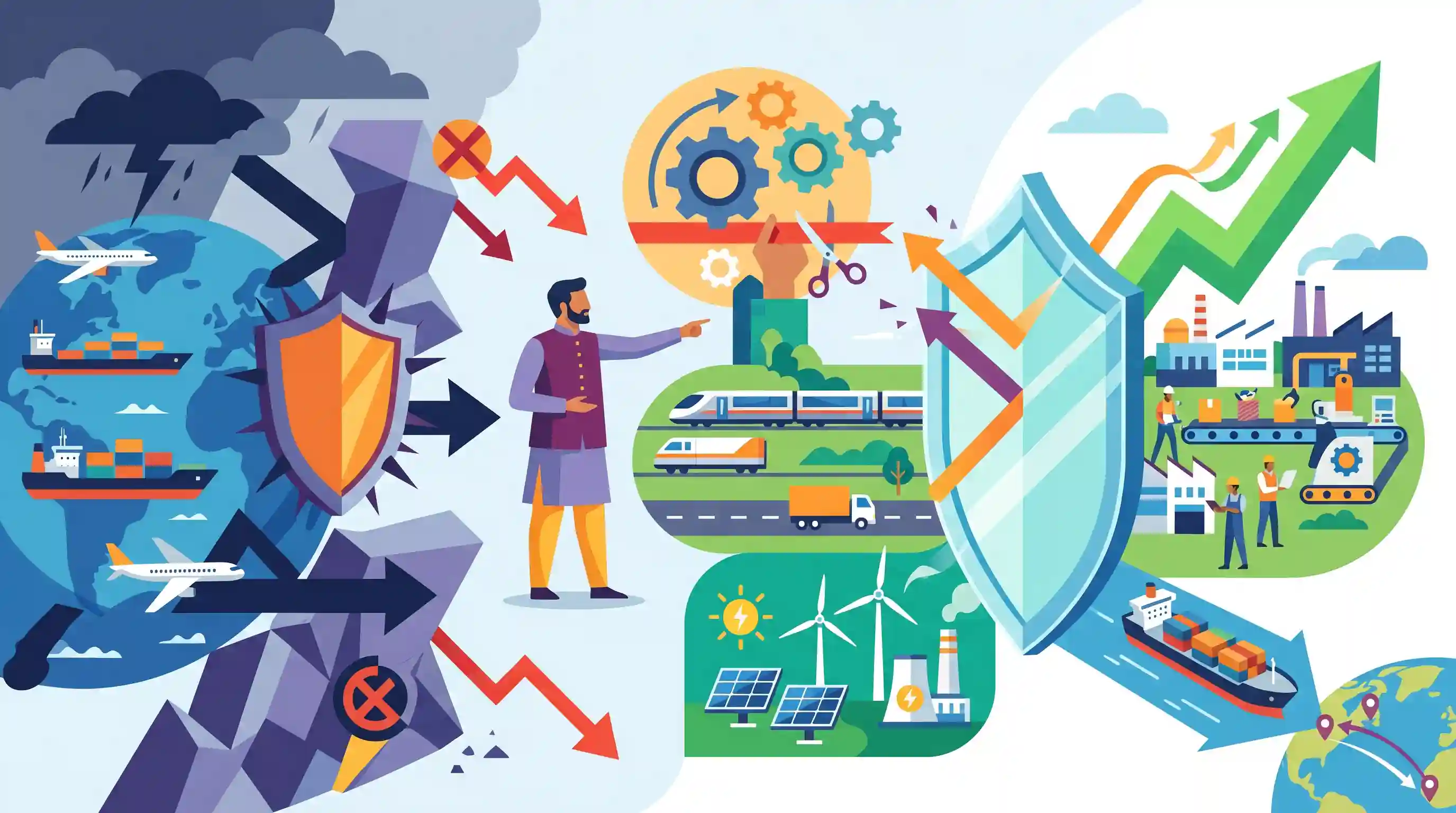
The shift from a multilateral free-trade world to an era of bilateralism and protectionism poses significant challenges for emerging economies. The CEA's insights provide a strategic roadmap for India—emphasizing domestic structural reforms and cost-competitiveness as primary tools to counter external tariff barriers, which is highly relevant for GS3 questions on trade, MSMEs, and industrial policy.
Summary
Chief Economic Advisor V. Anantha Nageswaran highlighted that lowering the domestic cost of doing business is crucial for India to withstand global economic challenges, particularly the rising trend of tariffs and protectionism in international trade. By streamlining regulations, reducing compliance burdens, and addressing structural costs (like logistics and energy), India can foster a highly competitive manufacturing and business ecosystem. This internal efficiency acts as a buffer, allowing domestic enterprises and exporters to absorb the impact of external tariff barriers while maintaining their market share and driving overall economic growth.
Key Points
- Chief Economic Advisor (CEA) V. Anantha Nageswaran emphasized that India must lower the cost of doing business to build a resilient domestic economy capable of navigating global trade shocks.
- As the global trade paradigm shifts towards protectionism and higher tariffs, Indian exporters may face higher barriers; thus, internal competitiveness is essential to offset these external costs.
- Improving the 'Ease of Doing Business' must transition beyond mere regulatory simplifications to actively reducing the 'Cost of Doing Business'—which includes logistics, power tariffs, credit costs, and compliance burdens.
- A streamlined and highly competitive domestic economic environment enables industries (especially manufacturing and MSMEs) to absorb global tariff hikes without losing their price competitiveness in international markets.
Important Terms
Chief Economic Advisor (CEA)

The senior economic advisor within the Ministry of Finance who leads the Economic Division and authors the annual Economic Survey of India.
UPSC context
GS Paper 3: Economic Development. Tests understanding of institutional roles in policy formulation and economic data interpretation.
Protectionism
Trade policies, such as tariffs and quotas, designed to shield domestic industries from foreign competition by making imports more expensive or restricted.
UPSC context
GS Paper 3: Effects of liberalization and international trade. Tests knowledge of global trade barriers and macroeconomic stability.
Cost of Doing Business
The total financial and administrative burden on an enterprise, including structural expenses like logistics, energy, and regulatory compliance, affecting overall competitiveness.
UPSC context
GS Paper 3: Industrial Growth. Tests understanding of manufacturing efficiency and structural reforms to enhance ease of business.
Logistics Cost
The collective expenditure on the movement, storage, and management of goods; high costs (historically ~13-14% of GDP) are a major bottleneck for Indian exports.
UPSC context
GS Paper 3: Infrastructure. Relevant for National Logistics Policy and its role in making Indian manufacturing globally competitive.
Department of Economic Affairs (DEA)
The nodal department under the Ministry of Finance responsible for formulating economic policies, managing capital markets, and preparing the Union Budget.
UPSC context
GS Paper 3: Government Budgeting. Tests knowledge of the administrative machinery behind India's financial and economic management.
Liberalization
The relaxation of government restrictions on economic activities, allowing for greater private sector participation and integration with global markets.
UPSC context
GS Paper 3: Effects of liberalization on the economy. Core concept for understanding India's post-1991 economic trajectory.
Prelims Trap
India's logistics cost remains structurally rigid at 13-14% of GDP, undermining export competitiveness.
Aspirants often memorize the older 13-14% figure. Recent government assessments (DPIIT/NCAER) estimate India's logistics costs have dropped to 7.8–8.9% of GDP for 2023-24.
Static Concepts Connected
How does Cost of Doing Business differ from Ease of Doing Business (EoDB)?
- EoDB Focus: Primarily targets regulatory simplifications, reducing time for administrative approvals, enforcing contracts, and digitizing bureaucratic compliances.
- CoDB Focus: Addresses structural and physical input expenses, including logistics bottlenecks, industrial power tariffs, cost of capital, and land acquisition costs.
What are the main types of trade barriers impacting global competitiveness?
- Tariff Barriers: Direct financial charges, duties, or taxes imposed on imported goods at the border to make them more expensive than domestic products.
- Non-Tariff Measures: Regulatory or policy-based restrictions like Sanitary and Phytosanitary (SPS) measures, Technical Barriers to Trade (TBT), import quotas, and embargoes.
Cross-Topic Patterns
MSME Formalisation + Export Competitiveness
High domestic compliance costs ('regulatory cholesterol') disproportionately hurt MSMEs. Easing these domestic burdens translates directly to export resilience against global tariff shocks.
Protectionism + National Logistics Policy
As global trade shifts to defensive tariffs, India's counter-strategy increasingly relies on the National Logistics Policy and PM Gati Shakti to build cost-buffers for domestic manufacturers.

Expect a 2026 GS3 Mains question linking PM Gati Shakti's logistics cost reduction directly to India's export resilience against tariffs.
Linked PYQs · 5
Linked PYQs · 5
- 2025MainsGS3
What are the challenges before the Indian economy when the world is moving away from free trade and multilateralism to protectionism and bilateralism? How can these challenges be met?
- 2018MainsGS3
How would the recent phenomena of protectionism and currency manipulations in world trade affect macroeconomic stability of India?
- 2023MainsGS3
Faster economic growth requires increased share of the manufacturing sector in GDP, particularly of MSMEs. Comment on the present policies of the Government in this regard.
- 2016PrelimsGS1
India's ranking in the 'Ease of Doing Business Index' is sometimes seen in the news. Which of the following has declared that ranking?
- 2019PrelimsGS1
Which one of the following is not a sub-index of the World Bank's 'Ease of Doing Business Index'?
