Endemic species adaptability and vulnerability in Eastern Ghats
Source:The Hindu ↗
Why It Matters
Species-specific profiles (like the critically endangered Elvira rat) are high-yield for UPSC Prelims Environment questions. The underlying concepts of ecological niches, endemism, and adaptability vs. vulnerability form strong analytical fodder for Mains GS3 biodiversity answers.
Summary
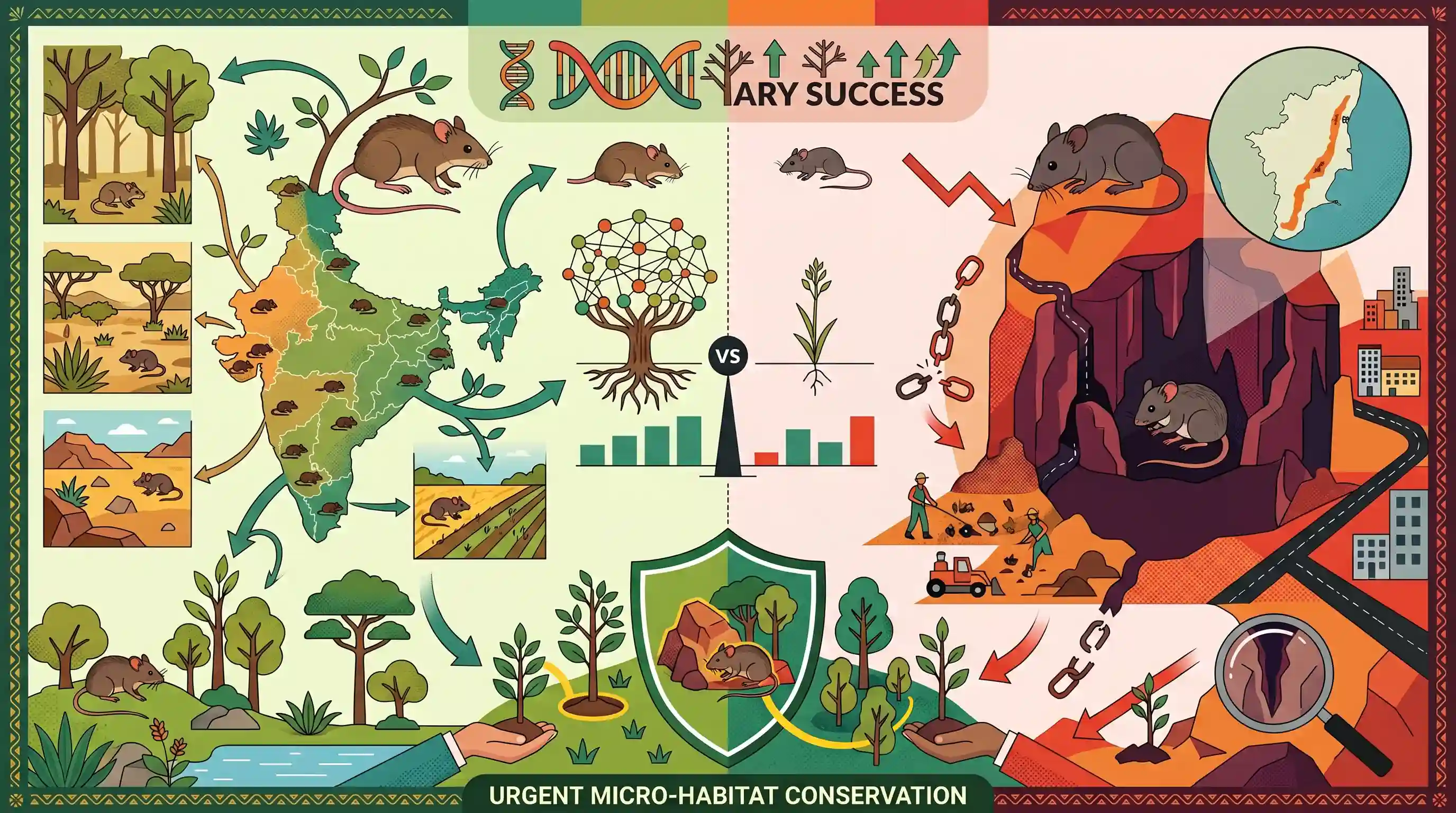
The article contrasts the critically endangered Elvira rat with the widely distributed, resilient Cutch rock rat to explore the biological link between species adaptability and evolutionary success. While the Cutch rock rat flourishes across diverse arid and rocky environments in India, the Elvira rat's survival is severely imperiled by its specialized niche and restricted endemism in the Eastern Ghats of Tamil Nadu. This highlights how narrow ecological adaptability exacerbates a species' vulnerability to habitat fragmentation and human interference, calling for urgent micro-habitat conservation strategies.
Key Points
- The Elvira rat (Cremnomys elvira) is a critically endangered rodent endemic to a highly restricted area in the Eastern Ghats of Tamil Nadu (specifically Salem district), threatened severely by poor adaptability and habitat loss.
- In contrast, the closely related Cutch rock rat (Cremnomys cutchicus) thrives across multiple states including Gujarat and Rajasthan, enjoying a 'Least Concern' conservation status due to its high ecological resilience and broad habitat tolerance.
- The comparison serves as a classic ecological study in evolutionary biology: ecological 'specialists' with narrow niches (Elvira rat) are disproportionately vulnerable to anthropogenic changes, while 'generalists' (Cutch rock rat) adapt and survive.
- The findings underscore the critical need for targeted conservation of microhabitats in the Eastern Ghats, which face significant pressures from deforestation, mining, and agricultural expansion.
Important Terms
IUCN Red List

A global inventory maintained by the IUCN that assesses the extinction risk of biological species based on scientific criteria.
UPSC context
Environment (GS III); crucial for identifying species status in Prelims and Mains conservation questions.
Wildlife Protection Act (WPA), 1972
India's primary legal framework for protecting flora and fauna; the 2022 Amendment rationalized its schedules from six to four.
UPSC context
Governance/Environment (GS II/III); tests knowledge of legal protections, schedules, and recent amendments.
Critically Endangered (CR)
The highest risk category on the IUCN Red List for wild species, signifying they face an extremely high risk of extinction.
UPSC context
Environment (GS III); focus on flagship/endemic species (like Elvira rat) at high risk.
Endemic Species
Species restricted to a specific geographical area and found nowhere else naturally; high vulnerability to habitat loss.
UPSC context
Geography/Environment (GS I/III); key for biodiversity hotspots and regional ecology (Eastern Ghats).
Eastern Ghats
A discontinuous mountain range along India's eastern coast, known for tropical dry deciduous forests and unique endemic biodiversity.
UPSC context
Geography (GS I); understanding physiographic divisions and ecological sensitivity.
Ecological Niche
The functional role or 'job' of a species within its ecosystem, including its use of resources and interactions.
UPSC context
Ecology (GS III); fundamental concept explaining species coexistence and adaptation success.
Prelims Trap
"The Elvira rat is a critically endangered species endemic to the Western Ghats."
Aspirants frequently associate South Indian endemism strictly with the Western Ghats. The Elvira rat is critically endangered but strictly endemic to the Eastern Ghats.
Static Concepts Connected
What is the ecological difference between niche specialists and generalists?
- Niche Specialists: Species with narrow habitat or dietary requirements. Highly efficient in stable conditions but severely vulnerable to habitat fragmentation (e.g., Elvira rat).
- Niche Generalists: Species that thrive across varied environments and diets. Highly adaptable to anthropogenic changes and fluctuating ecological conditions (e.g., Cutch rock rat).
What defines the unique geographical ecology of the Eastern Ghats?
- Geological Fragmentation: Unlike the continuous Western Ghats, they are older, highly fragmented relic mountains divided by major peninsular rivers, creating isolated microhabitats.
- Dry Deciduous Dominance: Vegetation is primarily dry deciduous and scrub forest, hosting highly localized endemic species that often lack formal National Park protected status.
Cross-Topic Patterns
Endemism vs. Mineral Extraction
The threat of bauxite mining to the Elvira rat in Salem mirrors ecological conflicts like the Niyamgiri hill disputes in Odisha, linking biodiversity loss directly to resource extraction policies.
Neglect of Non-Mega Fauna in PAs
The focus on 'charismatic megafauna' in large Protected Areas leaves highly localized, unprotected microhabitats of critically endangered smaller species severely vulnerable to land-use changes.

A 2026 prelims pairs-question will likely test Eastern Ghats endemics (Elvira Rat, Jerdon's Courser) against Western Ghats equivalents.
Linked PYQs · 3
Linked PYQs · 3
- 2018PrelimsGS1
The term "sixth mass extinction/sixth extinction" is often mentioned in the news in the context of the discussion of
- 2025PrelimsGS1
Regarding Peacock tarantula (Gooty tarantula), consider the following statements : I. It is an omnivorous crustacean. II. Its natural habitat in India is only limited to some forest areas. III. In its natural habitat, it is an arboreal species. Which of the statements given above is/are correct?
- 2019MainsGS3
Define the concept of carrying capacity of an ecosystem as relevant to an environment. Explain how understanding this concept is vital while planning for sustainable development of a region.
