India economic growth paradox highlights persistent wealth gap
Source:The Hindu ↗
Why It Matters
The coexistence of wealth concentration and multidimensional poverty is a core theme in the UPSC syllabus across GS2 (Social Justice) and GS3 (Economy). Understanding the mechanisms driving this disparity is crucial for answering questions on inclusive growth, the effectiveness of welfare schemes, and policy interventions needed for equitable development.
Summary
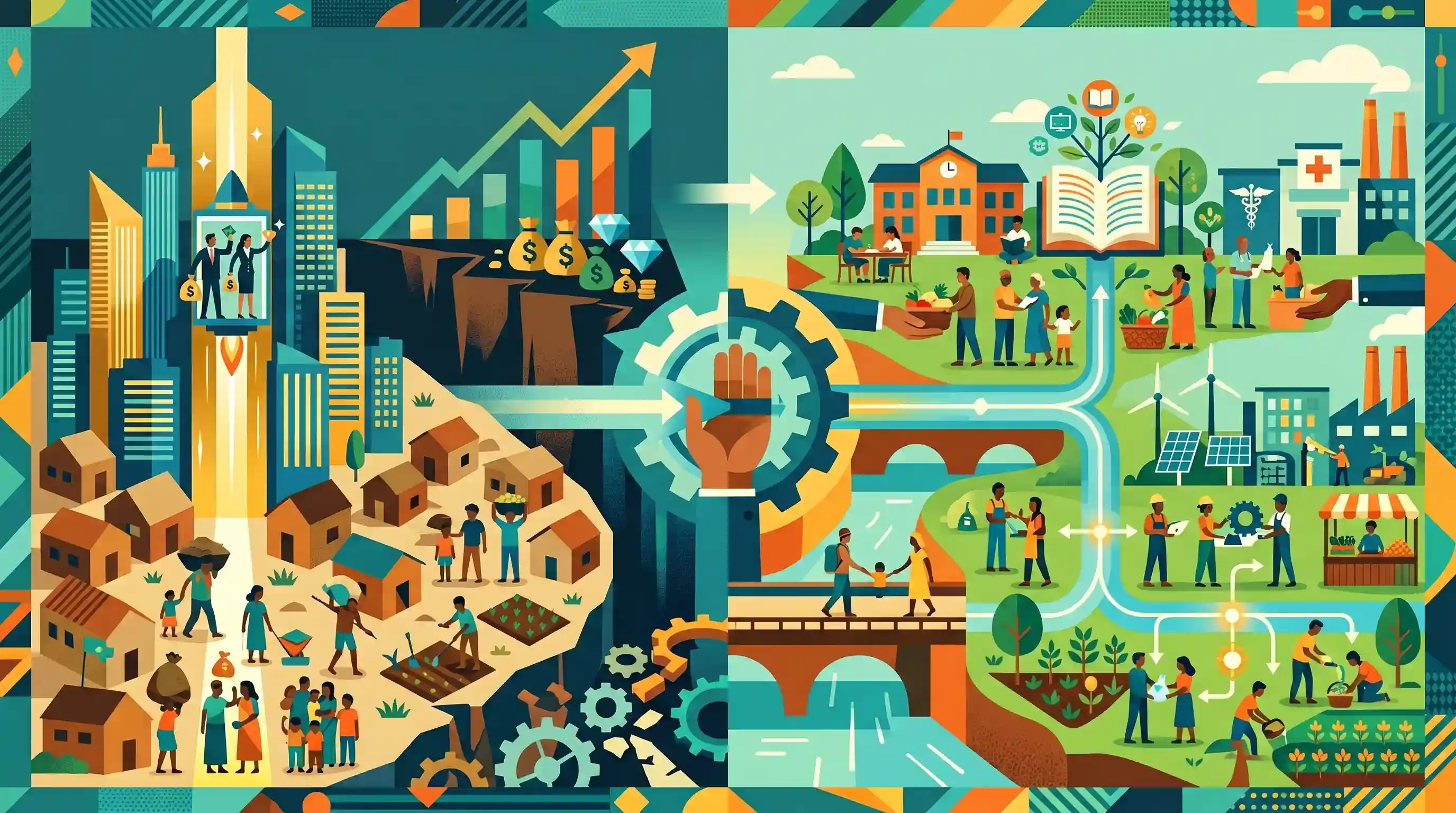
The article critically examines the paradox of India's economic growth, highlighting the stark contrast between rising affluence among a small segment of the population and the persistent deprivation faced by the majority. It underscores how structural inequalities and the limitations of current economic models contribute to a widening wealth gap. To break this cycle, the author advocates for a departure from purely aggregate growth metrics toward inclusive policies that prioritize equitable resource distribution, employment generation, and substantial investments in human capital development.
Key Points
- India's economic trajectory exhibits a stark paradox where high aggregate GDP growth coexists with widening structural inequalities and persistent deprivation for the vulnerable majority.
- The phenomenon is often characterized as a K-shaped recovery or bifurcated growth, where the affluent accumulate wealth while the rural and informal sectors face income stagnation.
- Reliance on trickle-down economics has proven insufficient; there is a pressing need for policies that focus on redistributive justice, employment generation, and equitable resource allocation.
- Breaking the intergenerational cycle of poverty requires robust investments in human capital, particularly through accessible, high-quality education and healthcare, rather than just basic welfare provisioning.
Important Terms
MGNREGA

A 2005 legal framework guaranteeing 100 days of unskilled wage employment per year to rural households. It serves as a critical social security net for the rural poor.
UPSC context
GS Paper 2 & 3: Welfare schemes, rural development, and employment. It tests understanding of rights-based legislation and inclusive growth.
Multidimensional Poverty Index (MPI)
An assessment tool measuring poverty through overlapping deprivations in health, education, and living standards. It complements traditional income-based metrics to show a holistic picture of poverty.
UPSC context
GS Paper 2 & 3: Poverty, inequality, and growth metrics. Essential for analyzing the depth and nature of deprivation beyond mere GDP.
NITI Aayog
India's premier policy think tank that replaced the Planning Commission. It focuses on cooperative federalism, inclusive growth, and monitoring national development indices like the National MPI.
UPSC context
GS Paper 2: Statutory/regulatory bodies. Tests knowledge of India's move from centralized planning to advisory-led development models.
UNDP
The UN's global development network advocating for poverty eradication and inequality reduction. It co-publishes the Global MPI and partners with India on Sustainable Development Goals (SDGs).
UPSC context
GS Paper 2: International organizations. Evaluates the role of global bodies in local welfare, human development, and environmental sustainability.
Inclusive Growth
A development approach ensuring the benefits of economic growth reach all sections of society, particularly the marginalized. It emphasizes employment, equity, and access to essential services.
UPSC context
GS Paper 3: Economic development. A core theme testing strategies for reducing regional disparities and income inequality.
Prelims Trap
"High GDP growth rates automatically ensure proportional reduction in wealth inequality across all income deciles."
GDP growth often concentrates in formal, capital-intensive sectors (K-shaped recovery). Aggregate economic growth can coexist with, or even exacerbate, wealth inequality if redistributive policies are absent.
Static Concepts Connected
What distinguishes a K-shaped economic recovery from V or U-shaped recoveries?
- Divergent paths: Different demographic segments and industries recover at entirely disparate rates, resembling the divergent arms of the letter 'K'.
- Formal vs Informal: Large corporations and wealthy individuals see rapid wealth accumulation, while rural and informal sector workers face income stagnation.
- Exacerbates Inequality: Unlike universal V-shaped growth, a K-shaped recovery structurally deepens existing income and wealth disparities, nullifying trickle-down effects.
What are the core dimensions of the Global Multidimensional Poverty Index (MPI)?
- Three Dimensions: Health, Education, and Standard of Living, each weighted equally at one-third of the total index.
- Health and Education: These dimensions are measured by indicators like nutrition, child mortality, years of schooling, and school attendance.
- Standard of Living: Assessed via access to cooking fuel, sanitation, drinking water, electricity, housing, and basic asset ownership.
Cross-Topic Patterns
Human Capital vs Demographic Dividend
The K-shaped wealth divide prevents the informal sector from investing in health and education, threatening to turn India's demographic dividend into a demographic disaster due to low employability.
Welfare Schemes + Fiscal Constraints
Bridging the inequality gap demands massive human capital investment, but rigid fiscal deficit targets often push governments toward cheaper consumption-based welfare rather than structural capacity building.

Expect a 2026 Prelims question contrasting NITI Aayog's dropping MPI figures with rising Gini coefficient and wealth concentration reports.
Linked PYQs · 5
Linked PYQs · 5
- 2025MainsGS2
Inequality in the ownership pattern of resources is one of the major causes of poverty. Discuss in the context of 'paradox of poverty'.
- 2017MainsGS3
What are the salient features of 'inclusive growth'? Has India been experiencing such a growth process? Analyse and suggest measures for inclusive growth.
- 2022MainsGS2
Besides the welfare schemes, India needs deft management of inflation and unemployment to serve the poor and the underprivileged sections of the society. Discuss.
- 2020MainsGS3
Explain intra-generational and inter-generational issues of equity from the perspective of inclusive growth and sustainable development.
- 2012PrelimsGS1
The Multi-dimensional Poverty Index developed by Oxford Poverty and Human Development Initiative with UNDP support covers which of the following? 1. Deprivation of education, health, assets and services at household level 2. Purchasing power parity at national level 3. Extent of budget deficit and GDP growth rate at national level Select the correct answer using the codes given below:
