Multidimensional Strategies for Anaemia Prevention in India
Source:The Hindu ↗
Why It Matters
Anaemia is a critical indicator of public health and human capital formation in India. Understanding multidimensional strategies beyond iron supplementation helps aspirants answer questions on malnutrition, health sector policies, and human resource development.
Summary
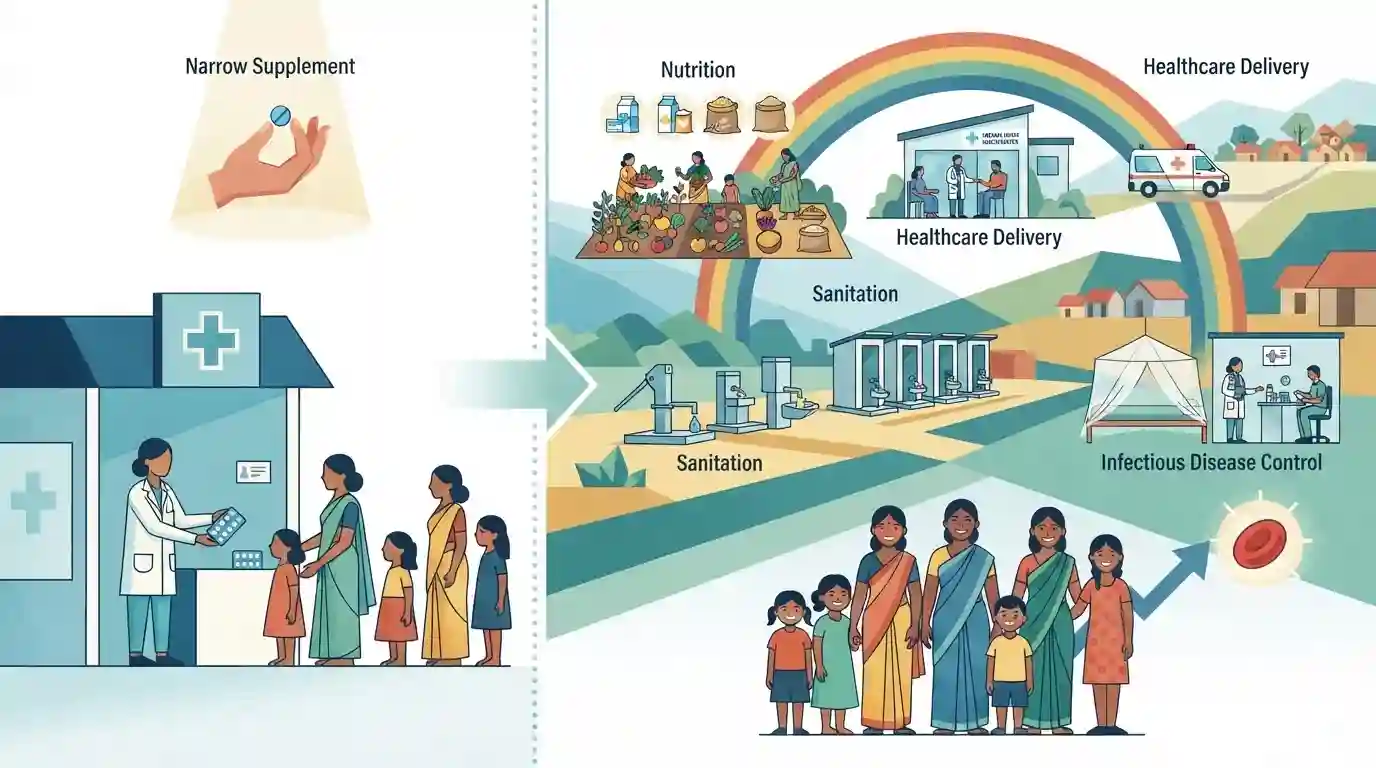
The article discusses the persistence of anaemia as a major public health concern in India and highlights the necessity of shifting from a narrow iron-supplementation model toward a comprehensive, multidimensional strategy. This includes addressing nutritional deficiencies, underlying infectious diseases, sanitation, and healthcare delivery mechanisms to effectively reduce the burden of anaemia.
Key Points
- Anaemia remains a significant public health challenge in India, affecting women, children, and adolescents disproportionately.
- Traditional approaches focusing solely on iron-folic acid supplementation have limitations due to compliance issues, side effects, and multi-factorial root causes.
- A multidimensional strategy incorporating dietary diversity, water, sanitation, hygiene (WASH), and treatment of underlying infectious diseases is crucial.
- Strengthening public health infrastructure and leveraging technology for tracking and data-driven policy execution can improve anaemia prevention outcomes.
Important Terms
Anaemia Mukt Bharat

A comprehensive national initiative launched by the Ministry of Health and Family Welfare to reduce anaemia prevalence across various demographic groups using a life-cycle approach and a 6x6x6 framework.
UPSC context
UPSC GS Paper II (Health, Social Sector): Tests understanding of government interventions and public health strategies to combat malnutrition and anaemia.
World Health Organization
The specialized United Nations agency responsible for international public health, setting global health standards, guidelines, and monitoring disease burdens worldwide.
UPSC context
UPSC GS Paper II (International Organizations / Health): Evaluates the role of global bodies in formulating health policies and disease prevention frameworks.
Ministry of Health and Family Welfare
The nodal central government ministry in India responsible for formulating, implementing, and monitoring national health policies, schemes, and family welfare programs.
UPSC context
UPSC GS Paper II (Governance): Tests knowledge of institutional machinery and administrative frameworks governing public health delivery in India.
Static Concepts Connected
What are the core pillars and targets of the Anaemia Mukt Bharat (AMB) strategy?
- Nodal Agency: Launched by the Ministry of Health and Family Welfare and UNICEF in 2018 to reduce anaemia across life stages.
- Core Strategy: Adopts a 6x6x6 strategy: 6 target beneficiaries, 6 interventions, and 6 institutional mechanisms.
- Interventions: Key interventions include prophylactic iron-folic acid supplementation, deworming, and delayed cord clamping.
Cross-Topic Patterns
Anaemia + WASH Infrastructure Linkages
Combines nutritional health with WASH infrastructure deficits, testing how public health outcomes intersect with rural development and sanitation schemes like Swachh Bharat.
Vertical Health Schemes to Horizontal Primary Care
Reflects the policy shift from vertical single-disease interventions to horizontal, life-cycle based primary healthcare delivery systems under NHM.

NFHS-5 anaemia data coupled with multi-factorial causes (WASH, infections) is prime for a statement-based Prelims question.
Linked PYQs · 3
Linked PYQs · 3
- 2024MainsGS2
Poverty and malnutrition create a vicious cycle, adversely affecting human capital formation. What steps can be taken to break the cycle ?
- 2021MainsGS2
Can the vicious cycle of gender inequality, poverty and malnutrition be broken through microfinancing of women SHGs? Explain with examples.
- 2024MainsGS2
In a crucial domain like the public healthcare system the Indian State should play a vital role to contain the adverse impact of marketisation of the system. Suggest some measures through which the State can enhance the reach of public healthcare at the grassroots level.
