Drawing Parallels Between Industrial Revolution and AI on Wages
Source:The Hindu ↗
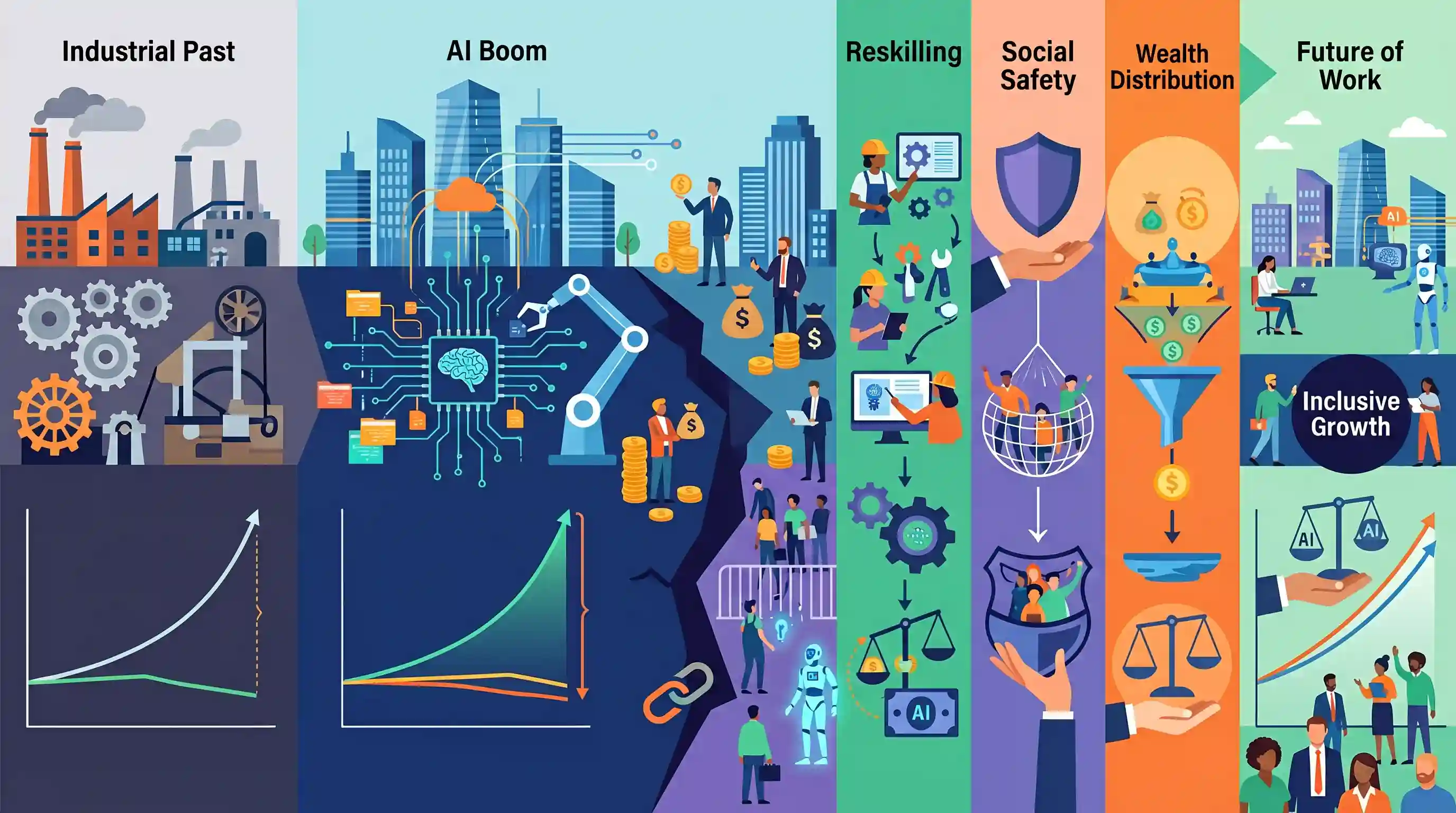
Why It Matters
Provides a powerful historical framework (the 'Engels' pause') for analyzing contemporary debates around AI's impact on labor markets, directly addressing UPSC syllabus themes of technology-induced structural unemployment, jobless growth, and inclusive development.
Summary
The article draws a historical parallel between the British Industrial Revolution and the contemporary Artificial Intelligence boom. It uses the concept of the 'Engels' pause'—a period coined by economic historian Robert Allen where wages stagnated despite rising GDP—to warn that AI could similarly decouple economic growth from wage increases. The author argues that without deliberate policy interventions such as reskilling programs, robust social safety nets, and equitable wealth distribution models, the AI revolution could lead to massive job displacement, structural unemployment, and a widening inequality gap where capital owners reap the benefits while labor stagnates.
Key Points
- The 'Engels' pause' describes a period during the British Industrial Revolution (1790-1840) where rapid technological progress and GDP growth were accompanied by stagnant working-class wages.
- The rapid adoption of Artificial Intelligence (AI) and automation threatens to create a modern-day Engels' pause, decoupling economic productivity from wage growth.
- While capital owners and highly skilled tech professionals stand to gain disproportionately from AI, low and middle-skilled workers face severe risks of job displacement and wage stagnation.
- Preventing widening socio-economic inequality requires proactive policy interventions, including robust social safety nets (like Universal Basic Income), large-scale reskilling initiatives, and progressive taxation.
Important Terms
Engels’ Pause

A term coined by Robert Allen describing a period where real wages remain stagnant despite rapid GDP growth and technological progress, typically during major shifts like the Industrial Revolution or AI boom.
UPSC context
GS Paper III: Indian Economy. Relevant for analyzing technology's impact on labor's share of income and economic inequality.
Universal Basic Income (UBI)
A periodic, unconditional cash transfer provided to all citizens individually, regardless of their income or employment status, to ensure a basic living standard and financial security.
UPSC context
GS Paper III: Inclusive Growth. Tests knowledge of radical welfare alternatives and fiscal feasibility in India.
Jobless Growth
An economic phenomenon where an economy experiences expansion (rising GDP) without a proportional increase in employment opportunities, often due to capital-intensive growth or automation.
UPSC context
GS Paper III: Employment. Key for discussing India’s demographic dividend and the challenges of labor-intensive growth.
Structural Unemployment
Long-term unemployment arising from a mismatch between the skills workers possess and the requirements of available jobs, often triggered by fundamental shifts in the economy or technology.
UPSC context
GS Paper III: Economy/Employment. Essential for analyzing the skill-gap and the need for large-scale reskilling initiatives.
Inclusive Growth
Economic growth that is broad-based, creates productive employment, and ensures that the benefits of development reach all sections of society, particularly marginalized groups.
UPSC context
GS Paper III: Major Topic. Core objective of India’s development strategy and NITI Aayog's vision.
Social Safety Net
A collection of government-led welfare services and programs, such as insurance, pensions, and food subsidies, designed to protect vulnerable individuals from falling into absolute poverty.
UPSC context
GS Paper II: Social Justice. Relates to the protection of labor rights and welfare in a disrupted economy.
Prelims Trap
The 'Engels' pause' signifies a period of economic recession where both GDP and working-class wages decline simultaneously.
The trap implies both decline. In reality, an Engels' pause means GDP and productivity surge due to technology, but working-class wages stagnate, decoupling growth from labor compensation.
Static Concepts Connected
What is 'Employment Elasticity' in the context of jobless growth?
- Definition: The percentage change in employment associated with a 1% change in economic growth (GDP).
- Jobless Growth: When elasticity approaches zero, macroeconomic output (GDP) expands rapidly but proportional new jobs are not created, signaling jobless growth.
- Indian Context: Historically low in India's formal manufacturing and IT sectors, where automation and capital-intensive tech have decoupled growth from mass hiring.
What are the three core principles of Universal Basic Income (UBI)?
- Universality: It is provided to all citizens universally, bypassing the administrative costs, corruption, and exclusion errors typical of targeted means-testing.
- Unconditionality: It is granted without any stipulations, proof of need, or work-seeking requirements, ensuring baseline financial dignity.
- Cash Transfer: Payments are made directly in cash at regular intervals to enhance consumer choice, rather than as in-kind transfers or vouchers.
Cross-Topic Patterns
AI vs. India's Demographic Dividend
As India seeks to leverage its youth bulge, AI-driven automation in the IT/BPO and manufacturing sectors threatens to erode entry-level jobs, risking a demographic disaster without rapid reskilling.
Capital Concentration & DPSP Article 39(c)
The AI-driven widening gap between capital owners and labor connects directly to GS2/GS3 themes of wealth concentration (Article 39(c)), making progressive taxation and redistributive policies highly relevant.

Expect a 2026 Mains GS3 question directly linking AI-induced 'jobless growth' to India’s demographic dividend and the viability of UBI.
Linked PYQs · 5
Linked PYQs · 5
- 2022MainsGS3
Economic growth in the recent past has been led by increase in labour productivity." Explain this statement. Suggest the growth pattern that will lead to creation of more jobs without compromising labour productivity.
- 2019MainsEssay
Rise of Artificial Intelligence: the threat of jobless future or better job opportunities through reskilling and upskilling
- 2016MainsEssay
Digital economy: A leveller or a source of economic inequality
- 2015MainsEssay
Technology cannot replace manpower.
- 2023MainsGS3
Most of the unemployment in India is structural in nature. Examine the methodology adopted to compute unemployment in the country and suggest improvements.
