Global Energy Transition and Climate Justice Ethics
Source:The Hindu ↗
Why It Matters
Provides a critical GS4 (Ethics) and GS3 (Environment) perspective on climate change, shifting the focus from purely technical and economic solutions to the moral responsibilities of nations, corporations, and society.
Summary
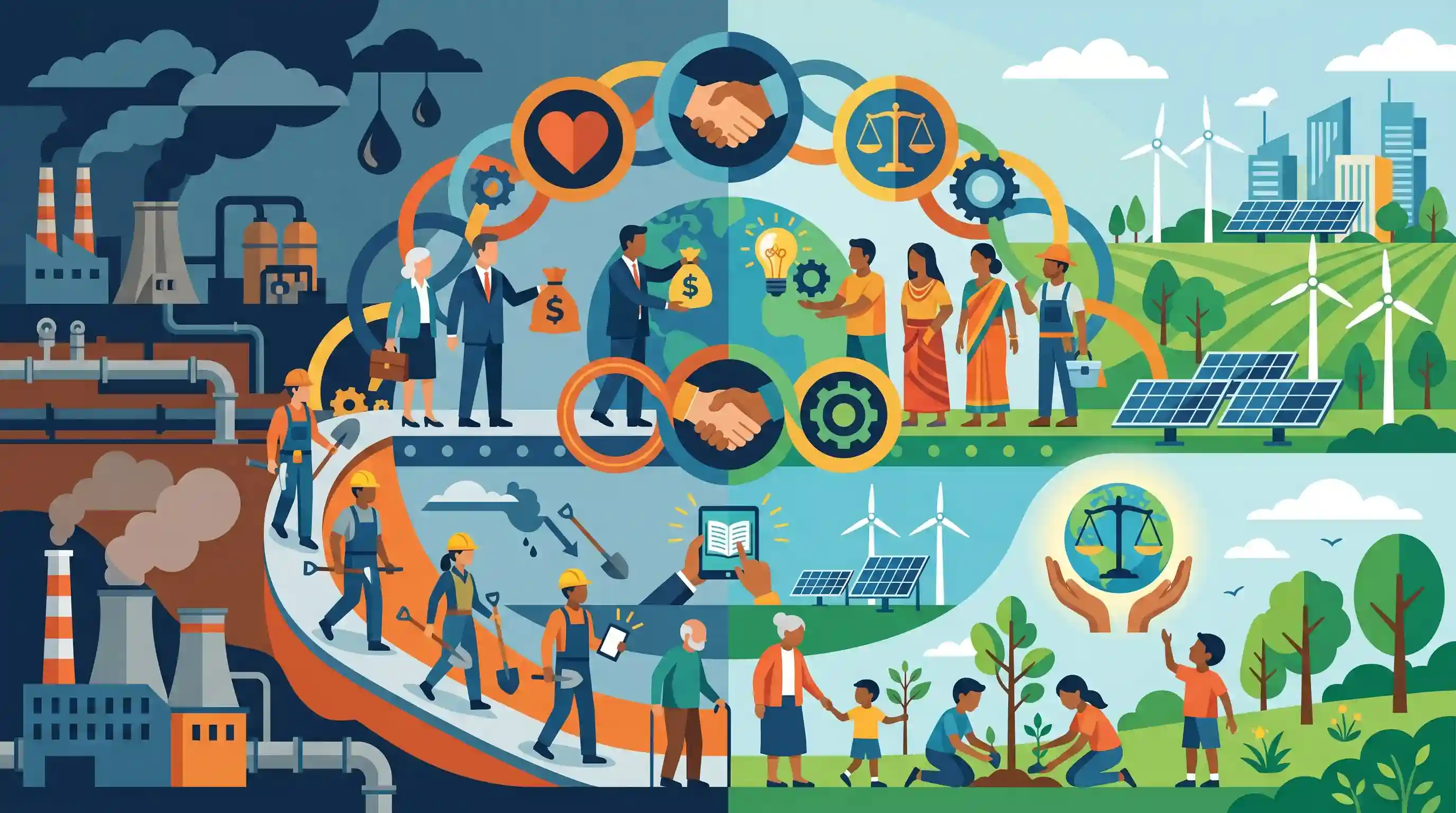
The article argues that the global shift from fossil fuels to renewable energy must be underpinned by ethical principles rather than just economic or technological drivers. It emphasizes climate justice, the necessity of a 'Just Transition' for affected workers, and the ethical responsibility of the Global North to support the Global South through technology transfer and climate finance, ensuring equity and intergenerational fairness.
Key Points
- The transition to renewable energy must transcend technological and economic motivations to center on ethical considerations, such as intergenerational equity and climate justice.
- Global North countries have an ethical obligation, aligned with the principle of Common But Differentiated Responsibilities (CBDR), to provide technology and climate finance to developing nations.
- A 'Just Transition' is necessary to safeguard the livelihoods of workers and communities currently dependent on fossil-fuel industries, ensuring they are not left behind.
- Climate negotiations and policies must prioritize the needs of marginalized communities and the Global South, who face disproportionate impacts of climate change despite contributing the least to historical emissions.
Important Terms
Climate Justice

A framework viewing climate change as an ethical and political issue, emphasizing that those least responsible for emissions often suffer the most.
UPSC context
GS Paper IV (Ethics) and GS III (Environment). Tests understanding of equity and moral responsibility in global climate policy.
Just Transition
A shift toward a green economy that is fair and inclusive, ensuring workers in fossil-fuel sectors are supported and not left behind.
UPSC context
GS Paper III (Environment/Economy). Relevant for questions on energy security, labor rights, and inclusive growth.
Common But Differentiated Responsibilities (CBDR)
A principle acknowledging that all states are responsible for addressing climate change, but developed nations bear greater burden due to historical emissions.
UPSC context
GS Paper II (International Relations) and GS III. Foundational for understanding global negotiations and North-South dynamics.
Paris Agreement
A 2015 legally binding international treaty aiming to limit global warming to well below 2°C, preferably 1.5°C, through national commitments.
UPSC context
GS Paper III (Environment). Essential for topics on climate mitigation, adaptation, and India's NDCs.
UNFCCC
The 1992 treaty established to stabilize greenhouse gas concentrations and prevent dangerous human interference with the climate system.
UPSC context
GS Paper III (Environment). The primary framework for annual COP summits and global environmental governance.
Sustainable Development Goals (SDGs)
A set of 17 global targets adopted in 2015 to end poverty and protect the planet, specifically SDG 7 (Energy) and SDG 13 (Climate).
UPSC context
GS Paper III. Frequently used for framing answers on sustainable growth and social equity.
IPCC
The UN body that assesses the science related to climate change, providing policymakers with objective assessments and future risk projections.
UPSC context
GS Paper III (Environment). Crucial for understanding the scientific reports (like AR6) that drive global climate policy.
Prelims Trap
"Just Transition primarily refers to the rapid technological shift from fossil fuels to renewable energy."
'Just Transition' is a socio-economic framework, not a technological one. It specifically addresses protecting the rights and livelihoods of fossil-fuel dependent workers during the shift.
Static Concepts Connected
What is the principle of Common But Differentiated Responsibilities (CBDR) under the UNFCCC?
- Rio Earth Summit: Formalized at the 1992 UNCED, establishing a foundational framework for global environmental action and equity.
- Shared but unequal: Acknowledges all nations must fight climate change, but developed countries bear a greater proportional responsibility.
- Historical emissions: Mandates the Global North to provide climate finance and tech transfer due to their dominant historical greenhouse gas contributions.
How does Intergenerational Equity function as a core principle of Environmental Ethics?
- Earth as trust: Asserts that the present generation acts as stewards of natural resources, holding the planet in trust for future generations.
- Sustainable development: Forms the ethical backbone of the Brundtland Commission's mandate: meeting present needs without compromising future generations' abilities.
Cross-Topic Patterns
Just Transition + Informal Economy
In India, transitioning away from coal directly impacts millions of informal workers (like scavengers and transporters). This bridges GS3 environmental targets with GS2 socio-economic labor protections.
Climate Finance + International Ethics
The Global North's climate finance obligations are increasingly framed in GS4 as ethical reparations for historical emissions, moving beyond the traditional GS2 lens of discretionary foreign aid.

Expect a GS4 case study on a 'Just Transition' scenario—balancing a district's coal-mine closure with the livelihoods of local workers.
Linked PYQs · 5
Linked PYQs · 5
- 2022MainsGS3
Do you think India will meet 50 percent of its energy needs from renewable energy by 2030 ? Justify your answer. How will the shift of subsidies from fossil fuels to renewables help achieve the above objective ? Explain.
- 2018MainsGS3
“Access to affordable, reliable, sustainable and modern energy is the sine qua non to achieve Sustainable Development Goals (SDGs).” Comment on the progress made in India in this regard.
- 2015MainsGS4
What is meant by 'environmental ethics'? Why is it important to study? Discuss any one environmental issue from the viewpoint of environmental ethics.
- 2025MainsGS4
Keeping the national security in mind, examine the ethical dilemmas related to controversies over environmental clearance of development projects in ecologically sensitive border areas in the country.
- 2024PrelimsGS1
Consider the following: 1. Battery storage 2. Biomass generators 3. Fuel cells 4. Rooftop solar photovoltaic units How many of the above are considered "Distributed Energy Resources"?
