Early monsoon downpours and metropolitan drainage system deficits
Source:Indian Express ↗
Why It Matters
Urban flooding is a recurrent and escalating issue directly impacting millions of lives and the economy. This article provides critical case studies (Mumbai, Delhi, Bengaluru) and structural reasons (encroachment on water bodies, outdated drainage, changing rainfall patterns) that are highly relevant for GS1 (Urbanization), GS2 (Local Governance), and GS3 (Disaster Management) questions.
Summary
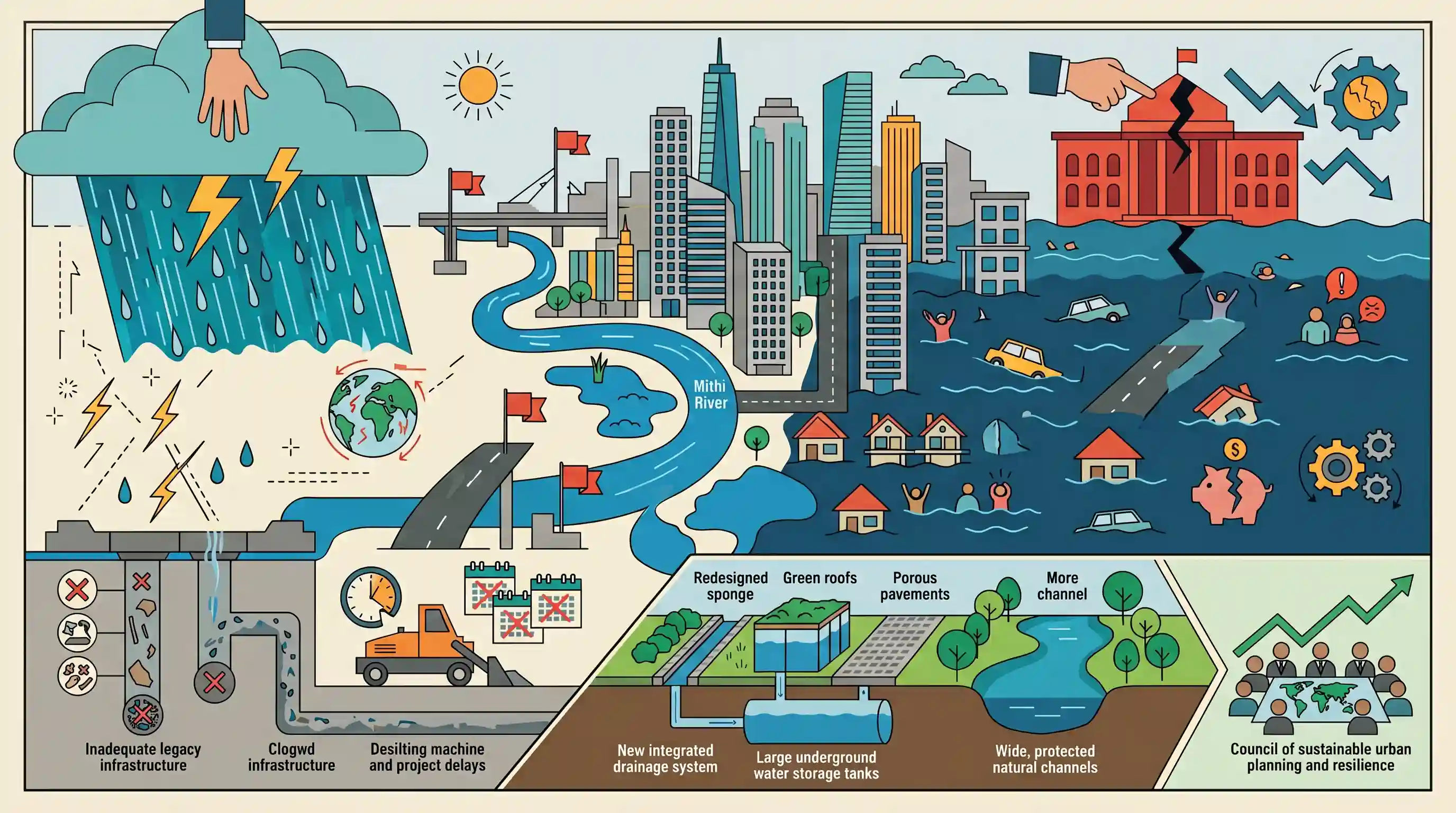
The editorial discusses the severe urban planning challenges exposed by the early arrival of the monsoon in India, leading to unexpected and intense flooding in major cities like Mumbai, Bengaluru, and Delhi. It highlights that legacy drainage systems are inadequate for handling the new normal of short, intense rainfall patterns exacerbated by climate change. Furthermore, infrastructural apathy—such as missed desilting deadlines, incomplete overhaul projects like BRIMSTOWAD, and real estate encroachment on natural water bodies (like the Mithi River)—has compounded the crisis. The article criticizes the governance failure of these wealthy municipalities and urges city planners to treat weather anomalies as a permanent reality, prioritizing flood mitigation to safeguard the economy and public life.
Key Points
- The early arrival of the monsoon, marked by short and intense downpours, caused severe disruptions in major cities like Mumbai, exposing inadequate infrastructural preparedness.
- Legacy drainage systems in cities like Mumbai and Delhi (unchanged since 1976) are ill-equipped for current extreme weather patterns, and major overhaul initiatives like the BRIMSTOWAD project remain incomplete.
- Encroachment on natural water bodies by real estate, such as Mumbai\'s Mithi River and Bengaluru\'s lost lakes, has drastically reduced the natural absorption capacity for rainwater.
- The recurring inundation of India\'s wealthiest municipalities points to a significant governance crisis and a failure to prioritize climate resilience.
- City planners must accept extreme weather vagaries as the \'new normal\' and urgently revamp drainage infrastructure to prevent economic losses and protect lives.
Important Terms
Urban Flooding

The inundation of property or land in a built-up environment caused by rainfall exceeding the capacity of drainage systems, often worsened by unplanned urbanization and loss of natural buffers.
UPSC context
GS Paper 3 (Disaster Management); tests knowledge of anthropogenic causes, climate change impacts, and urban resilience strategies.
BRIMSTOWAD project
Brihanmumbai Storm Water Disposal System; a major project to upgrade Mumbai's Victorian-era drainage network, aimed at increasing rainwater receding capacity to 50 mm per hour through widening and pumping stations.
UPSC context
GS Paper 3 (Disaster Management/Infrastructure); highlights challenges in urban planning, cost overruns, and the need for climate-resilient infrastructure.
Brihanmumbai Municipal Corporation (BMC)
India's richest municipal corporation responsible for the civic governance of Mumbai. It manages urban planning, public health, and disaster management under the 74th Constitutional Amendment.
UPSC context
GS Paper 2 (Governance); relevant to Urban Local Bodies (ULBs), their administrative roles, and fiscal autonomy in megacity management.
Mithi River
A seasonal river in Mumbai that functions as a natural stormwater drain. It is a critical case study due to extreme pollution, narrowing from encroachment, and role in major floods.
UPSC context
GS Paper 3 (Environment/Disaster Management); illustrates the impact of river degradation and floodplain encroachment on urban flood risks.
Desilting
The removal of accumulated silt, sand, and debris from riverbeds and drainage channels to restore their hydraulic capacity, essential for pre-monsoon flood preparedness.
UPSC context
GS Paper 2/3 (Governance/Urban Planning); tests understanding of routine maintenance failures as a cause for infrastructure-led disasters.
Encroachment
Unauthorized construction on floodplains, wetlands, and natural watercourses, which reduces the ground’s natural absorption and restricts water flow, significantly increasing urban flood risks.
UPSC context
GS Paper 1 (Urbanization/Societal issues); examines regulatory failures and the link between unplanned growth and environmental degradation.
Prelims Trap
Urban flooding is primarily caused by a significant increase in the total annual monsoon rainfall due to climate change.
Climate change shifts rainfall distribution to short, high-intensity downpours. The total annual volume often remains stable, but the sudden intensity overwhelms infrastructure.
Static Concepts Connected
What are the core NDMA guidelines specific to Urban Flooding?
- Separate Identity: Treating urban flooding as a legally and technically distinct disaster from traditional riverine flooding.
- Early Warning: Establishing a localized, dense network of Automatic Rain Gauges (ARGs) and Doppler radars for micro-level real-time monitoring.
- Watershed Focus: Creating detailed contour maps and watershed-based inventories of all urban drains to prevent flow obstruction.
What constitutes the 'Sponge City' approach to urban flood management?
- Permeability: Increasing porous surfaces like permeable pavements and green roofs to maximize localized groundwater recharge and reduce runoff.
- Blue-Green Infra: Restoring interconnected natural water bodies (blue) and urban parks (green) to act as natural flood sinks.
- Decentralization: Shifting from centralized concrete storm drains to decentralized, nature-based rainwater retention and absorption systems.
Cross-Topic Patterns
74th CAA & Parastatal Agencies
The 'governance deficit' of wealthy municipalities ties into the 74th CAA. Parastatal agencies often bypass elected ULBs, leading to disjointed accountability in drainage maintenance and urban planning.
Wetland Rules vs. Real Estate Encroachment
Encroachment on Mumbai's Mithi River and Bengaluru's lakes exposes the diluted enforcement of the Wetlands (Conservation and Management) Rules, 2017, in high-value real-estate zones.

Expect a GS3 Mains question linking 'Sponge City' concepts with the 74th CAA's failure to empower ULBs in managing urban micro-drainage.
Linked PYQs · 4
Linked PYQs · 4
- 2024MainsGS3
Flooding in urban areas is an emerging climate-induced disaster. Discuss the causes of this disaster. Mention the features of two such major floods in the last two decades in India. Describe the policies and frameworks in India that aim at tackling such floods.
- 2021MainsGS1
What are the environmental implications of the reclamation of water bodies into urban land use ? Explain with examples.
- 2020MainsGS1
Account for the huge flooding of million cities in India including the smart ones like Hyderabad and Pune. Suggest lasting remedial measures.
- 2015MainsGS1
How far do you agree that the behaviour of the Indian monsoon has been changing due to humanizing landscapes? Discuss.
