Critique of Assigning Anti-Terror Roles to Unprepared Forces
Source:The Hindu ↗
Why It Matters
UPSC repeatedly examines the structure, mandate, and challenges of various security forces and intelligence agencies (GS3). Understanding the debate around agency mandates and the operational logic of counter-terrorism deployment is crucial for answers on internal security and police reforms.
Summary
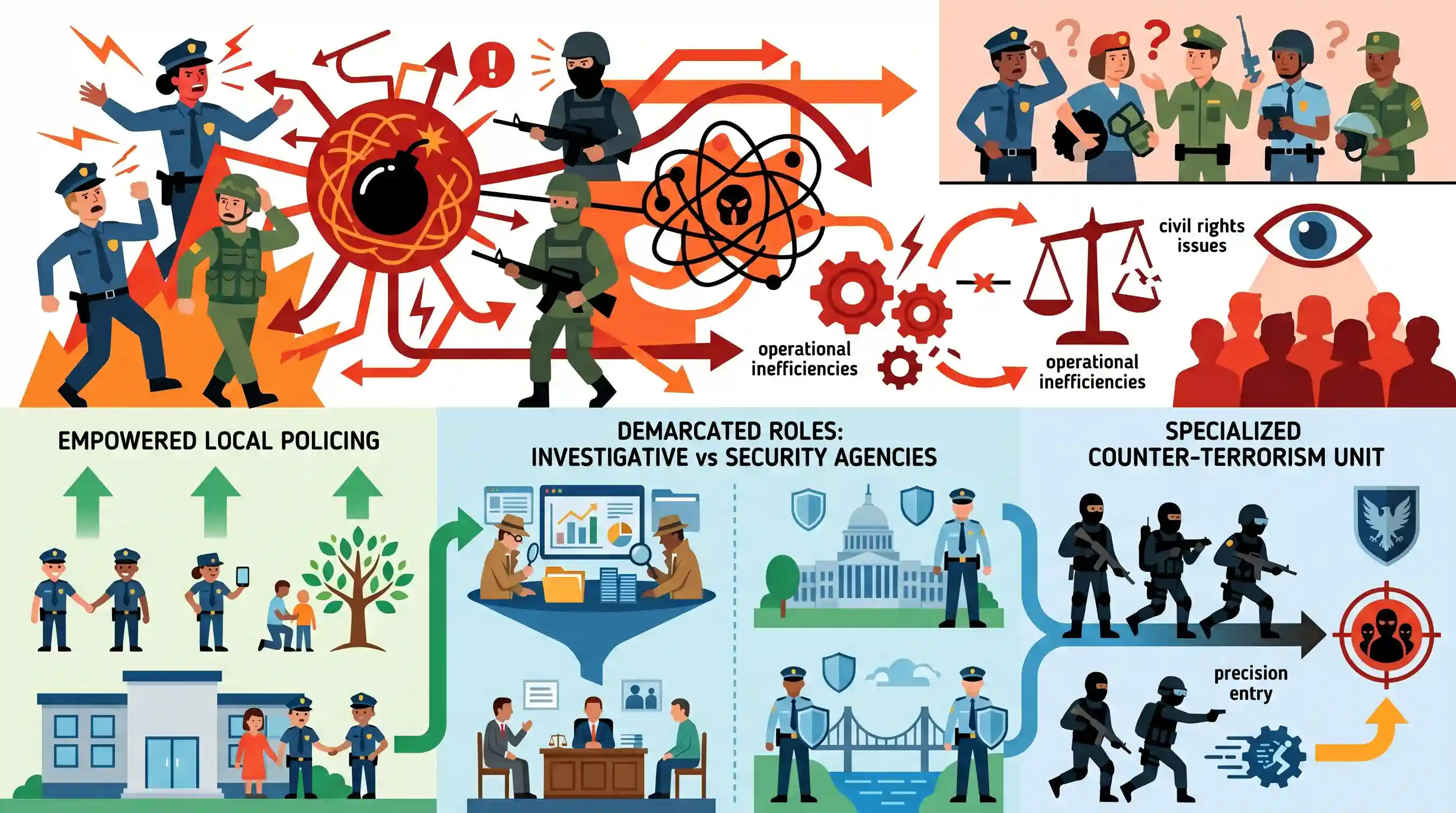
The article critiques the assignment of anti-terror roles to forces or agencies that are not structurally or operationally designed for such specialized tasks. It argues that blurring the mandates between state police, central armed police forces (CAPFs), and military units defies the logic of specialized counter-terrorism, potentially leading to operational inefficiencies and civil rights issues. For an effective internal security architecture, the author emphasizes the need to empower local policing, clearly demarcate the roles of investigative and security agencies, and rely on specialized, well-trained counter-terrorism units rather than ad-hoc deployments.
Key Points
- Assigning complex anti-terror responsibilities to agencies or forces lacking specialized counter-terrorism training undermines operational effectiveness and defies strategic logic.
- There is an urgent need to clearly demarcate the operational roles and mandates of Central Intelligence, Investigative Agencies, CAPFs, and the State Police.
- Over-reliance on non-specialized forces for sensitive internal security duties can lead to human rights concerns and alienate local populations.
- A sustainable counter-terrorism strategy requires empowering local law enforcement, structural police reforms, and specialized training rather than ad-hoc deployments.
Important Terms
Armed Forces (Special Powers) Act (AFSPA)

Statutory legislation granting extraordinary powers, such as arrest without warrant and use of lethal force, to security forces in regions designated as 'disturbed areas' to maintain public order.
UPSC context
GS Paper 3 (Internal Security); tests understanding of security legislation, civil rights, and state-federal security dynamics.
Central Armed Police Forces (CAPF)
Seven specialized central security organizations (e.g., CRPF, BSF, NSG) under the Ministry of Home Affairs, responsible for border guarding and assisting states in internal security.
UPSC context
GS Paper 3 (Security Forces); tests knowledge of mandates and the institutional role of central forces in domestic stability.
National Investigation Agency (NIA)
India's premier federal statutory body (under the NIA Act, 2008) empowered to investigate and prosecute terrorism and national security-related offenses across state borders without specific state consent.
UPSC context
GS Paper 3 (Investigative Agencies); focuses on the federal counter-terrorism framework and specialized criminal investigation.
State Police
Law enforcement agencies under state government jurisdiction (7th Schedule) responsible for local law and order, crime prevention, and acting as primary responders to security threats.
UPSC context
GS Paper 3 (Police Reforms); examines the efficacy of local law enforcement and the need for police modernization.
Indian Army
The land-based branch of the Indian Armed Forces tasked with external defense. It also assists civil administration during major insurgencies or internal disturbances under specific legal frameworks.
UPSC context
GS Paper 3 (Security Forces); assesses the suitability and operational logic of deploying military units for domestic counter-terrorism.
Prelims Trap
"Internal security and counter-terrorism management are exclusively Union subjects under the 7th Schedule of the Constitution."
While the Union manages CAPFs, 'Police' and 'Public Order' are exclusively State List subjects (Entry 1 & 2). The Centre deploys forces only to 'assist' civil power under Article 355.
Static Concepts Connected
What are the primary mandates of India's major Central Armed Police Forces (CAPFs)?
- CRPF: Designated as the lead national-level internal security and counter-insurgency force.
- BSF & ITBP: Dedicated border guarding forces (BSF for Pakistan/Bangladesh; ITBP for China/Tibet border).
- CISF: Tasked with securing critical national infrastructure, space installations, atomic energy plants, and airports.
How does the Constitution distribute internal security and policing powers?
- State List: 'Public Order' and 'Police' are exclusive state subjects, making local police the primary first responders.
- Union List: Controls the deployment of armed forces in aid of civil power, central intelligence, and federal investigation agencies (like NIA).
- NIA Act: A federal agency created post-26/11 to investigate specific terror-related offences, holding concurrent jurisdiction across states.
Cross-Topic Patterns
Police Reforms + Federalism Friction
The reliance on central forces for internal security reflects the failure of states to implement the 2006 Supreme Court directives on police reform, shifting the security burden and creating federalism flashpoints.
Godbole Committee & Border Management
Using border forces (BSF/ITBP) for internal counter-terrorism weakens frontier grids, violating the 'one border, one force' principle recommended by the Godbole Task Force.

Mains 2026: Expect a question analyzing how delayed state police reforms force an over-reliance on CAPFs, degrading their core mandates.
Linked PYQs · 3
Linked PYQs · 3
- 2023MainsGS3
What are the internal security challenges being faced by India? Give out the role of Central Intelligence and Investigative Agencies tasked to counter such threats.
- 2021MainsGS3
Analyse the multidimensional challenges posed by external state and non-state actors, to the internal security of India. Also discuss measures required to be taken to combat these threats.
- 2020MainsGS3
Analyze internal security threats and transborder crimes along Myanmar, Bangladesh and Pakistan borders including Line of Control (LoC). Also discuss the role played by various security forces in this regard.
