India Ageing Population Needs Comprehensive Geriatric Care Policy
Source:The Hindu ↗
Why It Matters
As India transitions from a young nation enjoying a demographic dividend to an ageing society, understanding the vulnerabilities, healthcare needs, and social security requirements of the elderly becomes crucial for inclusive governance and sustainable policy planning under the framework of a welfare state.
Summary
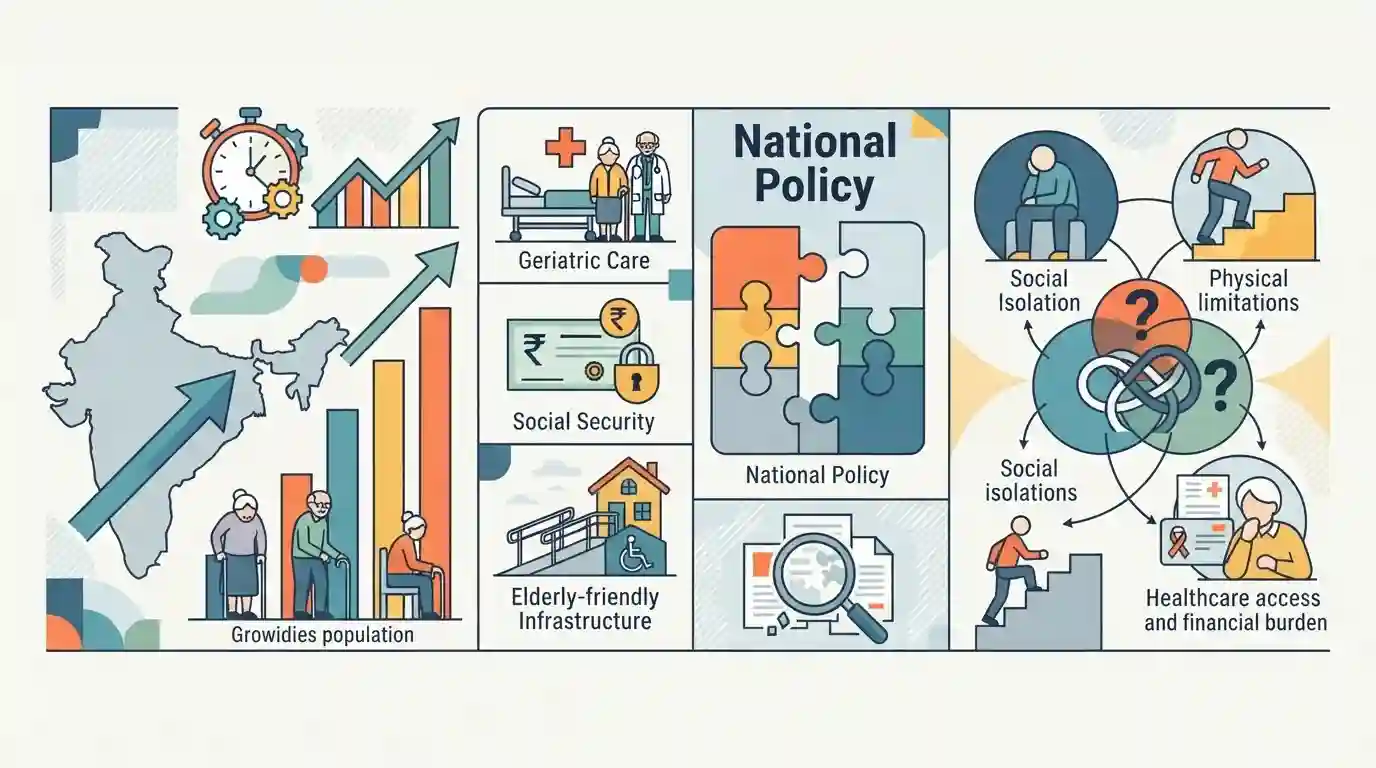
The article discusses India's rapidly ageing population, highlighting that while demographic counts and surveys document the growing share of elderly citizens, the country lacks comprehensive understanding, policy depth, and infrastructure to address the multi-dimensional challenges of geriatrics, healthcare, and social security.
Key Points
- India's population is rapidly ageing, with a rising proportion of elderly citizens being counted in demographic surveys and censuses.
- Despite numerical tracking, the socio-economic, health, and psychological dimensions of an ageing population remain insufficiently understood and planned for.
- Geriatric healthcare, social security systems, and elder care infrastructure face massive gaps in policy formulation and implementation.
- The transition from a demographic dividend to an ageing demographic profile requires structural shifts in welfare economics, labor markets, and public health delivery.
Static Concepts Connected
What are the key institutional frameworks and constitutional provisions for elderly citizens in India?
- Constitutional Basis: Constitutional Mandate: Article 41 (DPSP) directs the state to make effective provision for securing public assistance in old age, sickness, and disablement.
- Statutory Framework: Statutory Rights: The Maintenance and Welfare of Parents and Senior Citizens Act, 2007 makes it a legal obligation for children and heirs to provide maintenance to senior citizens.
- Policy & Schemes: Welfare Schemes: Initiatives like the National Policy on Older Persons, Atal Pension Yojana, and Ayushman Bharat PM-JAY (covering seniors aged 70+) form the core welfare architecture.
Cross-Topic Patterns
Demographic Transition and Fiscal Federalism
As the working-age population shrinks relative to dependents, fiscal pressures mount on public pensions and healthcare delivery systems, testing macroeconomic stability.
Public Health Delivery and Geriatric Care
Geriatric healthcare needs intersect with the National Health Mission and Ayushman Bharat, shifting public health priorities from reproductive and child health to chronic and non-communicable diseases.

Elderly demographics + social security architecture (NPS/APY/Maintenance Tribunal Act) is a prime match for a mains analytical Q.
Linked PYQs · 3
Linked PYQs · 3
- 2020MainsGS2
In order to enhance the prospects of social development, sound and adequate health care policies are needed particularly in the fields of geriatric and maternal health care. Discuss.
- 2011PrelimsGS1
India is regarded as a country with “Demographic Dividend”. This is due to
- 2020PrelimsGS1
Which part of the Constitution of India declares the ideal of Welfare State?
