AMPIN Hybrid Renewable Project: Financial Closure in AP
Source:renewablewatch ↗
Why It Matters
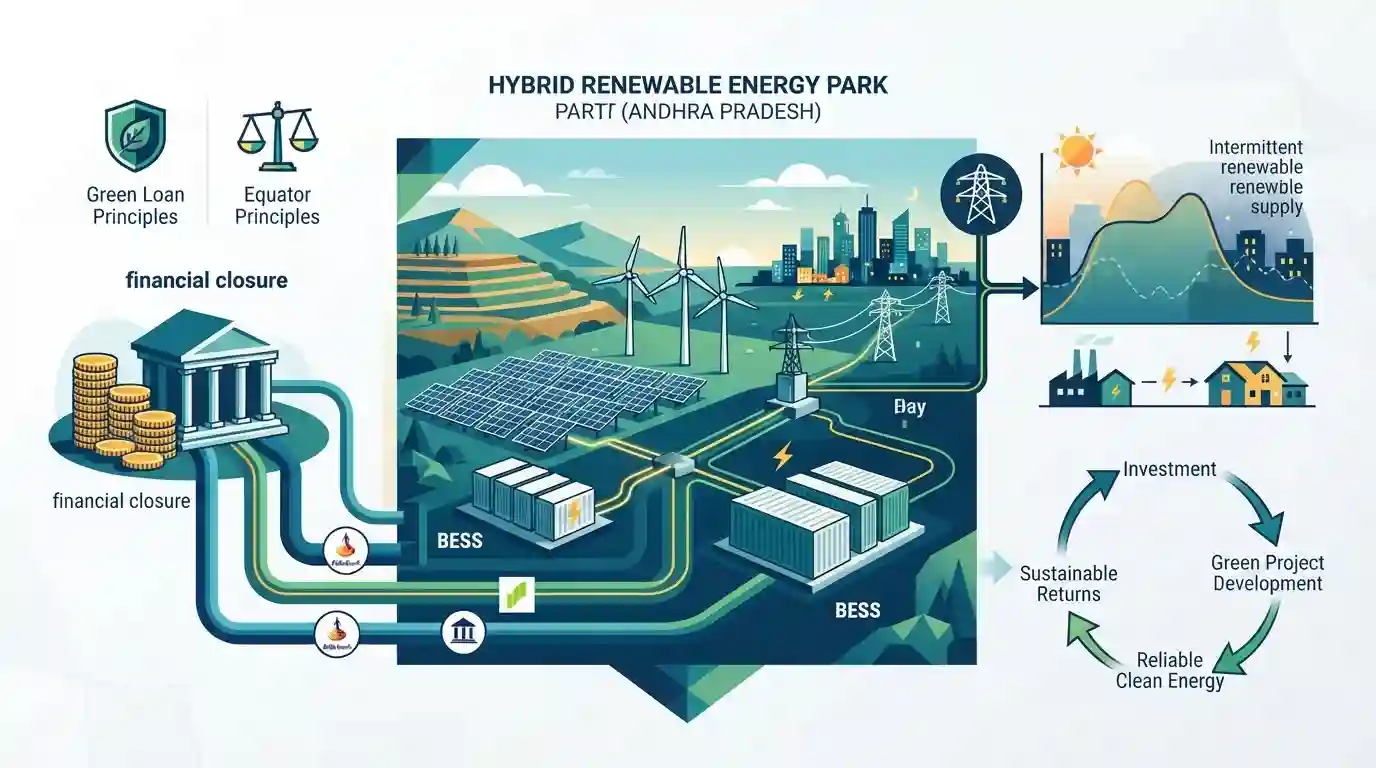
Highlights the increasing viability and deployment of hybrid renewable models combined with Battery Energy Storage Systems (BESS) to solve grid intermittency issues. It also illustrates the critical role of international green finance frameworks, such as the Green Loan Principles and Equator Principles, in mobilizing private capital for India's clean energy transition.
Summary
AMPIN Energy Transitions has successfully achieved financial closure for a $195 million long-term project finance facility to develop a 100 MW hybrid renewable energy project in Andhra Pradesh. The project innovatively integrates solar, wind, and battery energy storage systems (BESS) to supply reliable, dispatchable power during peak demand hours, addressing the intermittency challenges of renewables. The financing was secured from international banks, including Sumitomo Mitsui Banking Corporation (SMBC) and Rabobank, and is structured in accordance with the Green Loan Principles and Equator Principles, highlighting the growing significance of ESG-compliant green financing in India's energy transition.
Key Points
- AMPIN Energy Transitions secured a $195 million long-term project finance facility for a 100 MW hybrid renewable project in Andhra Pradesh.
- The hybrid project combines solar, wind, and battery energy storage systems (BESS) to ensure a stable supply of dispatchable power during peak demand.
- The financing arrangement strictly adheres to international sustainability standards, including the Green Loan Principles and Equator Principles.
- Major financial institutions involved in backing the project include Sumitomo Mitsui Banking Corporation (SMBC) and Rabobank.
Important Terms
Green Loan Principles

A voluntary framework of market standards ensuring loan proceeds are used exclusively for environmentally beneficial projects, promoting transparency and integrity in the sustainable finance market.
UPSC context
Relevant for APPSC Group-I Paper-IV (Economy). Tests knowledge of green financing mechanisms, ESG compliance, and sustainable economic development in India.
Equator Principles
A globally recognized risk management framework adopted by financial institutions to identify, assess, and manage environmental and social risks in large-scale project financing.
UPSC context
Essential for APPSC Group-I Paper-V (Environment). Tests understanding of international environmental and social risk assessment standards in infrastructure project financing.
AMPIN Energy Transitions
A prominent Indian renewable energy independent power producer developing large-scale solar, wind, and hybrid battery storage projects to supply reliable, dispatchable clean power.
UPSC context
Important for APPSC Group-I Paper-IV (AP Economy). Tests awareness of key private investments driving renewable energy and hybrid infrastructure in Andhra Pradesh.
Prelims Trap
"The Equator Principles is a UN-mandated legally binding framework for renewable energy."
The Equator Principles is a voluntary risk management framework adopted by private financial institutions, not a legally binding UN or intergovernmental treaty.
Static Concepts Connected
What is a Battery Energy Storage System (BESS) and its role in renewable grids?
- Peak Shaving: Stores excess energy generated during low-demand periods and discharges it during high demand, ensuring a dispatchable power supply.
- Mitigating Intermittency: Smooths out the fluctuating nature of solar and wind generation by releasing stored power when weather conditions halt natural generation.
- Grid Stability: Provides ancillary services like frequency regulation and voltage control, crucial for maintaining the health of the power grid.
What are the Equator Principles in the context of infrastructure finance?
- Voluntary Framework: A globally recognized, voluntary framework adopted by financial institutions for identifying, assessing, and managing environmental and social risks.
- IFC Baseline: They are primarily based on the International Finance Corporation (IFC) Performance Standards and the World Bank Group Environmental, Health and Safety Guidelines.
- Project Applicability: They typically apply to large-scale infrastructure and industrial projects globally, requiring developers to prove ESG compliance to secure funding.
Cross-Topic Patterns
AP's Renewable Energy Export Policy
APPSC often links state infrastructure policies to revenue mechanisms. The AP Renewable Energy Export Policy 2020 incentivizes outside sales but mandates land lease and green energy charges to boost state revenues.
Green Finance and RBI Guidelines
International frameworks like the Equator Principles align with India's domestic regulatory push, such as the RBI’s Framework for Acceptance of Green Deposits, aimed at combating greenwashing in project finance.

Expect a multi-statement question merging AP's renewable energy policies with BESS utility and Equator Principles ESG criteria.
Linked PYQs · 2
Linked PYQs · 2
- 2024APPSC_PRELIMSGS1
The Interim Union Budget (FY25) has proposed initiatives to boost India's Green Energy Sector. Which of the following proposals are connected with developing India's Green Energy ? I. Viability Gap Funding (VGF) for utilizing solar energy projects II. To set up coal gasification and liquefaction capacity of 100MT by 2030 III. Optional blending of Compressed Bio Gas (CBG) in Compressed Natural Gas (CNG) for transport and Piped Natural Gas (PNG) for domestic purposes IV. Provision of financial assistance for procurement of biomass aggregation machinery V. Setting up of a payment security system for expanding the bio-manufacturing system in the country Select the correct answer using the codes given below :
- 2024APPSC_PRELIMSGS1
The strategic objective of Asset Monetization Programme may be explained as :
