Atlantic Meridional Overturning Circulation Slowdown and Monsoon
Source:Indian Express ↗
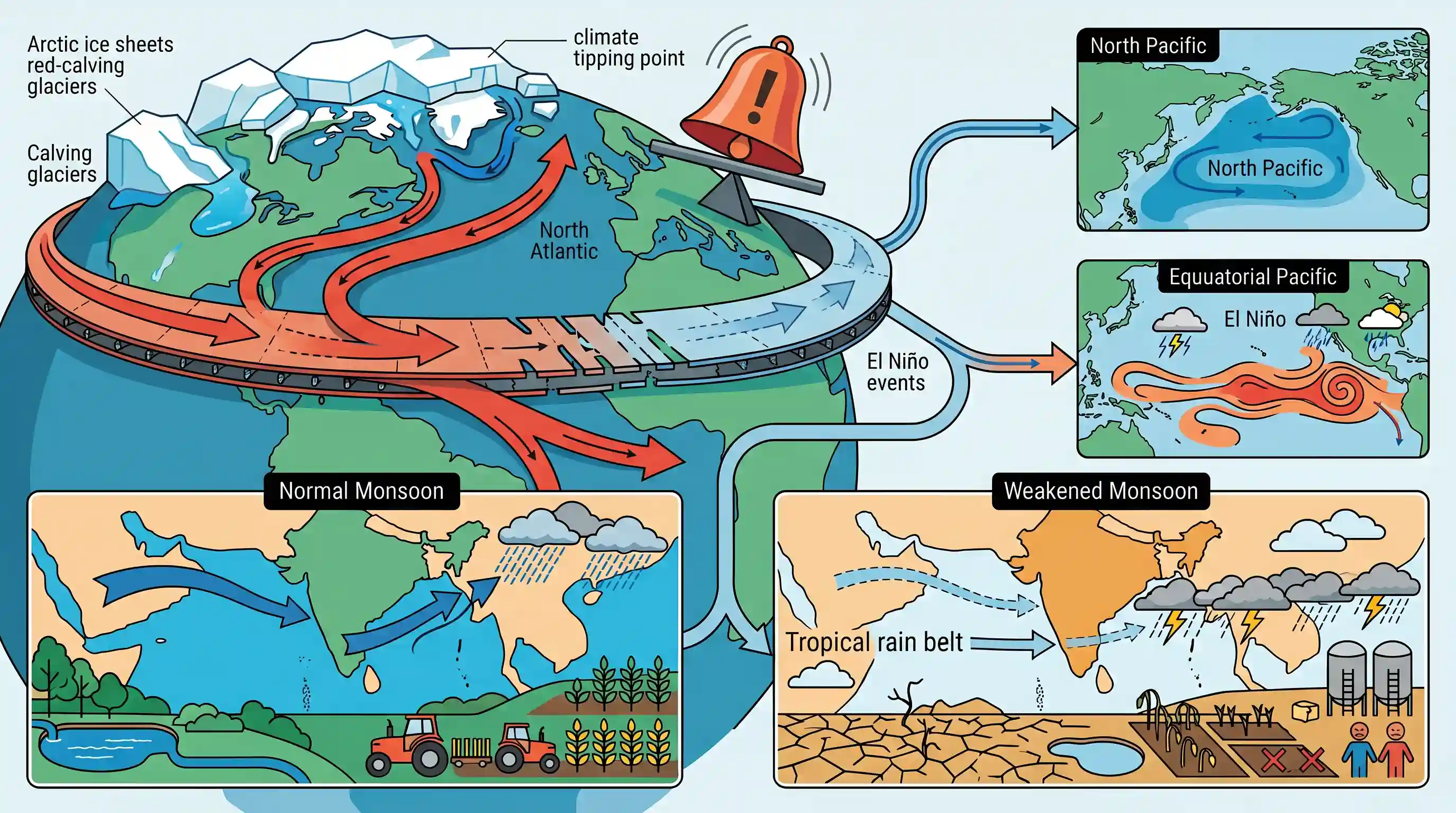
Why It Matters
Demonstrates the crucial teleconnections between global ocean current systems (AMOC), El Nino, and the Indian Summer Monsoon. This provides highly relevant analytical fodder for GS1 Physical Geography questions on ocean currents and monsoon dynamics, as well as GS3 Environment topics on climate change.
Summary
The Atlantic Meridional Overturning Circulation (AMOC) is slowing down at an alarming rate due to climate change-induced Arctic ice melt, posing a severe threat to global and Indian weather systems. The AMOC functions as a massive ocean conveyor belt, and its potential collapse represents a critical 'climate tipping point.' A weakened AMOC disrupts global temperature balances, notably cooling the North Pacific and making El Niño events more unpredictable. For India, this oceanic shift threatens to pull the tropical rain belt southward, significantly weakening the moisture-carrying winds from the Arabian Sea. This disruption could lead to shorter wet seasons, severe droughts, and major risks to the country's agriculture and food security.
Key Points
- The AMOC acts as a global oceanic conveyor belt, moving warm, salty water from the tropics to the Arctic, where it cools, sinks, and drives global circulation.
- Freshwater from melting Arctic ice dilutes the North Atlantic\'s salinity, impeding the sinking mechanism and slowing the AMOC.
- New research suggests the AMOC could weaken by up to 59% by 2100, representing a critical climate \'tipping point\' that could trigger an irreversible collapse.
- A weakened AMOC leaves the North Pacific cooler, altering the temperature balance that drives El Niño and making such events more unpredictable and extreme.
- For India, a sluggish AMOC would pull the tropical rain belt southward, weakening moisture-carrying winds from the Arabian Sea and threatening the summer monsoon and food security.
Prelims Trap
"An AMOC slowdown will push the ITCZ further north, leading to excess monsoon rainfall in India."
A weakened AMOC actually cools the Northern Hemisphere, shifting the thermal equator and ITCZ southward. This deprives India of moisture-laden winds, causing severe monsoon deficits, not excess rain.
Static Concepts Connected
What drives the global thermohaline circulation (ocean conveyor belt)?
- Density Gradients: Deep ocean currents are driven by differences in water density, not wind.
- Temperature (Thermo): Cold water is denser than warm water, causing it to sink at the poles.
- Salinity (Haline): High salinity increases water density. Freshwater influx from melting ice lowers salinity, stopping the sinking process.
How does the ITCZ influence the Indian Southwest Monsoon?
- ITCZ Mechanism: A low-pressure zone formed by converging trade winds, acting as the Earth's thermal equator.
- Northward Shift: In summer, the ITCZ shifts north over the Indian subcontinent, drawn by intense land heating.
- Wind Deflection: This shift pulls southeast trade winds across the equator, which deflect right (Coriolis effect) to become the Southwest Monsoon.
Cross-Topic Patterns
Climate Tipping Points cascade
AMOC collapse is interconnected with other global tipping points like Amazon rainforest dieback and Greenland ice sheet melting, creating a cascade of irreversible planetary climate shifts.
Complex Oceanic Teleconnections
UPSC increasingly links Atlantic phenomena (AMOC) with Pacific (ENSO) and Indian Ocean (IOD) dynamics to test holistic understanding of macro-weather teleconnections and monsoon variability.

Expect a multi-statement Prelims question in 2026 directly linking AMOC slowdown, a southward ITCZ shift, and Indian monsoon deficits.
Linked PYQs · 5
Linked PYQs · 5
- 2022MainsGS1
What are the forces that influence ocean currents? Describe their role in fishing industry of the world.
- 2015MainsGS1
Explain the factors responsible for the origin of ocean currents. How do they influence regional climates, fishing and navigation?
- 2014MainsGS1
Most of the unusual climatic happenings are explained as an outcome of the El-Nino effect. Do you agree?
- 2024PrelimsGS1
Which of the following is/are correct inference/inferences from isothermal maps in the month of January? 1. The isotherms deviate to the north over the ocean and to the south over the continent. 2. The presence of cold ocean currents, Gulf Stream and North Atlantic Drift make the North Atlantic Ocean colder and the isotherms bend towards the north. Select the answer using the code given below :
- 2010PrelimsGS1
A new type of El Nino called El Nino Modoki appeared in the news. In this context, consider the following statements: 1. Normal El Nino forms in the Central Pacific ocean whereas El Nino Modoki forms in Eastern Pacific ocean. 2. Normal El Nino results in diminished hurricanes in the Atlantic ocean but El Nino Modoki results in a greater number of hurricanes with greater frequency. Which of the statements given above is/are correct?
